

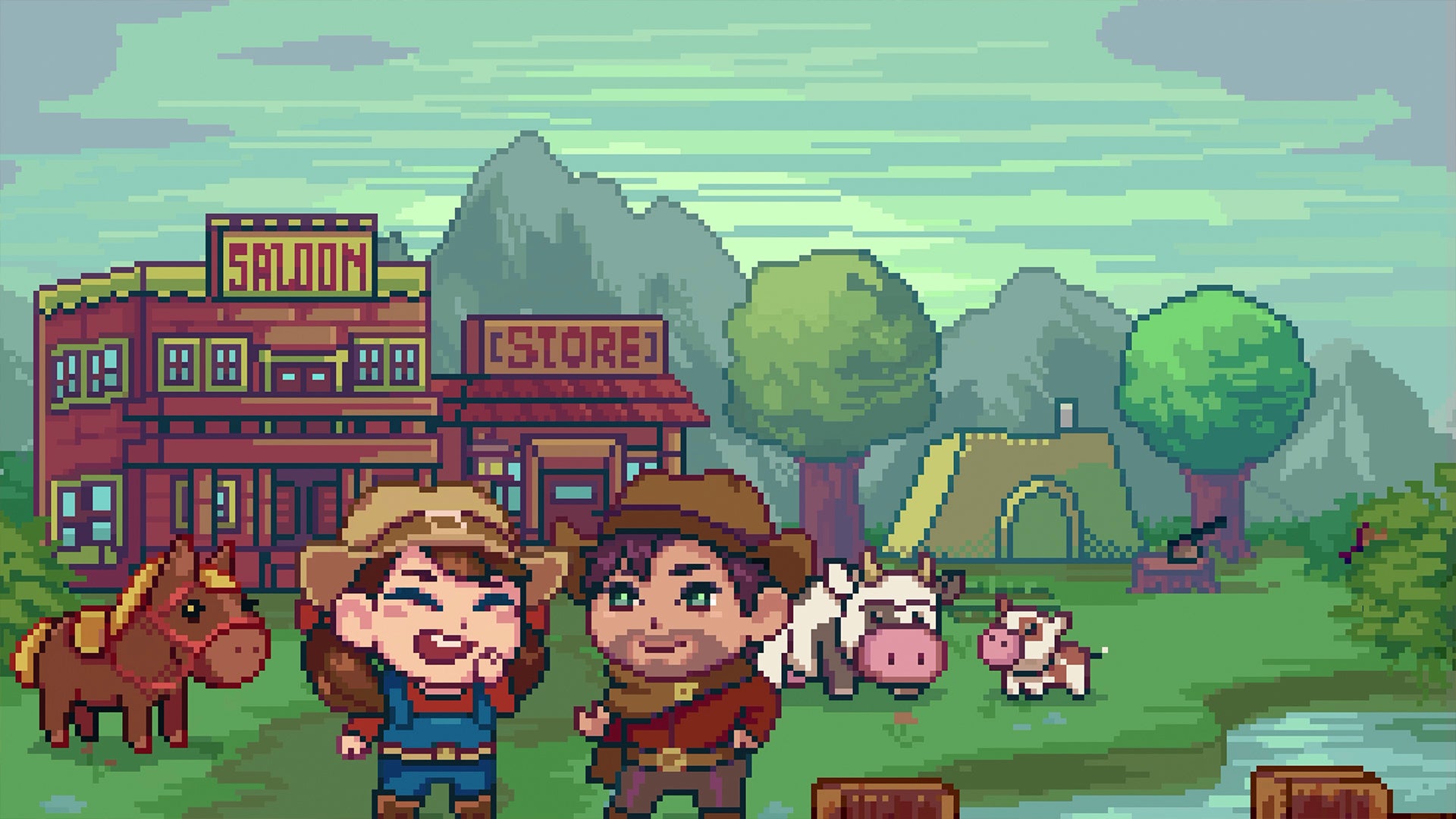
It’s hard to look back on the effect that Stardew Valley had on the farming sim genre, which wasn’t limited to one game prior, but mostly ran through Harvest Moon. After that, and with the Cozy Sim genre growing exponentially in popularity, you can expect farming sims to use the game as mentioned earlier. They can be made on an indie budget, have pixel sprite art, but unlike them, it’s hard to see them as a throwback to the earliest years of the genre on the NES, and more of an homage to an homage. This is true in the case of Cattle Country, the latest game from developer Castle Pixel, best known for their Blossom Tales games.
Cattle Country has an interesting spin on the genre, though not as strong as other releases like One Lonely Outpost, which was released a few months ago. You play as a character who acquired land in this world’s frontier. This isn’t based in the real world, as, like most of these games, there is a slight twist of fantasy at play as well, but much of the game’s world draws from the westward expanse, as well as the Oregon Trail. Arriving in this area, you are given a large parcel of land, and you know what to do with it. Much of the sim falls into the predictable loop of chopping trees, breaking rocks, growing crops, and trying to make a new life for your character out here.

This narrative does offer some welcome twists to the expected form of this. One of which is a sense of lawlessness in the area. Wandering through a back road, getting some fishing in, and I got jumped by bandits. Dealing with them is a pretty easy button prompt game mini event, but I messed up my first try because my PlayStation Portal chose that moment to have internet issues. Obnoxiously, it was a prompt per bandit, and despite only missing one of them, you clear two enemies before getting shot, losing some money, and waking up in the infirmary. I would later get my revenge, though I didn’t lose much, having previously used all my money on stupid stuff. Another twist on this is the town being small and incomplete, ready for expansion with the influx of your capital and work. In fairness, these fetch and grind quests aren’t new; they are an expected part of the experience, but the way the plot presents this helps engross you in the settings and themes.
Unfortunately, these elements, and many others, are very grindy even for a genre that often pads itself with a zen-like loop of forage, build, and repeat. All upgrades for the town come by way of a bank you deposit money in (which functions as a way to not get robbed). These missions, despite being presented to you with a checklist of a lot of upgrades to add, can only be done one at a time. This begins with investing a lot to finish the town hall, which needs to be completed before you can even buy the proper house upgrade for your house. This is followed by upgrading the saloon, by which point money should be no object, but you need a large amount of spring and summer crops to be able to fully upgrade, and this is a start to the about 20-item list you receive, one you can expect to not get much better.
Farming, or at least foraging, will take up as brunt of the experience. You gain access to a standard list of crafting items early on, and leveling, which only rewards you with craftable items, is easy, so you can expect to have a lot more soon. Most other games in the genre tend to reward levels with branchable upgrades or skill points as well, making this feel slightly underwhelming when you spend all day in the mine only to be rewarded with new versions of chairs and benches rather than something that will make gathering those materials easier. To make everything more manageable, you need to level up your tools, which can be a little bit of a slog with early upgrades easily found, but the player needs to complete things that aren’t clearly outlined to unlock more. You are limited by a stamina gauge on what you can do per day, however, several tasks like mining reward you with a surplus of food that can fully recover your strength, making continued work actually pretty manageable. which is too often overlooked, especially when you have a gigantic forest where your house is going that needs to be cleared.

Mining was one of the biggest twists to the norm that worked far better than expected. Drawing from games like Terraria, the mine is simply one big vertical area of blocks, some stone, some ore, that you dig through. As you clear the area and make parts harder to traverse, there are items such as platforms and rope ladders that can be placed so that you can backtrack to the exit. You also need to manage light so you can see, placing wall lanterns to illuminate your path. Farming is where the game struggled to perform like the norm. Clearing an entire plot of land could mean nothing, as the next day might see new trees or bushes, sometimes on par with what you cleared, appear. Usually, these games give you a head start of a few days before you need to worry about going over that portion again. This makes further management more of a slog, even with easy access to items to help. Additionally, at multiple points, these weeds reappeared on land where I placed stone walkways, which is usually the one way to guarantee you some relief from a resurgence of foliage.
The game’s art direction, especially for the landscape, is a high point of the experience. The character sprites leave something to be desired as they are tiny, lacking the detail of nearly everything you walk past. These characters do have the traditional high-quality art for dialogue, which helps make all characters investable, all feeling in theme. One of the most annoying elements of the pixel sprite world is the clouds, which were a cool touch when I started, until you realize why only the shadows of clouds are usually included. They are full sprites that go transparent the closer you get, but imagine if you were leaving your house in the morning, your crops being nearby, only for a cloud to be flying over and blocking them, and you need to run over there to check on them. This is EXTREMELY common, and it doesn’t need to be crops. This being said, though, there is a visual stunner of an early morning texture with vibrant light shining through your farm that is unlike anything I have ever seen in a game like this before.

Verdict
Cattle Country’s biggest sin is being in an extremely bloated genre. Throughout my time with it, there was nothing it did badly. It’s a perfectly serviceable Cozy/Farming sim to sink hours of your life in as you grow your little slice of the frontier. Even the most frustrating elements, such as the constant overtaking of plants despite my spending an entire day removing them, were something I could live with when the game’s setting was fully engrossing me. The problem is that there are too many games that I feel do these things better, which could amount to a constantly growing list. There is a lot to enjoy here as well, so if you have the time and the inclination, you should take a trip to Cattle Country.
Remember to follow us on Twitter, Facebook, and Bluesky to keep up to date on everything we have going on!
Review For PlayStation 5, Also available for PlayStation 4, Xbox One, Xbox Series S/X, Nintendo Switch, and Windows PC
A code was provided by Castle Pixel for the purposes of this review.
Developer: Castle Pixel
Publisher: Playtonic Friends
Release Date: May 27th, 2025
PROS:
+Good Art Style and some gorgeous visuals
+Western Themes
+The Mine
CONS:
-Slow Start
-Very Grindy
-Lackluster leveling
-Some of the foraging elements
-
Cattle Country
