

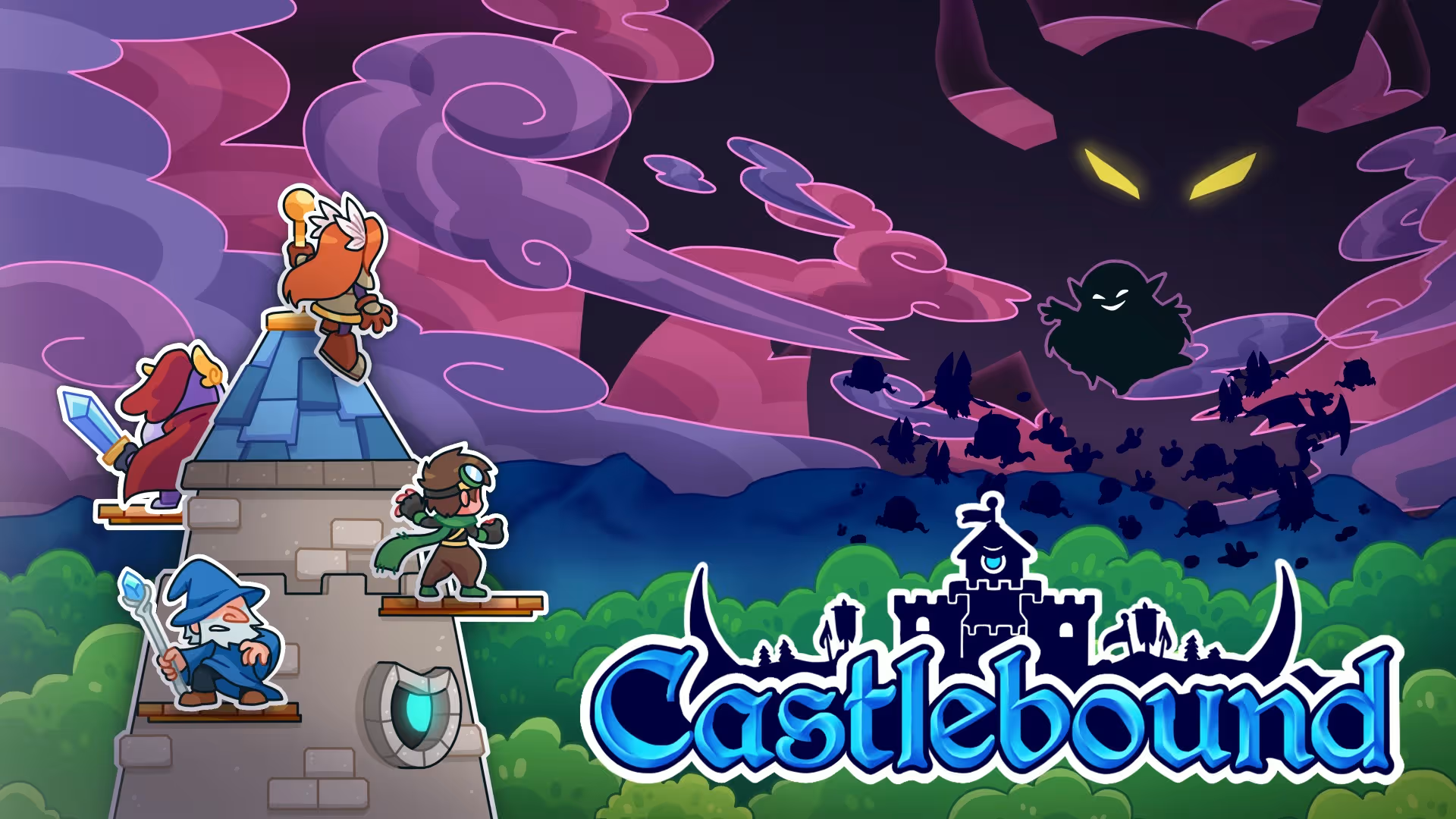
Have I ever mentioned that I can always get down with a roguelike? I feel like I have made that point across my other reviews. In the grand scheme of things, Castlebound is a fairly simple play on the genre overall. It also manages to be fairly effective, as it wasn’t long before it sucked me into a charming little loop of slowly making progress and buying abilities. Now, to be fair, it is an experience best enjoyed with friends, something that I don’t have… In the same hemisphere as me. You thought I was going for self-deprecating humor there, didn’t you? I would never.
There’s a fairly simple story here that sets everything up. We are introduced to Archer Lenora, the first character we get to play as. This evil force appears, creating these dark enemies around the world that she needs to fight off. Simple enough. Where it gets interesting is that she and her grandfather then awaken a tower-like structure, the titular castle, on these spider-like feet that are meant to help her. I have seen this story before, but in fairness, every time I have seen it, it is exactly for this reason. It’s a simple progression path to let the player just play. Once the setup stops, you only get one or two cutscenes past that; the rest is the loop itself.
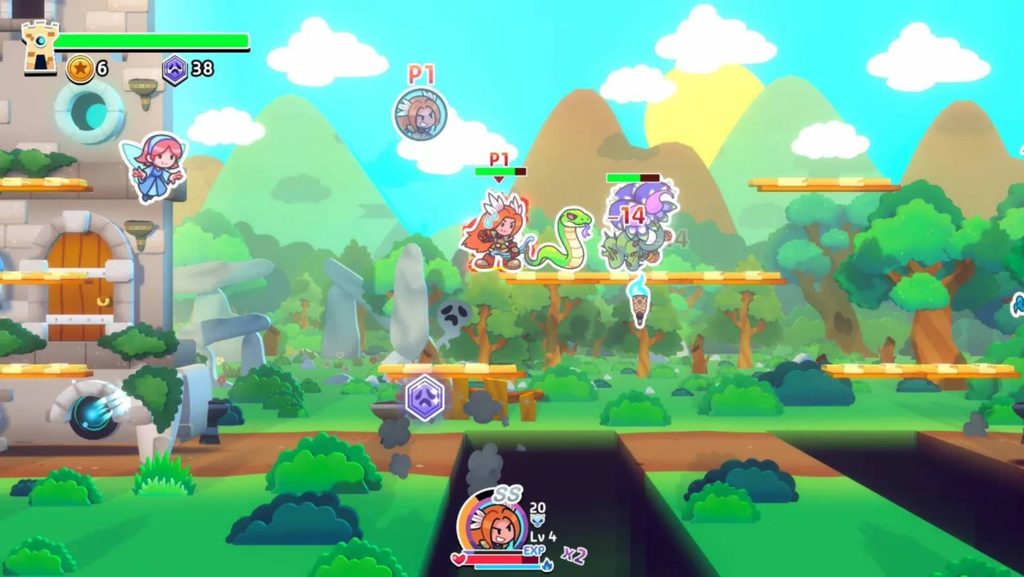
The game is relatively a platformer, structured partially like an old Mario game. More specifically, those old levels used to scroll from one side to the other, and you needed to keep up. Lenora uses a bow and arrow, so there is at least a good chunk of time you are dealing in ranged combat. Your character has health, some magic, and a special move. Then enemies start cropping up, and you are fighting them as the screen moves.
The biggest twist to this is the Tower, which acts as the leftmost point for the stage, moving from left to right, which moves the stage. Occasionally this is switched with the tower moving up and down. The tower can take damage, and that’s a big part of this, as stages do throw a decent variety of enemies at you. Some just move from one side to the other in a bid to hit the tower; others go after you. Some go after you until the tower gets closer, then go after it. If either the player character or the tower dies, you lose the stage, go back into your tower, and then prep for your next run.
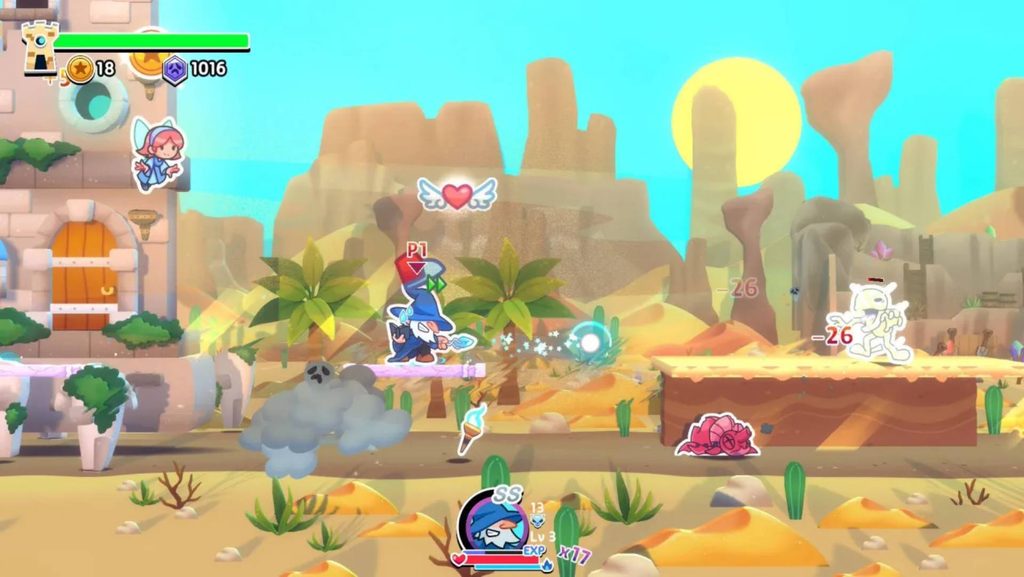
The characters also have interesting differences that should help you mix and match while still making single-player feel unique. Lenora, as an archer, shoots her bolts in an arc. This was something that made the first boss, this skeleton in a tank, a little difficult to fight, as it pops up and she needs to jump slightly to land her hits. The second character, Vargas, is a mage, but he shoots in a straight line. This allowed me to park on a platform and just fire magic to clear him easily. The next boss was a complete reversal: a floating monster that moves around a lot.
And this is partially the loop: you end up fighting a lot of these enemies as you traverse the levels, jumping around and shooting. The traversal, which is a big part, was the part where the game felt short for me from time to time, which was a bummer. The first of these issues was that the down button moves you down through platforms. This might sound counterintuitive, but the game really needed a buffer, like A + Down. At the game’s best, you will find yourself bouncing around the stages to avoid attacks and enemies galore; it is really easy to mess yourself up with a down you didn’t mean.
This compounds my other issue: some gaps or layouts can be hard to maneuver. You can unlock a double jump as part of your runs, but there is this give-and-take whether you can stomach not having it for a bigger attack. Some gaps or jumps can be too wide. The saving grace is that, since you have a health bar, you don’t die if you fall into a hole. The thing is, you can get stuck trying to jump between these points, or you can end up getting pushed into places where your character takes damage and resets.
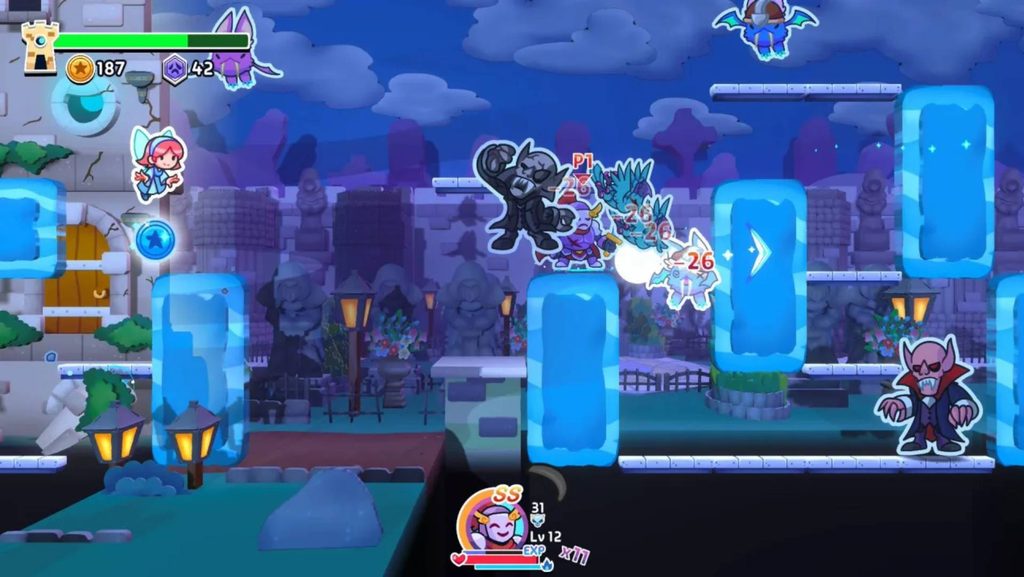
One way this becomes obvious is the characters’ level-ups. Once you reach the next level on a run, an item you can break appears at the top middle. For archers, since you have a well-designed omnidirectional attack, you can break them even if you can’t reach them. One good thing is that most items can be picked up by shooting an attack at them. There can be a struggle even in that to position yourself, not always, but a few times. In another case, there is one character that uses melee attacks.
Now that becomes frustrating when picking up items on the map, especially when they drop in awkward spots. This character also feels at odds, given that half the boss characters you fight require him to stand on them to hit them, though he takes a lot less damage. There are just plenty of points where this character in particular feels incapable of grabbing items as you struggle to jump to them. I do like the trade-off, from range to defense, making a few places easier. This just doesn’t feel like the character that, in a 4-player co-op, I want to get stuck with.
Another issue, and I hate to even need to go here, involves the art direction. Now, on the whole, the art is the best part of the whole thing. It has this Paper Mario style, so your character is paper, the enemies are paper, and they fall over flat when dead. It looks so good and is very inviting. The thing is, turning with your character has a slight delay as part of their flat nature. This can create a delay in attacks if you need to change directions, and that is unfortunate. Typically, enemies move from one side, and you meet them from the other. The more frantic it gets, the more you will need to swap attacking directions constantly, and that’s when it gets noticeable. The fantastic retro soundtrack helps you get over that, with an engaging synth and orchestral blend.
Thankfully, what keeps you coming back is the depth of what you unlock back at the tower. You have some basic stuff, such as improving starting stats, all of which are useful. Then there are unlocks for the blue and red cards you can earn as you fight through each of the stages. This greatly increases what you can do on each of your runs. You will even unlock harder settings for enemies, which I imagine makes co-op even more enticing.
Verdict
Castlebound is a short but sweet roguelike you can easily sink your time into. You can really expect to do that with a group of friends. It is a fairly simple platformer, but with a cast of characters to mix things up with, and plenty of unlocks to constantly upgrade your next run. There are some platforming issues in there, which is to be expected given that it is an intrinsic part of the experience. You get forced off an edge occasionally and get hit with gaps you might struggle with, and there is a melee character that feels at odds with the rest (at least in single-player). Despite those, though, there is little that prevents me from recommending this. It’s a good time.
You can follow us on Twitter, Facebook, and Bluesky to keep up to date with all our coverage and be part of the conversation.
Reviewed on Nintendo Switch 2, also available on Nintendo Switch, and PC
*A Code was provided by Ogre Pixel for the purposes of this review.
Developer/Publisher: Ogre Pixel
Release Date: November 11, 2026
Pros
+Characters has differences between then that lead to some changed gameplay.
+The Paper style artwork is really great to look at.
+Combat is frantic and fun across stages
+Unlocks between runs are meaningful.
Cons
-Some of the platforming can be frustrating
-The paper art style can get in the way slightly, mainly when flipping directions.
-Melee character feels at odds with the rest of the design.
-
Castlebound
