
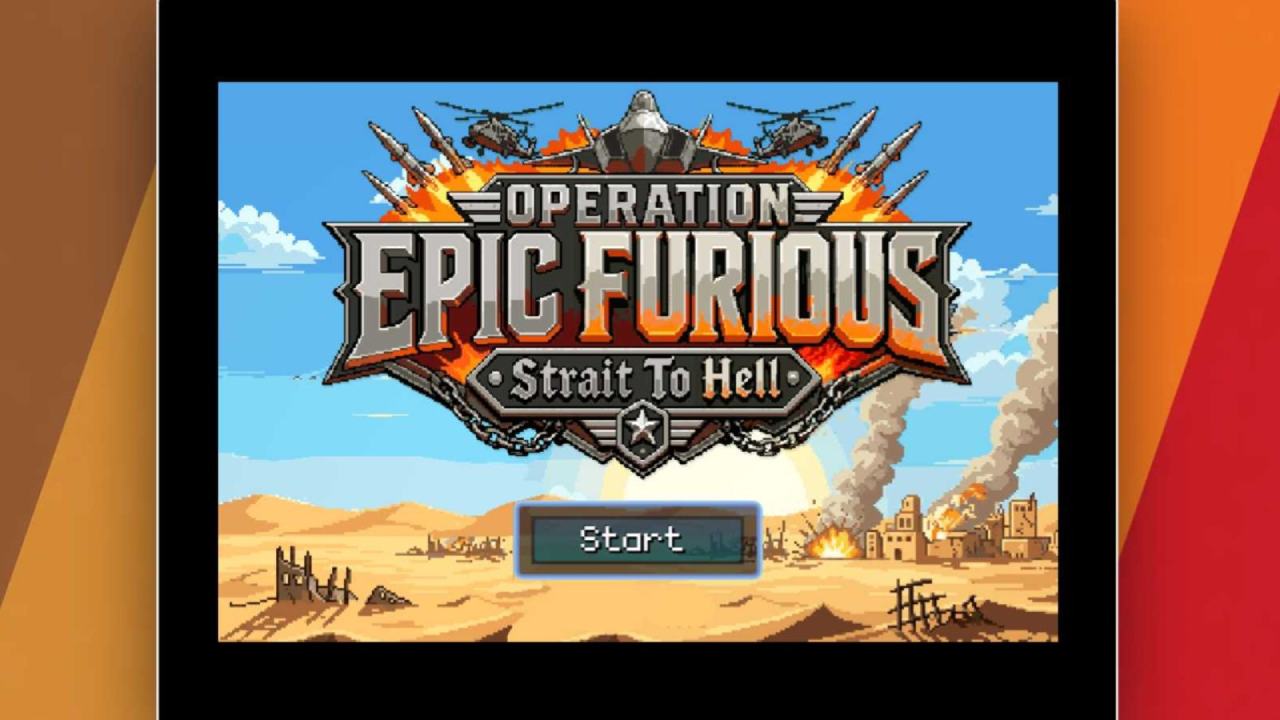
Operation: Epic Furious is going to make a certain subset of people… well… furious. And that’s precisely the point.
Operation: Epic Furious: Strait to Hell is a browser-based game made in RPGMaker that was shadow-dropped recently online by the team at Secret Handshake. Even the most die-hard indie game lovers probably will not recognize Secret Handshake; that’s because Secret Handshake is not a game studio. Secret Handshake is actually a guerrilla art collective. Specifically, the anonymous collective is best known for creating and erecting art pieces of the world’s most notorious sex trafficker and pedophile, Jeffrey Epstein, dancing joyously with current president of the United States Donald J. Trump. Other art installments include a replica of Trump’s new bathroom, complete with gaudy gold fixtures, and Epstein and Trump recreating the “King of the World” scene from Titanic.
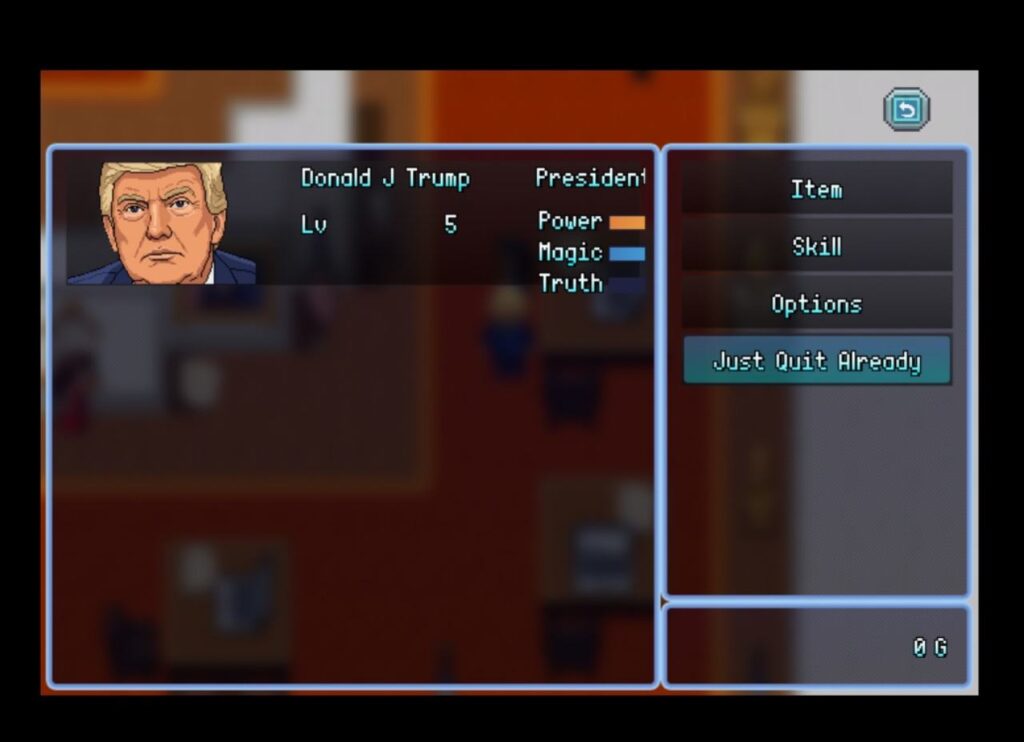
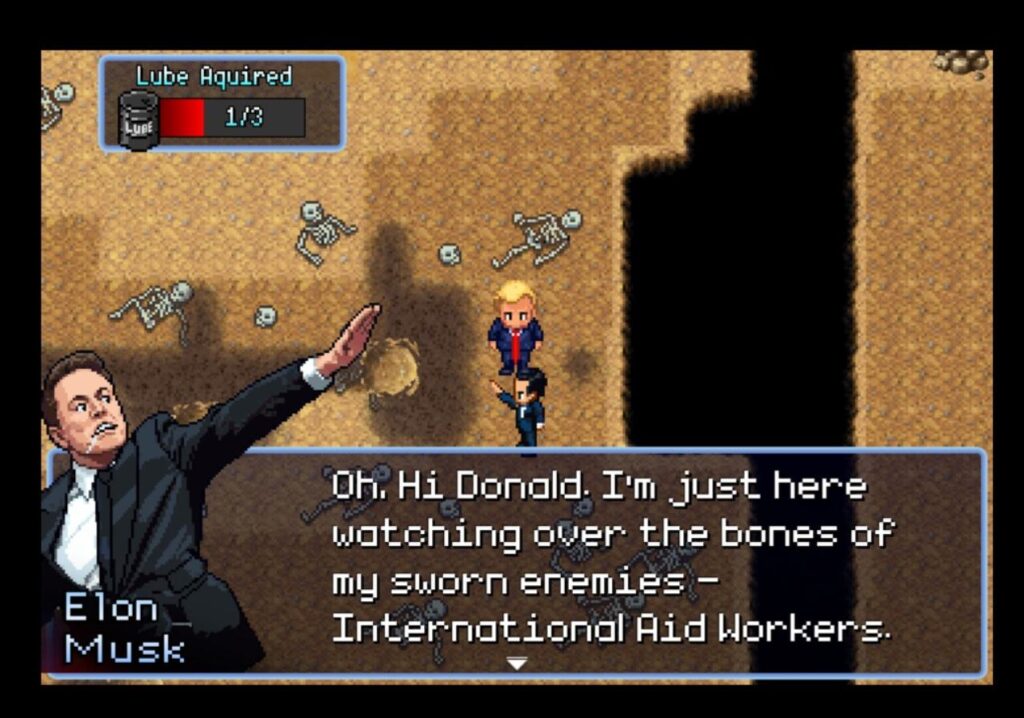
It’s this scathing satirical collective mind that Operation: Epic Furious was born from. Epic Furious is not just a game—it’s an act of protest. But it is important to note that it IS still a game, complete with plot, game mechanics, and everything that one would expect from a simple RPG title. Players take control of President Trump (don’t you wish someone would do this IRL at this point?) as he aims to destroy all the unreleased Epstein files (somewhere in the number of three million).
Upon realizing that that would take far too long, Trump makes the next logical move and launches a war against Iran, supported wholeheartedly by his sycophantic cabinet of clowns. Trump decides that the best form of liberation is to liberate them from their oil, though they call it “lube” in the game, because lube was cool like a Diddy party.
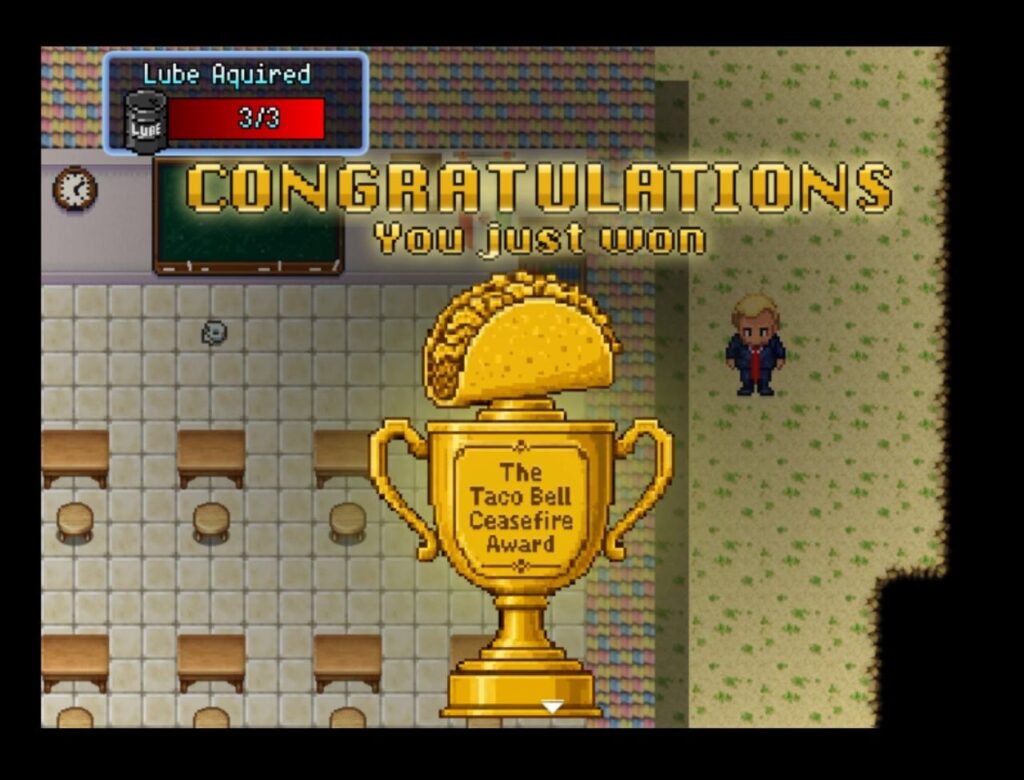
It’s a very simple, very quick game, but it is, in fact, a competent game. Trump fights “enemies” and “bad guys” (and those quotes are doing a lot of heavy lifting), levels up, and gains new skills like “Alternate Facts,” allowing for the bending of reality to gain quick Special Points, and his “Mar-a-Laser,” where he calls upon space lasers from Mar-a-Lago to hit all enemies. Trump is sent on fetch quests to find not just “lube,” but toilet paper, which can be used to make unhinged right-wing social media posts and trophies to keep Trump placated, such as the “Taco Bell Ceasefire Award.” The references are savage, hilarious, and, most importantly, accurate.
The game isn’t perfect, which may be expected when a team that doesn’t routinely make games takes a crack at one. During one playthrough trying to make it through the Strait of Hormuz, I accidentally was able to walk on top of the giant stanchion blocking it off. As such, I was stuck in a section of the map I couldn’t get out of and had to restart the game. Moreover, being as it is a browser game, there’s no save function. The game is designed to be played in one sitting, and considering the game’s brevity, that’s not a big ask.
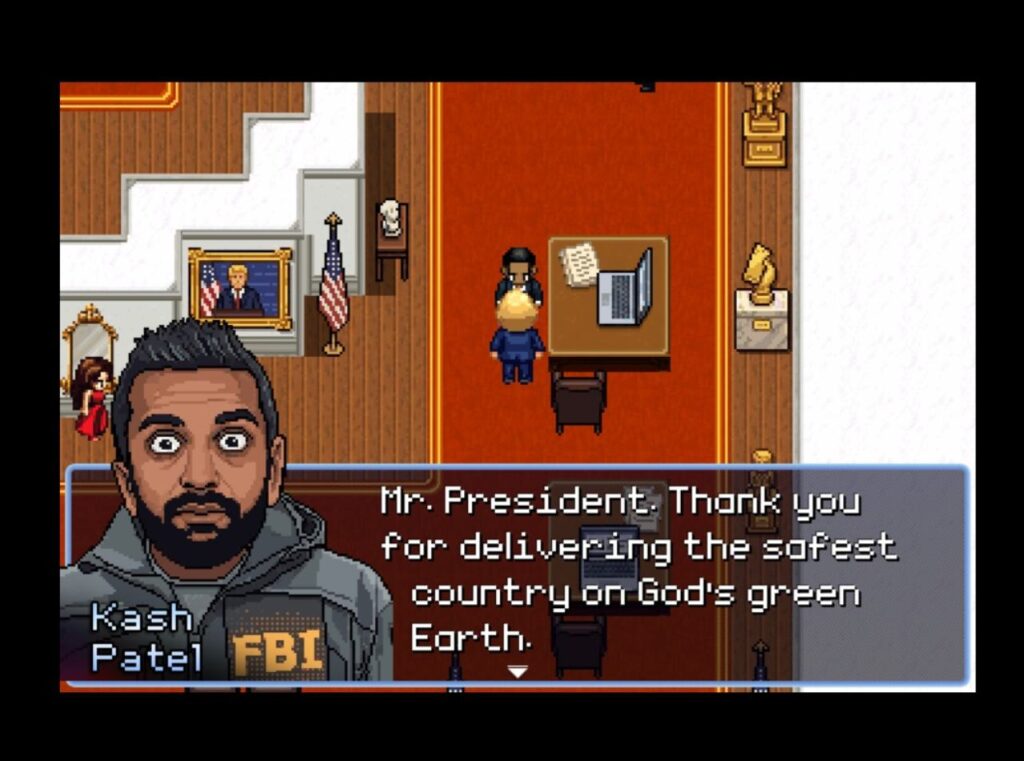
The game has a full cast of supporting characters, and not a single one escapes the sting of the game’s humor. Along the way, Trump will meet with his usual cast of absolute boobs. These include Vice President J. D. Vance, whom players can meet disturbingly close to a couch; F.B.I. director and conspiracy theorist Kash Patel, who, to no one’s surprise, can be met in a bar; and Robert F. Kennedy Jr., who in the game finally admits to being a worm piloting a human suit.
And watch out for First Lady Melania Trump, who, if not handled correctly, can insta-kill your playthrough. There’s even a surprise—and extremely funny—and extremely uncomfortable—appearance from the former U.S. Representative and Venmo enthusiast Matt Gaetz.
I already hear the screams and pouts from a certain subset of gamers: “Le Gasp! We don’t want politics in our games! Games should just be games!” First of all, no. Operation: Epic Furious isn’t the first game to have a blatant political message, and it won’t be the last either. The 2002 Xbox FPS America’s Army was developed and published by the United States Army and made no attempt to hide the fact that it was acting as a recruitment tool.
The People for the Ethical Treatment of Animals (PETA) notoriously made a line of simple games where Mario—yes, that Mario—does some pretty not-nice things to Tanookis to make his Tanooki Suit. To decry Operation: Epic Furious while ignoring past examples such as these belittles the medium of video games and their ability to deliver cultural and political messages. It also continues to propagate the current false dichotomy of messaging that’s fine when Trump does it but unacceptable or treasonous when it makes Trump look bad.
Secondly, the cry to take politics out of video games is an unserious one at best. Some of the best stories in the medium involve hints of politics. Both Far Cry 4 and Far Cry 6 involve the player character finding themselves in political turmoil, being thrust into the events of the Kyrat civil war and the overthrowing of the dictatorship of Yara, respectively.
The indie hit Papers, Please casts the player as a border officer for the country of Arztotzka, a hostile dictocracy. And even Fallout 4, often considered a weaker entry in the beloved Bethesda series, makes players seriously contend with the question of what defines a human. It then requires faction loyalties based on their thoughts and the rights those decisions infer. Secret Handshake isn’t the first group to make games political; like literature, film, music, and television before it, politics and culture go hand in hand with stories that deserve to be told, told boldly, and told well.
And if that game portrays Secretary of State Marco Rubio as a teeny tiny pixelated man-boy in a suit several sizes too big, well, that’s just icing on the cake.
Operation: Epic Furious can be found and played for free here.
