

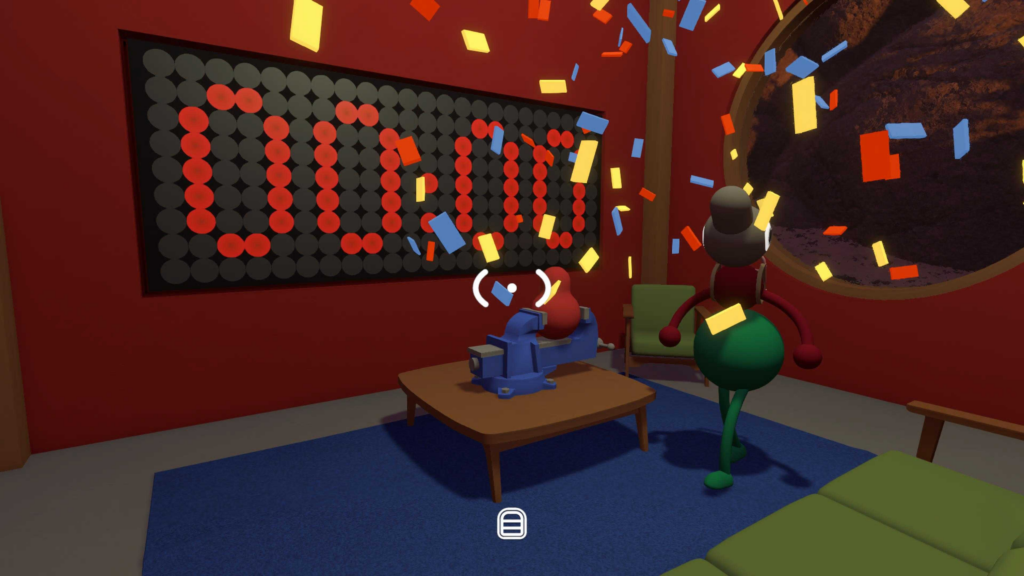
Big Walk begins with a simple premise and promise. The player, taking the embodiment of some kind of ant thing, spawns into a room with prompts. You walk those hallowed halls and get an explanation as to why you can do these things, but the game holds back on why you can do these things. You might think these are just expressive, but soon you will learn that Big Walk, despite being a small game, lives up to the promise of Big idea and Big adventure in every facet.
Once you leave that small base, you are given a crash course in just what kind of Big Walk you have departed on. There is no story, so feel free to make your own assumptions. Maybe this is a pilgrimage, perhaps some deeper calling… You don’t know. What you do learn through trial and error, however, is that there are odd-shaped keys scattered across the land that you must find. This is learned through a brilliant reliance on observation, oh, and teamwork.
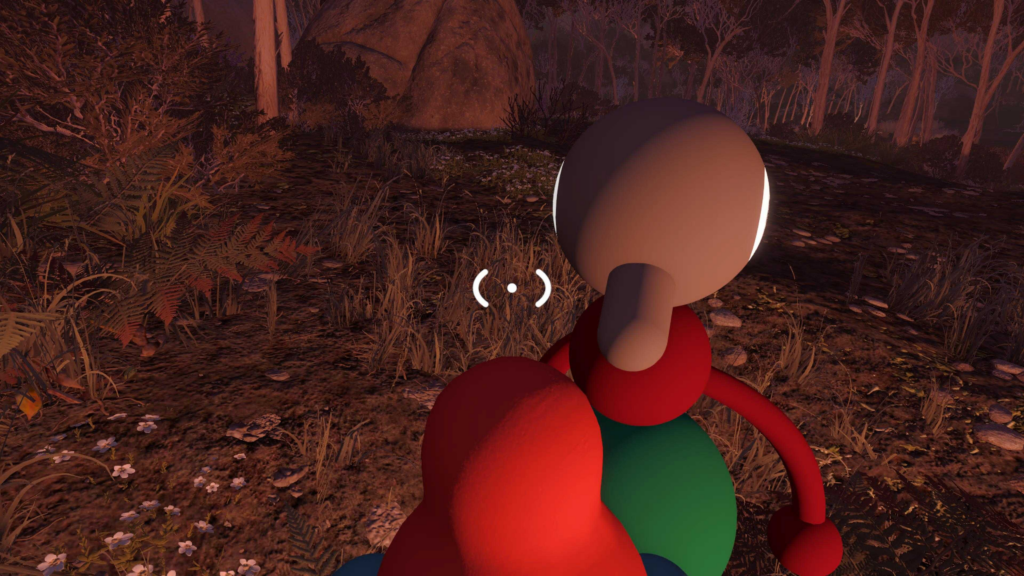
You do not play Big Walk alone, and you can have a group of up to 12 players running around the island in which the game is set. For this review, I predominantly played in the two-person build, with one session having three players. I can draw some conclusions on those bigger parties given how it plays with a smaller group, but this should be important to note moving forward, as these can drastically change the experience overall.
The game I first compared this to when my friend and I started was The Witness. That has always been one of my favorite puzzle games, and the comparisons are palpable. It’s a beautiful, peaceful world that, once you cross the threshold into the tutorial area, opens up and doesn’t limit your exploration. You are free to get lost, solve mysteries in any order, throw your friend off a cliff, or sit on the beach as the sun sets. There are only minor limits placed upon you, and they are brilliantly woven into an abstract progression system. Seeing things around the map and wondering, “How do these work?” Only to be hit with that A-ha! Moment, made all the more special by the gasps of the people you are with as you come to the revelation together.
Every puzzle in the game requires some version of cooperation, but that can vary based on the build you are playing in. The thing is, you might not piece it together right away just how the two heads are better than one. These tasks can be obviously outlined with buildings in clearings or hidden in forests, and a few have very non-obvious solutions. The thing is, the second player enhanced this. I wasn’t alone in my thoughts, trying to piece together what I needed to do. There were plenty of times I spread my hands like Adrian Monk and examined the environment to figure it all out, and other times I was on the receiving end of good instructions.
The best aspect is that the puzzles don’t all follow the same rules. You can expect a lot to come up multiple times, but there really is a variety buried in this world. One such task, which I hated the first time around, involved my friend putting on a helmet that obscures the world. The second then has to guide them through a walking puzzle around obstacles. The first time, hysterically enough, I was given the worst guidance literally possible, but we got it done. This was, as one might imagine, the only time I was the only person who wore the mask up to this point. When we traded off to do a second task, the first thing I heard was WHAT THE HELL!! Needless to say, my experience made me a better direction giver.
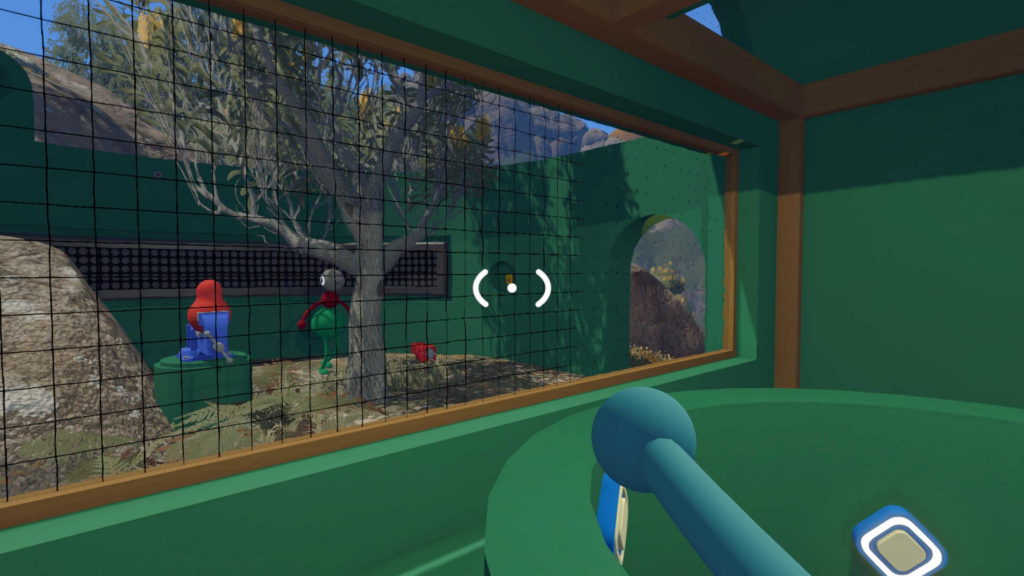
The most common of tasks you run into, though, will force the players into different rooms, asking them to nonverbally communicate tiles. There are a lot of variations on this. Maybe you need to make hand gestures, as you learned back at the beginning. You might need to show each other the tiles with some nods or shakes to let players know. In my favorites (the most frustrating puzzles always became my favorites once we pieced them out), one of us had a speaker, and one had a red light. We worked out a system of long press for yes, two presses for no. We even refined this later with three presses in another spot, like playing Wordle.
The thing is, this is our system. You might use it; you might even conclude independently of ever reading this review, but even if you do, that was ours for however brief it was. There are so many ways you work out these tasks, collect these keys, and progress, and it will be built on you. The adventure is unique even when twenty different groups tackle the same task because the people solving it are so built into the process, and it is masterful to watch it play out.
The social aspects in general are so perfectly implemented across the board. This starts with the proximity voice chat that you REALLY should be using. There are a few things in the game that will require in-game chat anyway, but this feature is so good. You stay close, and you can hear everybody; you move away, and you stop hearing everything. There are some arguments that this might be too short-range. I could conceive that, but I still loved every second of saying I’m going to check over there as my partner turns right, and we spend the next ten minutes running around to signal each other.
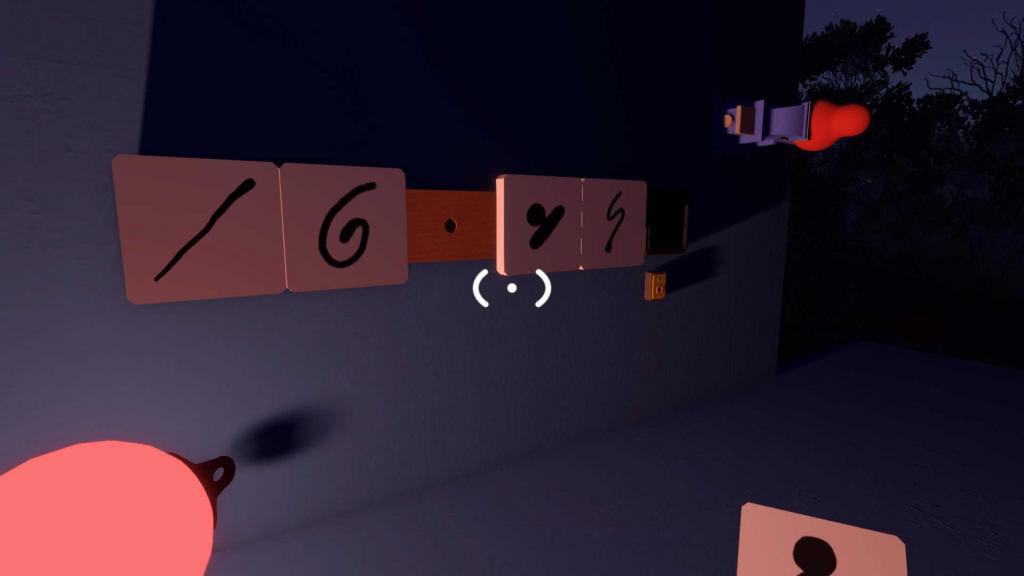
There are also ways the game extends this, such as walkie-talkies so you can communicate over a longer range. For example, there was one challenge on a mountaintop that required me to look through telescopes while they signaled with body gestures for a code that would have been so much easier if we had just brought these. There are also flares hidden around so you can find easy meetup points if you do get lost. You can only carry limited items, so I imagine task division could become very interesting with a bigger group. I saw it with only three folks on a Big Walk, so I am excited to explore this later on.
This is the main game, but there is just so much to get lost in. The world is gorgeous and filled with ambience that evokes a Big Walk that may or may not require you to solve mysteries. There is music as well, which is hauntingly tranquil at its worst (which is sheer perfection) but very bizarre at its best. These elements absolutely play into the big picture, but there are some things that the community is undoubtedly going to need to solve when more people go on their own walkabouts because, yes, there is some serious depth here. You start with simple tasks; they get progressively harder, but soon you realize there are things well beyond what the game guides you towards. This is before I point out every sound effect in this game was masterfully implemented and foundation-shaking.Big Walk
If this wasn’t enough, there is a day and night cycle that can entirely change the experience as the world gets pitch black. Some tasks became nightmarish because I couldn’t see. Then they left us laughing, as in the light it was an easy, obvious walk. You can get very lost if you lose your light, or if you are like me, rushed into the woods because you were too lazy to find one. Then proximity chat as you chat comes into play, as I heard the faintest calling of my name echoing through the trees, a light over the horizon because my ally was not as much of a moron as I. It’s an experience like no other, and it never fails to penetrate to the deepest layers of your person.
By the end of the game, which is decently long, we were IN SYNCH. The game had trained us in trust, and we were solving tougher puzzles with fewer tools and no failure. You don’t really think about it with each step, but looking back at the journey, it was impossible not to see the slight hand of developer House House building us up. The end really isn’t the end either, as there are many more things to find, with bigger mysteries to solve. They are more of the same, but by this point I was sufficiently hooked on something that even now I am struggling to design.
Verdict
Look, I’m going to just come right out and say it. Big Walk is one of the best puzzle games I have ever played. It is also one of the best social experiments I have ever participated in. From the proximity voice chat that created so many humorous moments and grounded me in this world, all the way to the moments of trust that were required to guide my friend through a blind puzzle box, or vice versa. There are moments of absolute joy and bliss that are yours for the taking in your journey and memories that will last you a lifetime. This is my new gold standard.
Remember to follow us on Twitter, Facebook, and Bluesky to keep up to date on everything we have going on!
Reviewed for PlayStation 5, also available on Nintendo Switch 2 and PC
*Three review keys for this game was provided by House House for the purposes of this Review.
Developer: House House
Publisher: Panic
Release Date: August 4, 2026
Pros
+Brilliantly crafted puzzles that require teamwork to solve
+Social elements such as proximity chat engross you in the world
+Day and Night cycle drastically change exploration strategy
+Several play options to account for party size
Cons
-Proximity Chat can be a slightly short in range
-
Big Walk
