
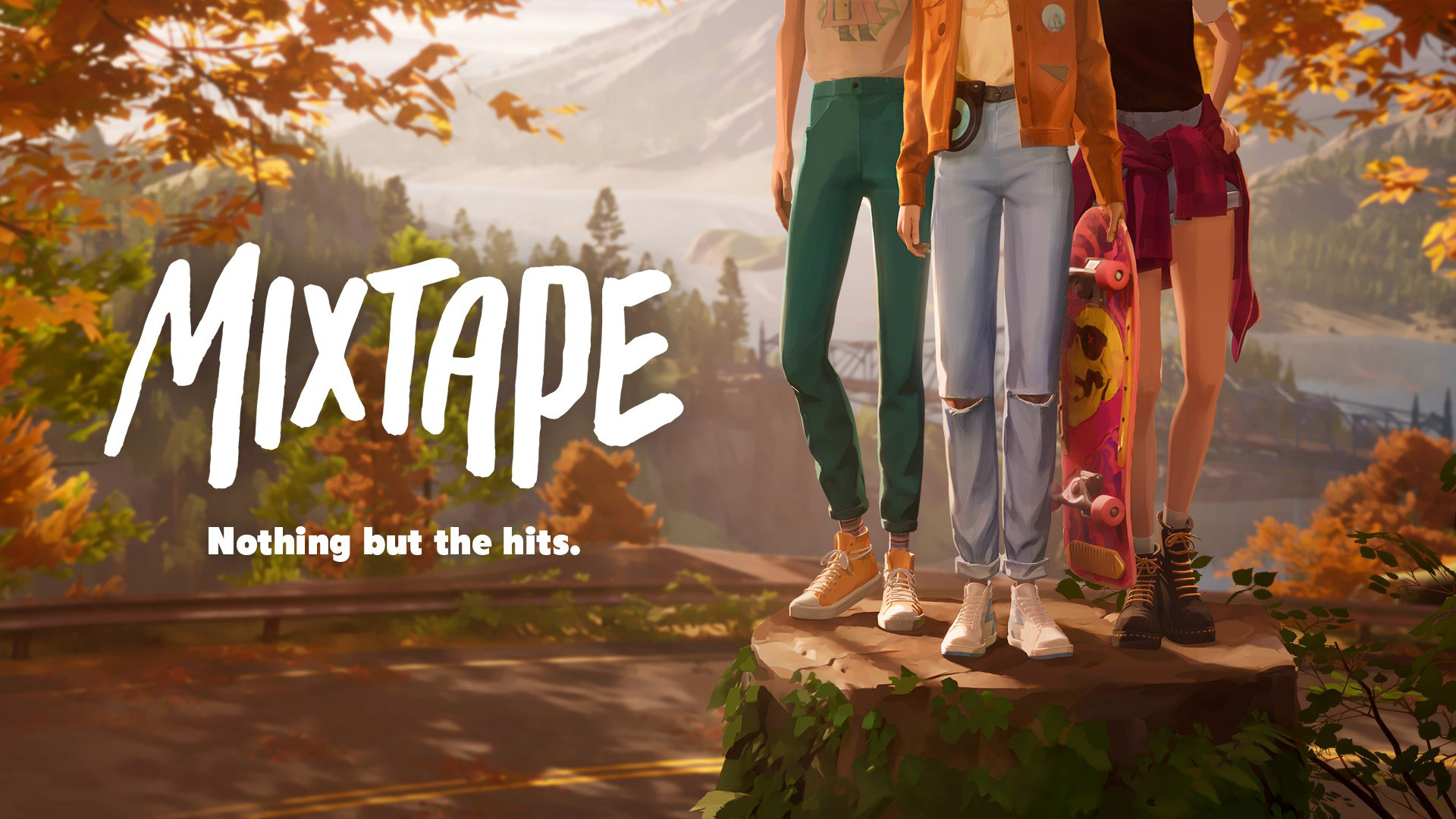
Mixtape works best when its powerful vignette moments express intimate moments of its titular young characters.
In the opening cutscene, protagonist Stacy Rockford talks directly to the camera, informing the audience to “make memories to good music, invest in high-quality headphones, and always make a soundtrack.” Why? “Because pretty soon you won’t be listening to music; you will be listening to who you were.” This narration, a simple setup, reverberates through the entirety of Mixtape and becomes, oftentimes, painfully relevant. We all have that track, those lyrics that act like a memory in a bottle, transporting us from who we are to who we were. Stupid, maybe. Rebellious, probably. That piece of you never dies; it just awakens the key in the lock to turn and free it and allow the memory to mingle, if for only a moment.
The thing is, for too many of us, the moment fades before we ever realize we had it. Thankfully, our young protagonists know they are on the edge of a milestone, and Stacy has curated a killer soundtrack on compact disc to encapsulate the moment. One last night together with her friends, the people who made everything that came before worth it. As we learn, Stacy, Slater, and Cass had plans to drive down California in their first true experience of freedom. Stacy had now changed her plans, buying a ticket to New York, where her sister lives. This is in hopes of facilitating a chance encounter to get a job of her dreams—music supervisor—due to her ability to pick the perfect track for every moment.
We will come to learn more about her musical prowess as the narrative progresses, with each set piece being curated to a specific song. The friction created by her choice will also come back to haunt the trio as they attempt to navigate the twisting, turning road from adolescence to adulthood. Structurally, while this is a coming-of-age story, it plays far more like a film than it does a game. This is present in nearly every element, starting with the game’s runtime, which was about a little under three hours. In fairness, there are a few places where time slows down, such as exploring Rockford’s room, in moments that have a similar vibe to Life is Strange. You can rush through it or enjoy the tunes and see all there is to see.
Much of the actual game refuses to pick a style, in the best way possible. It’s this, combined with the soundtrack syncing to every key moment, that I have compared the game to a merging of Road 96: Mile Zero and What Remains of Edith Finch, though with a far more upbeat attitude. While checking out a box in Stacy’s room, a memory is triggered of them fleeing the cop on a shopping cart, swerving along the streets while “Sensitive to Light” by Rainbow plays on. Soon, you make the evening news as cops give chase. This is a far cry from a previous moment where the characters adorably rock out to “Freak” by Silverchair.
Mixtape often slips into whimsical absurdity. While there is a forward narration as the last night in their town progresses. The end goal of this portion of the story is to find booze and make it to the coolest party ever, a la Superbad. This said, though, many of the best sets are encountered through flashbacks. This helps to reaffirm that this final Mixtape is a culmination of moments, good and bad, that led the trio to here. Typically, these sequences are short, forward-moving, with very little in the way to hinder you.
The headbanging scene is set in stone as you watch a series of scenes play out, the player simply having the ability to choose between three button prompts for their moments. This shifts as the scene progresses to stylized moments of Stacy slapping her hand on the car door or Stacy having fun playing with the above light, clicking it on and off. There is interactivity, but the scene plays out the same, taking the same amount of time, regardless of what you actually do.

Others, like a batting cage sequence set to “The Touch” by Stan Bush, might take you more time if you, like me, can’t get the batting timing on. Like A Dragon batting is now pretty ingrained in me, and the timing on hitting requires far more lead on the pitch. You only need to land about five or six hits to progress, but for me, I was thirty or forty pitches in before I could start hitting them properly. Other sequences, since there is no failure in the game, can technically be played out by failing every action right, with others like the skateboarding segments rewinding slightly if you hit something. Be kind, rewind.
Unfortunately, the moments that really took me out of it were the exploration ones. These are few and far between, thankfully, but they are odd. Not that they are bad moments as the characters walk and talk, but there is a visual disconnect between the characters and the backgrounds that is off-putting. Since you typically follow behind Slater and Cass, you will see them seemingly run on a treadmill in front of a green screen. Maybe this was the point; it just did not have the same effect as all the other moments. Skateboarding sequences and centralized moments in characters’ houses don’t have this effect, which makes it more out of place.
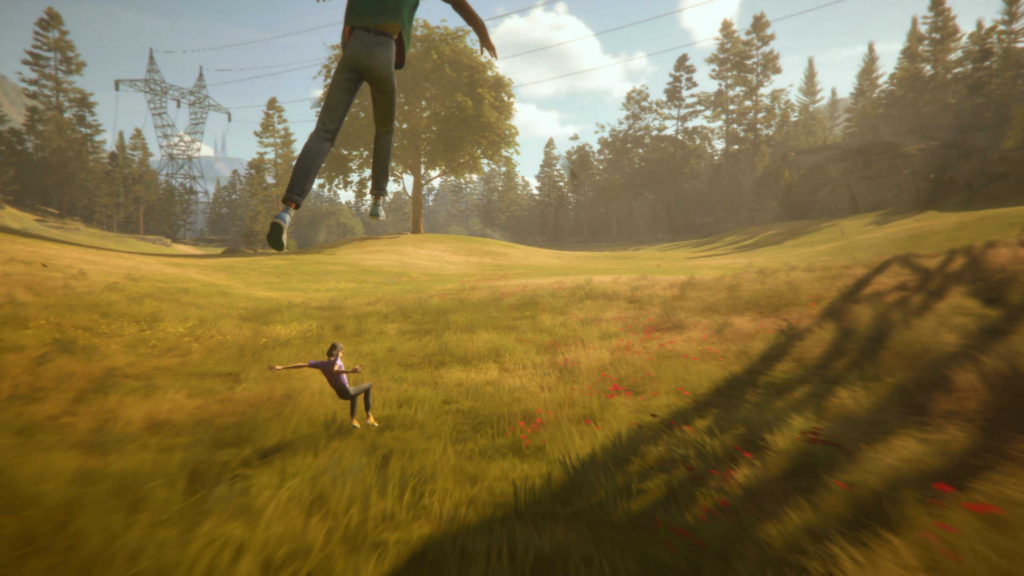
Thankfully, this barely matters; these moments are typically just goofy fun anyway. Kids being kids, floating away in their sadness or stumbling through a blockbuster drunk off their ass. The only moment that really left a bad taste in my mouth was a tongue-kissing sequence early on that was just ew, though I get the feeling that was what they wanted me to think. Mixtape doesn’t just shift gameplay but also art style from time to time, and in that kissing sequence, it was the perfect storm of all those designs working together to just turn me off. Little moments, though, are actually enhanced with these shifts. Digging through a drawer for a ticket stub is insanely satisfying when the physics of every object have character.
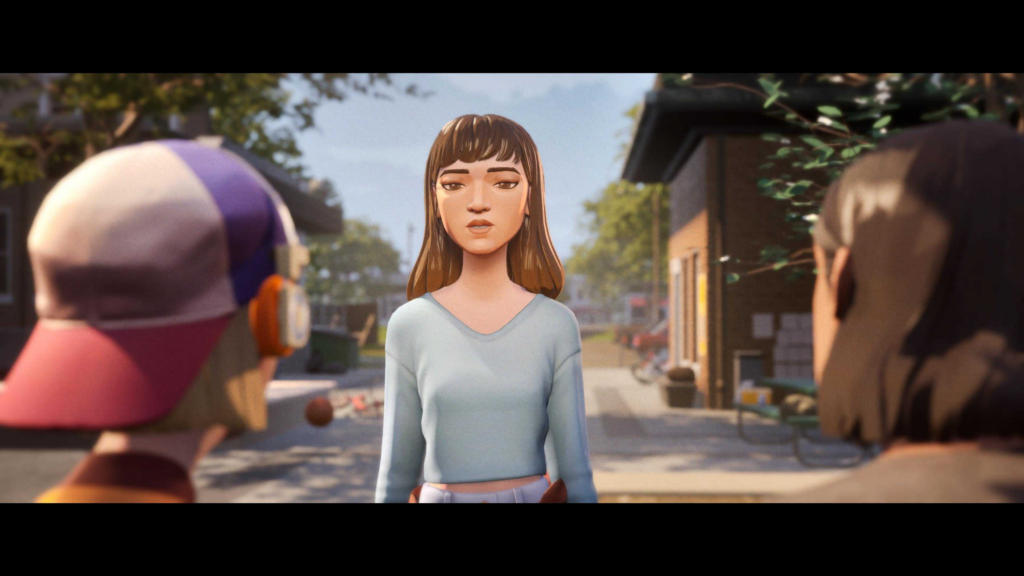
Which brings us to our main characters, who are tasked with carrying the story of Mixtape almost entirely. The development team did a fantastic job bringing them to life, as nearly every scene has emotive facial expressions and well-choreographed body movements, all synced well to the voice performances by Bella DeLong, Max Korman, and Jessica Ma. Stacy has hysterically funny, yet wonderfully underpronounced, moments throughout, with Cassandra managing to get some of the best character development throughout. With Slater serving as the glue holding the trio together, moments where all three share the screen are some of the absolute best.
Verdict
Mixtape is a musical romp through the last night of now and the beginning of forever. A narrative that can make you laugh and make you cry. It’s a wild absurdist piece with a curated soundtrack of licensed music that is never very far away from delighting you with another moment that makes you light up. Do all the pieces click? No. Every soundtrack has that one song that never really lands the same way, even if it isn’t bad. More than anything, Mixtape is the sum of its album, and it is a banger.
Remember to follow us on Twitter, Facebook, and Bluesky to keep up to date on everything we have going on!
Reviewed for PlayStation 5, also available on Xbox Series, Nintendo Switch 2, and PC
Developer: Beethoven & Dinosaur
Publisher: Annapurna Interactive
Release Date: May 7, 2026
Pros:
+Outstandingly crafted narrative
+Constant style shifts and changes
+Fantastic film work
Cons:
-Some moments of gameplay hold up less than others
-Off-putting disconnected animations during certain scenes
-
Mixtape
