

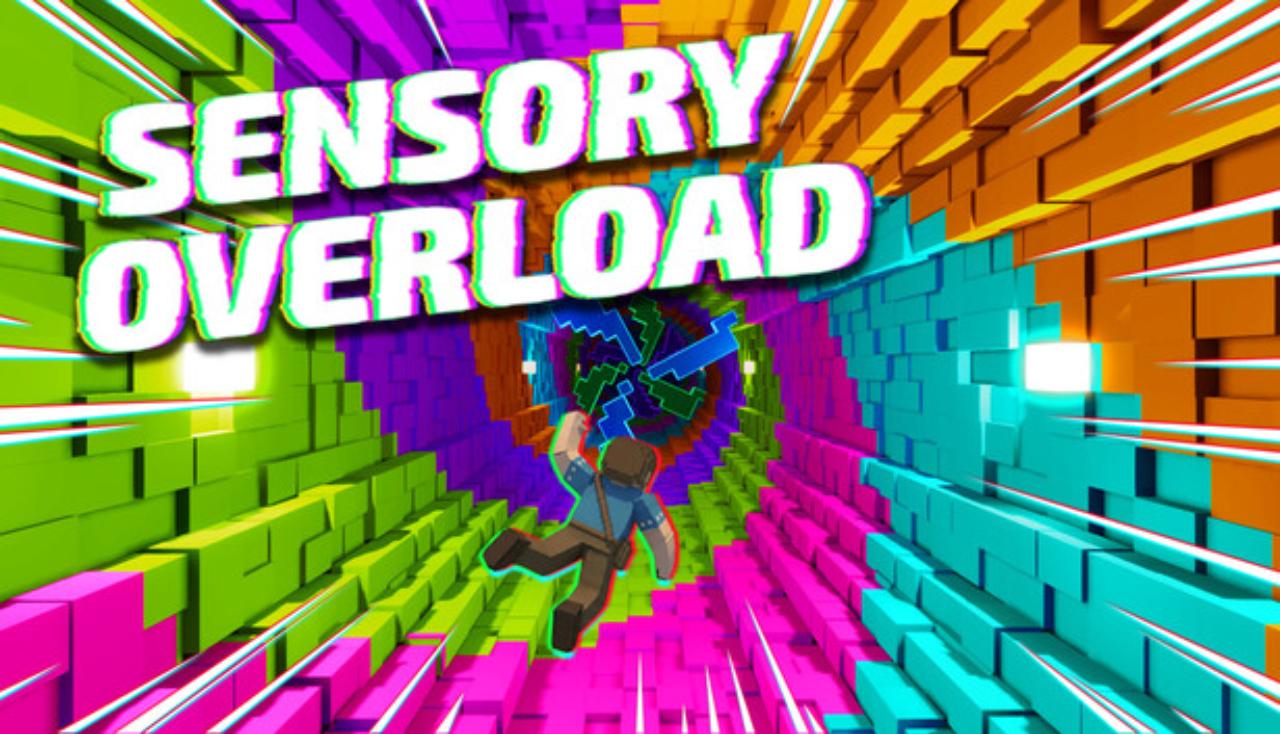
Here is an in-depth look at how a hectic game like Sensory Overload can help players living with ADHD achieve a flow state.
In hindsight, the signs were all there.
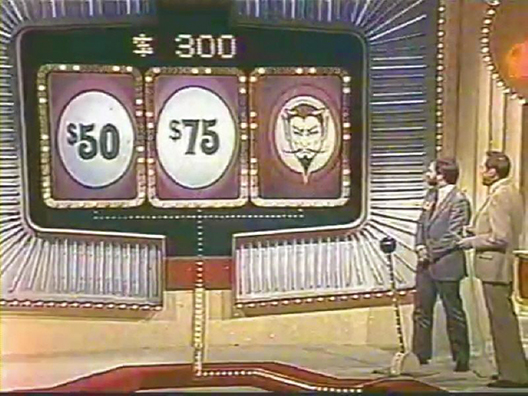
As a little child, my parents had a tape that they would play for me when I got fussy. It wasn’t a tape of cartoons or of sing-along videos; it was a tape of episodes of the old game show The Joker’s Wild, because I liked the spinning colors of the giant slot machine. Later, when I found video games, the ones I connected with the most, I was consumed with. I was so wrapped up in Final Fantasy IV (2 in the US) that I almost let a bird die because I forgot to feed it. (My parents intervened in that situation.) Today, when I write, I either write for twenty minutes or several hours, with no telling what it will be unless I set timers.
Back then, various phrases were used to describe my erratic nature. “Hyper.” “Sensitive.” “Highly intelligent.” “Shy.” “You know how boys are.” And my personal favorite, “He’ll grow out of it.” But in March of 2026, only a handful of months ago, I learned that the collection of phrases had a name: AuDHD.
My mental health team warned me to expect a diagnosis of ADHD from the psychological testing I underwent. I knew that in addition to the depression and anxiety there was some other factor undiscovered that deep within me wasn’t being addressed. They did not warn me about the autism part. I grew up in the ‘80s and ‘90s, when our collective knowledge of autism amounted to the kid you see on the last episode of St. Elsewhere obsessed with the snow globe. (If you understood that reference, you should probably schedule that colorectal cancer screening you’ve been putting off.)
Autistics, the 1980s medical community told us, were the nonverbal ones, the ones that threw a fit when their parents bought Cocoa Pebbles instead of Cocoa Krispies, the ones that would lose their minds if they accidentally bit into a stray pickle on their hamburger.
Of course, in the year of our Atom 2026, we now know that autism presents itself on a spectrum, and while some still fit in that pattern of “high support needs,” some autistic people show it in other, more minor ways. My day job is at a hotel, and it will bother me if the bell carts aren’t lined up neatly, or as my mind explains it to me, “correctly.” I also go around the desk capping pens, but I explain that to myself as the fact that uncapped pens have their ink dry up faster and Sharpies have gotten costly lately.
For the past six months, I had been trying to learn more about this diagnosis, even going so far as to personify it as a tiny imaginary dragon and calling it “Audy.” But AuDHD, as we understand it currently, only began to take form in the 2010s and solidify in the 2020s. While our understanding of both conditions separately had grown, the overlap was still new-ish territory, and information was not always as deep as the information on autism and ADHD separately.
And then I received a cold pitch for Sensory Overload. “Could Viral Game Sensory Overload Help Explain the ADHD Flow State?” the email asked in its subject line. Well, I don’t know, random email, could it? I replied in my mind. But I was drawn to one particular part of the email: a GIF showing a very brief clip of gameplay. It was colorful; it had spinning shapes. Just like the slot machine on The Joker’s Wild, this single gif had all of my attention.
Thus, I began my journey with Sensory Overload. And to quote a popular nighttime show from the Disney California Adventure theme park, the world is a carousel of color.
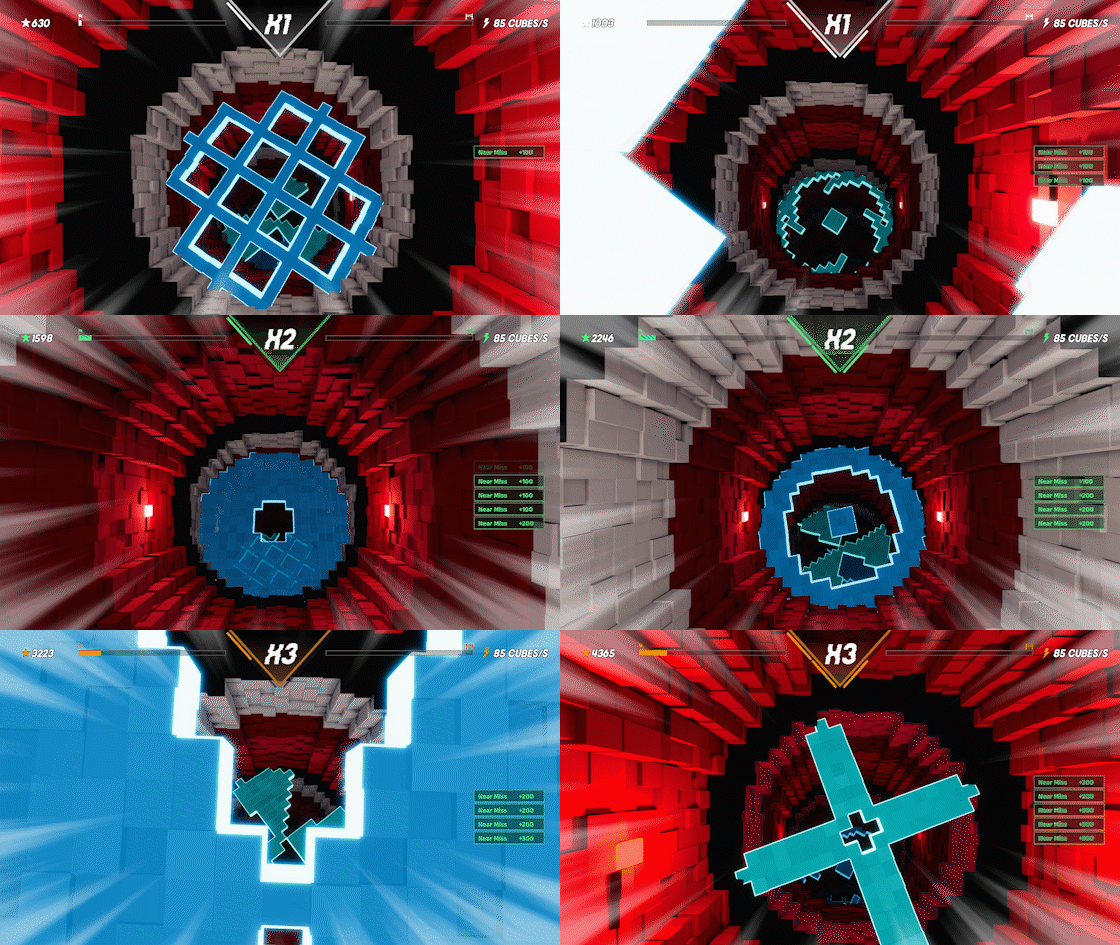
The object of each level is extremely simple: make it from one end of the tunnel to the other. On the way, everything but the kitchen sink will assault your senses, from bright colors to mesmerizing shapes and patterns to intense musical tracks. “I tried to give the game a bit more life by making the tunnel curve and move and rotate,” says Tim Berce, the solo developer behind Pancake Studios.
“I thought it was just some good fun, but when I started showing the prototype to other people, I started getting forceful responses, with people close to me saying it’s making them seriously nauseous. My lovely wife had a particularly strong reaction to it—she physically recoiled from the screen and called it the worst thing ever made and said that nobody would want to play a motion sickness simulator. So to spite her, I recorded a 30-second clip that exploded on YouTube and got five million views and thousands of comments of people wanting to try it.”
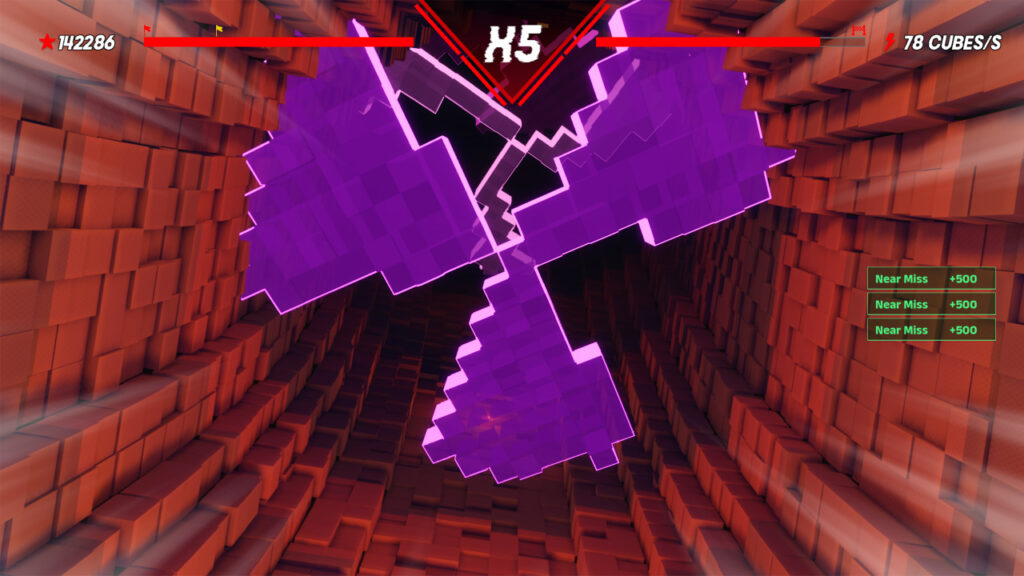
The game’s simple goals demand simplicity in return: smooth, small motions win the game. “Most people who do badly try to correct their movement massively,” says Berce, “which just makes it harder to dodge subsequent obstacles. Small movements allow for precise falling and make the game a lot easier. That’s partly why grazing obstacles is in the game, to reward methodical movements.”
The mentioned “grazing” mechanic—skirting just outside the edges of the obstacles thrown into the path—rewards daredevils with score multipliers, meaning that even those who reach the end of the tunnel have reason to replay it and improve performances.
Here’s the wild part: while neurotypical players may find the sensory overload found in Sensory Overload daunting, neurodivergent players may find the assault paradoxically soothing or calming.
“One thing I’ve learned is that ADHD is a misnomer,” says Berce as it pertains to neurodivergent players. “It’s not a lack of attention; it’s a difficulty in directing it. The brain is constantly hunting for stimulation, and most of the world doesn’t supply enough. So when something finally saturates every channel at once, there’s nothing left to hunt for. The searching stops, and what’s left apparently feels like quiet.”
My play reflects that. Instinctively, with an AuDHD mind, I thought that everything, everywhere, all at once would be overwhelming. In actuality, the sensory flooding began to blend seamlessly. The colors flashing to the beat of the phenomenal soundtrack crafted by Italian composer Giorgio Satta merged with the fluid motion of the tunnel. When I managed to smooth out my mouse movement instead of rapidly jerking it around, it all became one. Flow state was achieved.
This was the case when I was successful in a level as well as when I failed; only milliseconds passed between crashing into an obstacle and the next attempt, with the only perceptible difference being the level’s track restarting (which was okay because the soundtrack is top-shelf). Flow state remained unbroken.
The mark of a great puzzle game is the ability to make players decide to make one more attempt on a tough level, but Sensory Overload’s toughest decision to make is when to stop trying. On every tunnel, victory is within reach, and failure isn’t due to cheap tricks or bad level design. It can be done with a bit of “git gud.” Berce’s reaction to the difficulty and response to it was a sense of satisfaction. “I was most happy to see two things while watching other people play,” he stated. “One was an extremely strong sense of ‘one more try,’ and then the other is the absolute joy on people’s faces after they managed to beat a stage that took them hundreds of tries.”
Berce elaborated on the difficulty, saying that “the stages that people obsess over, the ones they retry hundreds of times with a smile, are the ones where they can FEEL themselves getting better every attempt. The stages I had to fix were the ones where progress felt random. So the tuning was less about easy versus hard and more about making sure every death teaches you something.
If you die and immediately know what you did wrong, the difficulty is right. If you die and feel cheated, I messed up. I rebalanced the Tornado stages during the playtest for exactly this reason, and instant respawn exists so the loop of attempt, lesson, attempt never gets interrupted.”
Berce’s playtesting reflects research on the ADHD mind, referred to sometimes as the concept of “skill plus 5%,” where the ADHD brain finds the most pleasure in tasks that come with a bit of challenge—not insurmountable, but also not mindlessly easy. Think back to the original Tetris for the NES and Game Boy. It was easy to learn but difficult to master. Making it through the early levels sped the blocks up, creating the “skill plus 5%” factor; as the levels increased, flow state was achieved (although in the ‘90s we used the goofy term “tetrisized”). An added benefit to the NES version: colors.
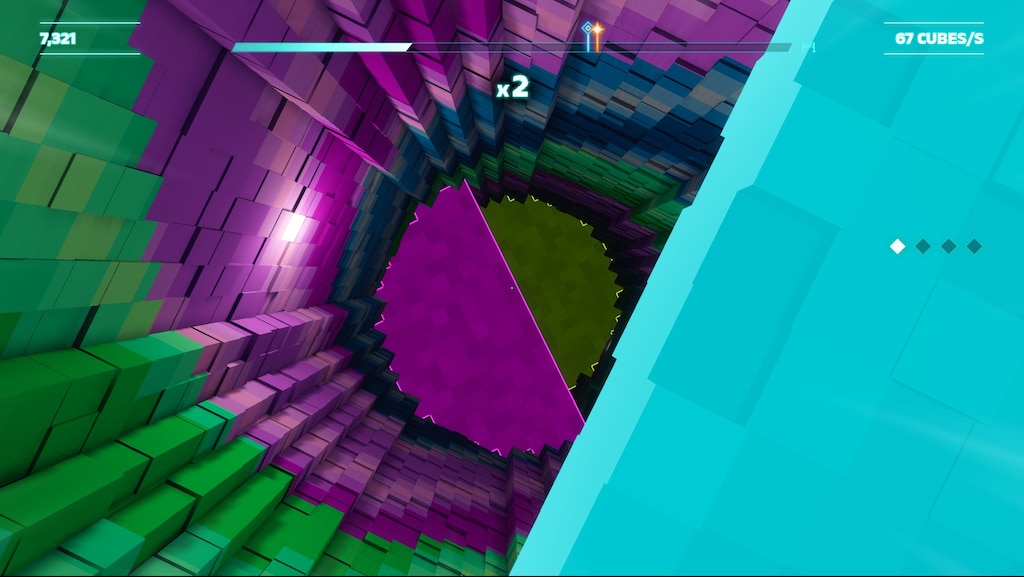
The catch is that for AuDHD minds, the trick remains to walk the tightrope between satisfying the ADHD need for stimulation while also not overstimulating the autistic side. While my playthroughs always spurred the “one more try” reaction, I topped out routinely at twenty to twenty-five minutes before I had to go do something, anything else. Berce confirmed this reaction. “I have AuDHD players who tell me the game quiets their brain but that they have to keep sessions short,” he stated.
“They’re also why I added accessibility settings like turning off the music-sync color beat to mellow out the game a little bit. Whether it could be used to understand these minds, I’m not qualified to say. There has been early interest from a university researcher in studying what the game actually does to the brain, so maybe someone with actual credentials answers this properly someday. I’d love that.”
All this knowledge gained from an indie project from a solo developer makes it easy to see why Tim Berce beams with pride. “Honestly beyond anything I could have ever imagined for a game that started off trying to see how much visual abuse gamers can take,” he said. “Over a million deaths in the first few days of the game releasing, a 94% positive rating on Steam, and a very active community with 70+ community levels released just days after the game came out. I’m beyond honored.”
Very few games come along that are more than just a game. Sensory Overload reaches that point. Not only did it train my brain to “play it right,” it taught me more about my new diagnosis than six months of researching dry scientific articles. And even after over 130 crashes in one single tunnel, it still compels me to watch the spinny, swirly colors and give it one more try.
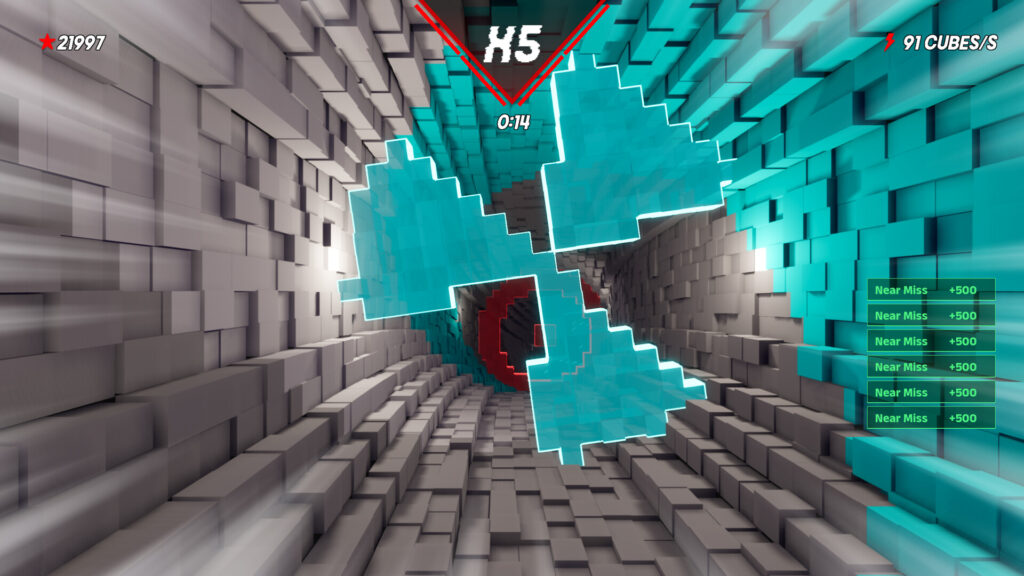
Sensory Overload is available on Steam for $9.99 US and may make its way to consoles at a date to be determined later. A Steam key was provided by Pancake Studios and Two Frogs in a Trenchcoat.

2 Comments
Pingback: Resonance: A Plague Tale Legacy Review – The Most Uncharted Thing Since Uncharted 4 - Pixelbytegaming
Pingback: Fall In Love Visual Novel Festival Spotlight - Pixelbytegaming