
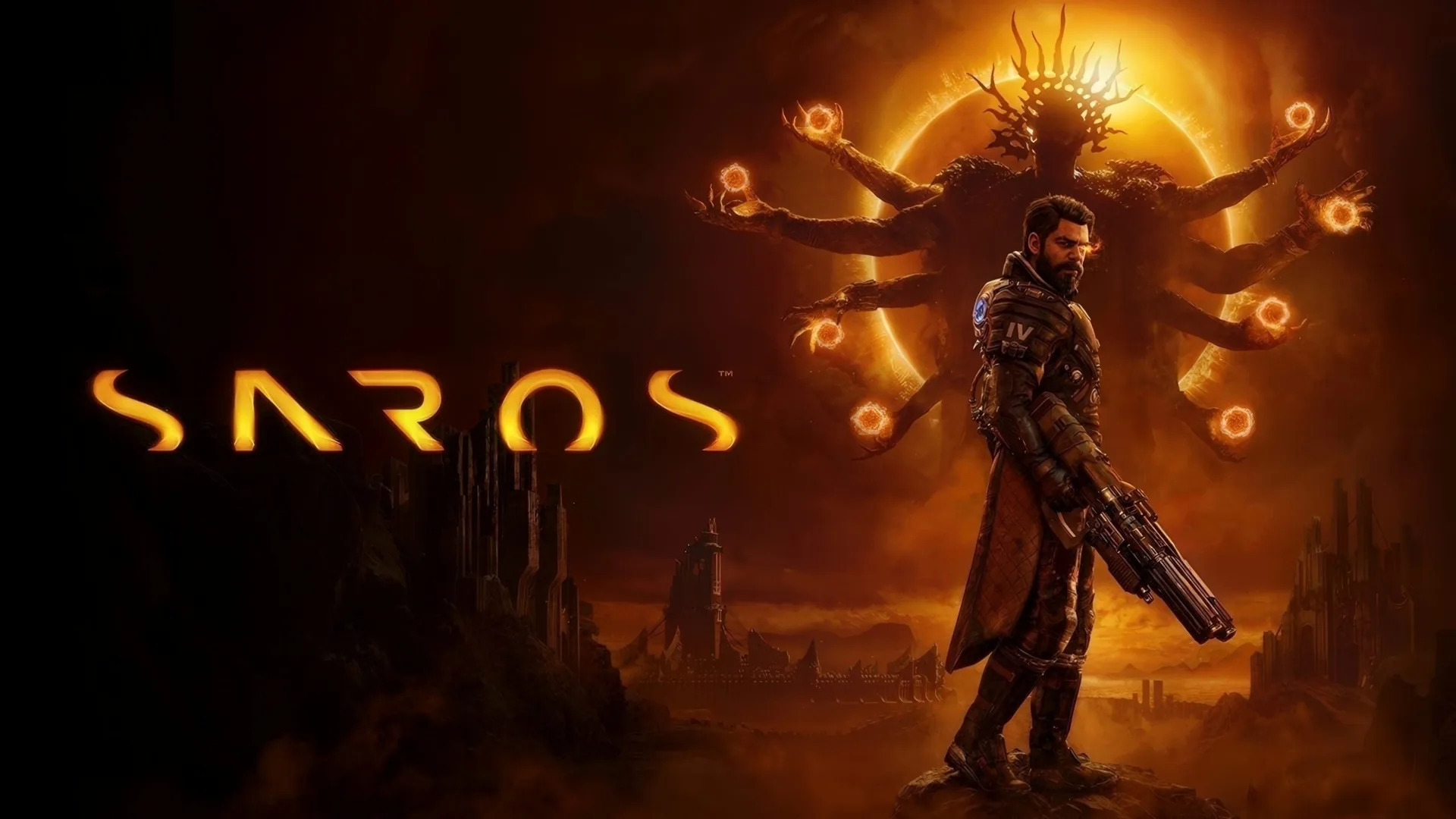
Saros is an experience that is hard to explain. Wrapped in bizarre moments of abstract horror, in between a narrative that could require a compass to navigate, it can be challenging to wrap your brain around it. Pulsating orbs of death with fast-paced death and decimation almost make you forget that the narrative isn’t heavy, wrapped and looped into a repetitive banquet of tawdry excess. Who among us doesn’t love a little excess, though?
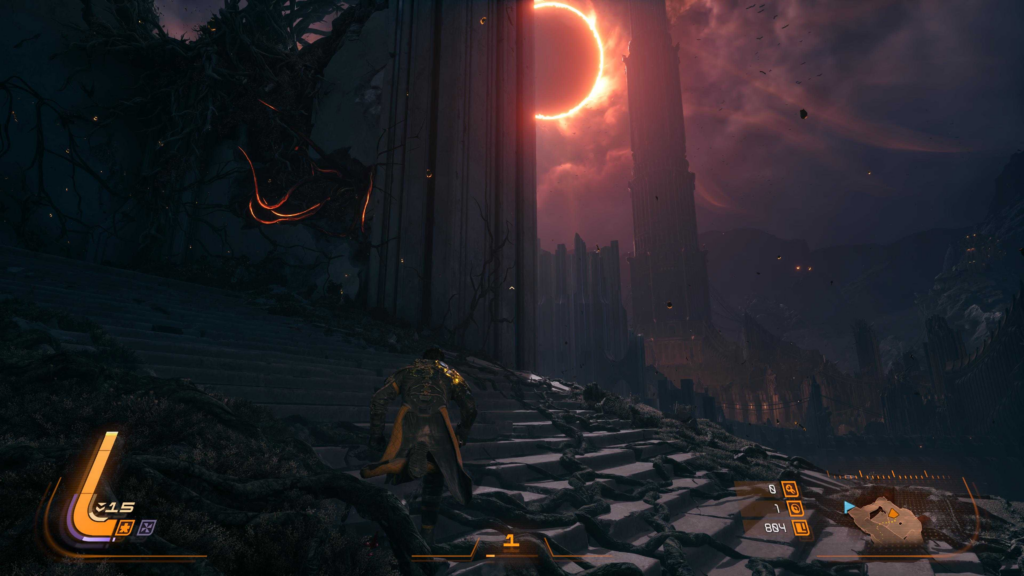
In the introduction, we join Arjun Devraj, who awakens already stuck in the loop of the planet Carcosa. A loop brought about by a visually striking eclipse hanging menacingly in the sky as if stalking your every move. You are given no time to actually learn the complex mechanics before the game throws you back into the same bullet hell you might be familiar with if you have played Returnal. Enemies throw easy-to-track balls at you that you must dodge or now shield. I clarify it this way because, within minutes, the game will teach you that such a simple concept hides a punishing depth.
When you inevitably die, the real cycle of death and rebirth begins, and it’s the first real twist to the formula. Whereas the previous protagonist, Selene, crash-landed and was alone, Arjun is not. In fact, he is joined by several members of Echelon IV, an emergency response team sent to the planet to discover what happened to three previous teams that were sent to this planet and have now gone missing. As Arjun learns upon his return, the team flows differently on this planet, as he believes they had only just landed, only to find this team now distrustful of him, having abandoned them for far longer.
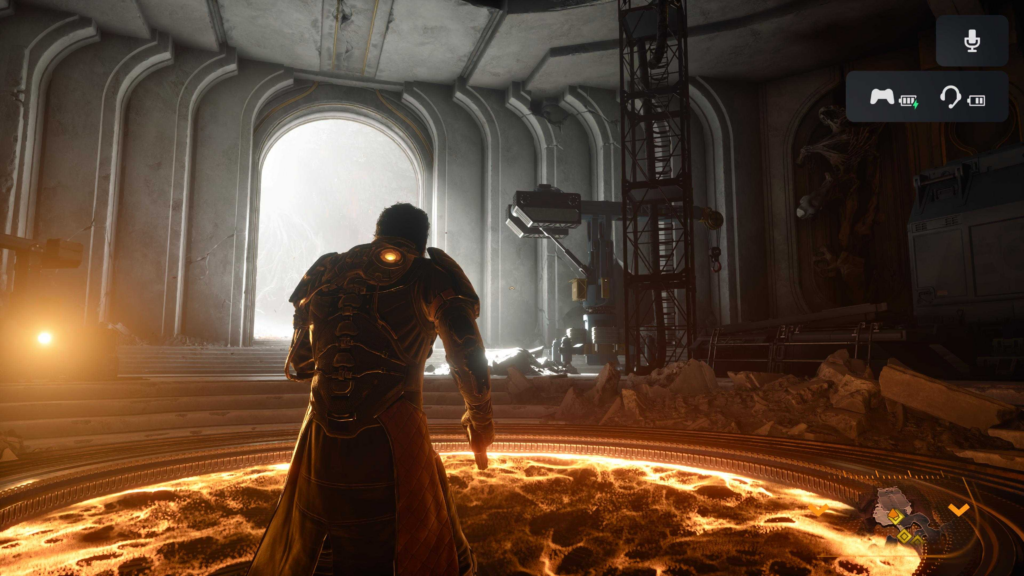
Rahul Kohli portrays Arjun with a lackluster sense of energy that betrays the depths of the story, especially in Act II. The atmosphere is oppressive, the world is rife with sadness, and yet Arjun still feels like the most boring of heroes. You get caught in the loop, only progressing the abstracts of the story upon completion of a biome, defeating a powerful boss in your way. It’s not like there are many moments he needs to carry, but two in particular stand out as being let down by this direction. The first is a revelation about the tasks they were trying to complete, which caused him to feel out of place in a scene with several other characters. The other is a key moment near the end that should be a defining point for the character development, playing out in the background, but instead just feels weak.
The absolute irony of this fact is the secondary performances that actually manage to bring some emotion into a journey about a planet that preys on your emotions. In particular, I was happy to see that Selene herself, Jane Perry, made a return(al?) as a new character able to showcase her acting skills. Returnal had a much lighter story, with Selene really being the only character present, so it was great to see her get legitimate screen time in the story. Adriyan Rae also deserves particular note, portraying the only character that seems to experience the planet from a normal perspective, a role she gives strong gravitas to.
Of course, though, the story is secondary. It serves as a reason, a guiding force to pick up your gun and start blasting and hunting your way across this twisted world. At each stage, you enter a beautiful tapestry of decay, drawing inspiration from H.R. Giger in the way the foreign planet has begun to mesh with the biomechanical tools left behind by the previous Echelon colonization attempts. As you progress, the way this decay is depicted, morphing into hauntingly lonely set pieces that beg you to ask how long you have been trapped here, looping over and over again, continues to be a highlight of the experience.
To go along with a twisted world, you get an equally twisted soundtrack. At times, feeling like noise poking your brain, nudging you forward. At others, simply an unsettling background noise to remind you that nothing happy has ever happened on Carcosa. Then it kicks up, enemies spawn, and you are frantically leaping and dashing for your life, your every move feeling choreographed to the sounds. When this ends, the unsettling dolcet sounds return, like nothing had ever happened in the first place.
Saros is a roguelike at its core, the entire experience tied to each run being unique, with different guns and power-ups to acquire, changing up your experience as you traverse the ever-changing biomes. The thing is, though, what Saros really attempts to do is cut back heavily on some complaints of the first game. One of the most noticeable things is you can keep the gun you ended a run on for the next, something much needed if you were really jelling with what you were using.
In addition, the game brings in a new modification that isn’t required but allows the player to make what can be a challenging game into something more manageable. Best yet, especially in a world where easy modes are punished often, the modifications don’t bar the player from earning trophies for the best ending. They can make the game effortless, so some might not like that, but the structure of needing to apply negative effects to get the most out of the buffs, like attack damage or armor buffs. I only started applying these near the end, well into my 60-hour journey, when I just didn’t have the energy anymore.
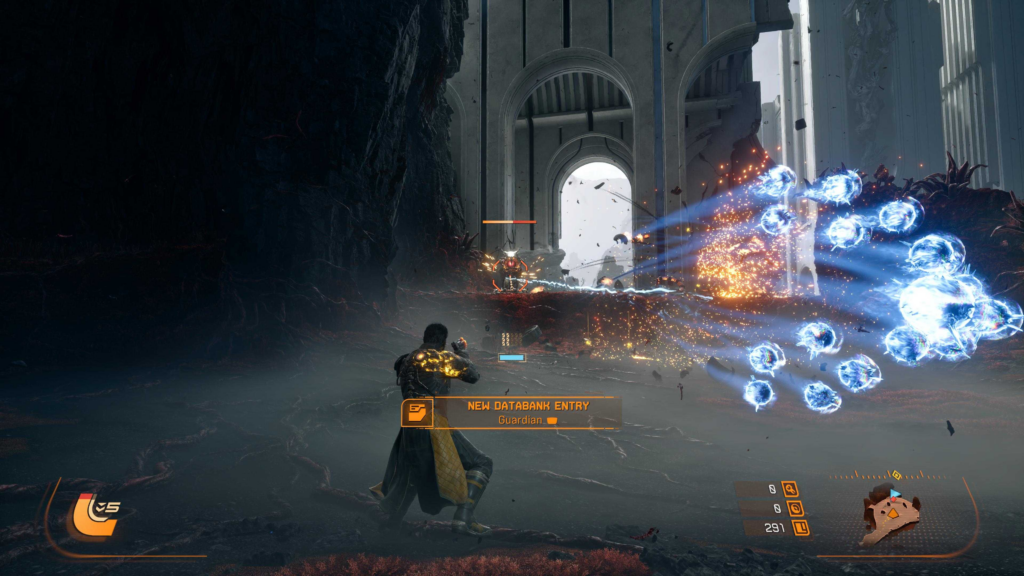
Structurally, though, the loop remains very similar to that of Returnal. Enemies have three bullet types that they shoot at the Arjun, with the basic concept being that if you stop moving, you die. What remains effective is that much of this concept feels like something you only see in smaller projects. Not a high-quality third-person shooter with hyperrealistic graphics. In the sense of these bullets, it still maintains the whimsy of a classic bullet-hell shooter, now juxtaposed with unsettling sci-fi horror.
The gimmick here, which can at times be more frustrating than fun, is that each of these bullets has a specific way to respond to them. Blue bullets, for instance, require the new shield ability. This also charges your power weapon, which can heal the new corruption chip damage your health bar can accumulate. The game gives light tutorials, but I will admit being twenty to thirty hours in before figuring out what any of what I just said means. Even on the fly, the game can throw so much at you so often; all of that goes straight out of your head.
That’s not an exaggeration either. Not every enemy will just splatter you with balls of death, but the game does run a lot of its biomes through areas that lock you in place. It throws at least one enemy that has a lot of health and attacks that generate countless obstacles for the player to navigate. These enemies aren’t really ‘hard,’ but the game banks heavily on distracting your focus from the arena, forcing you to try to clear a big guy so two little guys can hit you from off-screen. This can lead to many deaths feeling frustratingly cheap.
Running through a biome can take twenty to thirty minutes as well, so one area can ruin an entire run because they chose to hit you with everything they got. Health can be surprisingly sparse and definitely minimally helpful, so even if you do win, in the long run, you lose. There is a new leveling system as well to slowly address these issues, but my god, it is awful. It all tracks in a big, complex web that requires a massive zoom out to see the full picture. There is also no way to actually keep track of skills you didn’t upgrade yet, so there is a lot of wandering around. It will make you more powerful and help you survive this world, but it might be the most painful thing I have ever had to interact with.
This brings me to my next issue with the game, and one that is a holdover from the game’s predecessor. Traversal upgrades and guns are painful to unlock. The game basically hands them out one per biome, and there is really no way to know which kind is coming next. The first biome feels particularly frustrating to traverse, given that multiple optional areas are blocked behind abilities like a high jump platform or a golden forcefield. Some you can get early on; others take nearly the entire game to gain.
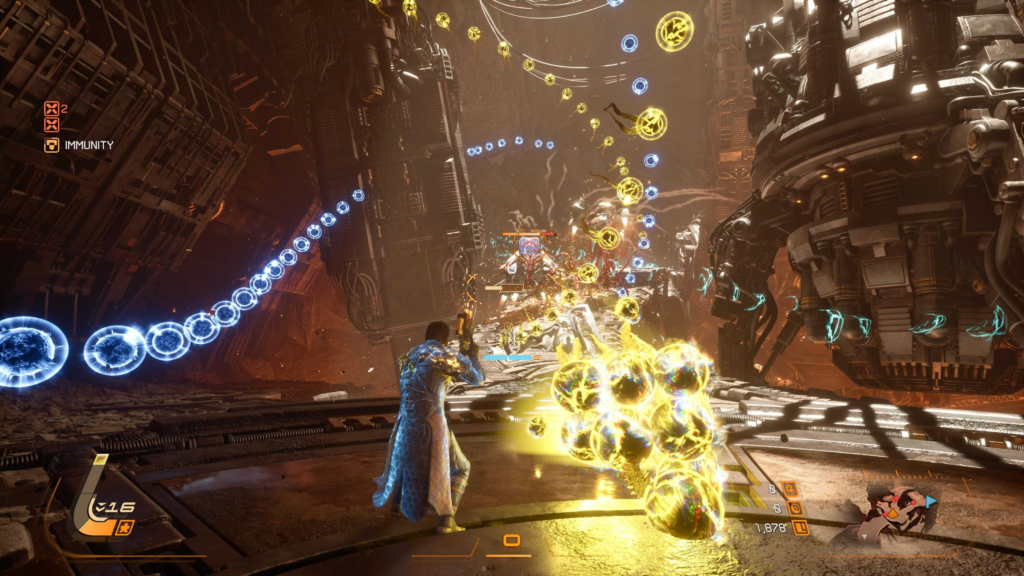
I love a new gun as much as the next person, but grabbing them was often undercut by wanting to fully explore previous areas, and instead of that, I have a… Saw gun? Ok, no, that one is good, though the arsenal you get to equip feels lackluster compared to the previous game. I at least bounced around in that one, feeling like every gun had a place, but by midway here, I was committed to two guns that outpaced the others by a lot. Worse yet, the handgun and assault rifle, the first two guns you get, become nearly useless before you even unlock the third gun.
The cool part is that each type of gun has variants, so even within a limited selection, you have options, and I can’t imagine everybody is supposed to love every gun. This being said, and I can’t stress this enough, the gun I landed on allowed me to auto-fire homing bolts from the door of an area and wipe out half my enemies before they even got close to me. This is compared to a rifle that may get thirty bullets to clear all but one hit on an enemy before forcing a reload. Though if you can hit the action reload, you are less limited in your combat.
Other places this struggles, though, are tools like the modifier unlock after a few biomes, meaning players do need to git gud at least somewhat to circumvent the need to git gud. The most egregious of examples, though, is the parry ability that unlocks pretty far into the game. This ability is the best counter to red bullets, meaning you are disadvantaged since dodging will also see you get hit by them, which just makes progress feel disjointed at times.
While the world is beautiful to explore, it remains an interconnected series of randomly spawning spaces, it also feels like there is less variety this time around. On the one hand, this choice was made to center levels around specific objectives, such as activating the platform by activating two machines. Saros actually falls back on this a lot, which makes a game about random generation feel, unfortunately, procedural. This will see you hit notable checkpoints a lot.
All this said, though, firing on all cylinders is a fun frenzy to blast your way through. When you are surrounded by enemies, pulling yourself across the area with a tether, then unloading roads as the machines leap on the platform to surround you and box you in. All hope is lost, and then one well-placed parry turns fate around. There are moments of absolute triumph to be had. Mixed in with the energy-sucking moments, you just want them to end.
Not to mention the game has one of the better uses of the DualSense controller. As somebody who loves playing on my PlayStation Portal, it equally gives the built-in DualSense on that a good showing as well. The haptic trigger gets a heavy half pull on the left side to allow for the secondary fire of each gun, which you will use a lot if you aren’t stupid. A stronger pull, and you are blasting with your power weapon to deal heavy damage and heal corrosion. This minor feature really puts you into the combat in a way I wasn’t expecting, with the added benefit of collecting everything that falls, getting dynamic rumble to punctuate the game’s collect-a-thon. Dynamic smoke or portals get a similar effect.
Verdict
Saros, like the lead protagonist Arjun, is flawed. It’s a lot of ways; it’s partially because of the team’s success. Somehow, Returnal remains largely uncopied, if at all, which is an absolute shame but means I can really only weigh this experience against its predecessor. In this vein, it falls short in plenty of ways. The moment when Selene escapes from her hell, only to be lowered into the ground and return on the other side, gives chills just thinking about it. One of the best moments in gaming. Saros really doesn’t have that moment or that feeling. What it does have is a competent return for Housemarque to the process of death and rebirth that can haunt and delight in equal measures. Personally, I think that’s enough.
Remember to follow us on Twitter, Facebook, and Bluesky to keep up to date on everything we have going on!
Reviewed For PlayStation 5
Developer: Housemarque
Publisher: Sony Interactive Entertainment
Release Date: April 30, 2026
Pros:
+Georgeous H.G. Giger inspirted world with beautiful setpieces
+creepy and atmospheric music
+Fast paced, frantic combat
+Deeper story than predecessor, but still light
+Supporting cast
+Usage of Duaslsense controller
Cons:
-Arjun not the most compelling lead
-Can feel frustratingly cheep and long
-leveling menu poorly thought out
-gun selection lackluster, with upgrades feeling frustrating to aquire
-
Saros
