

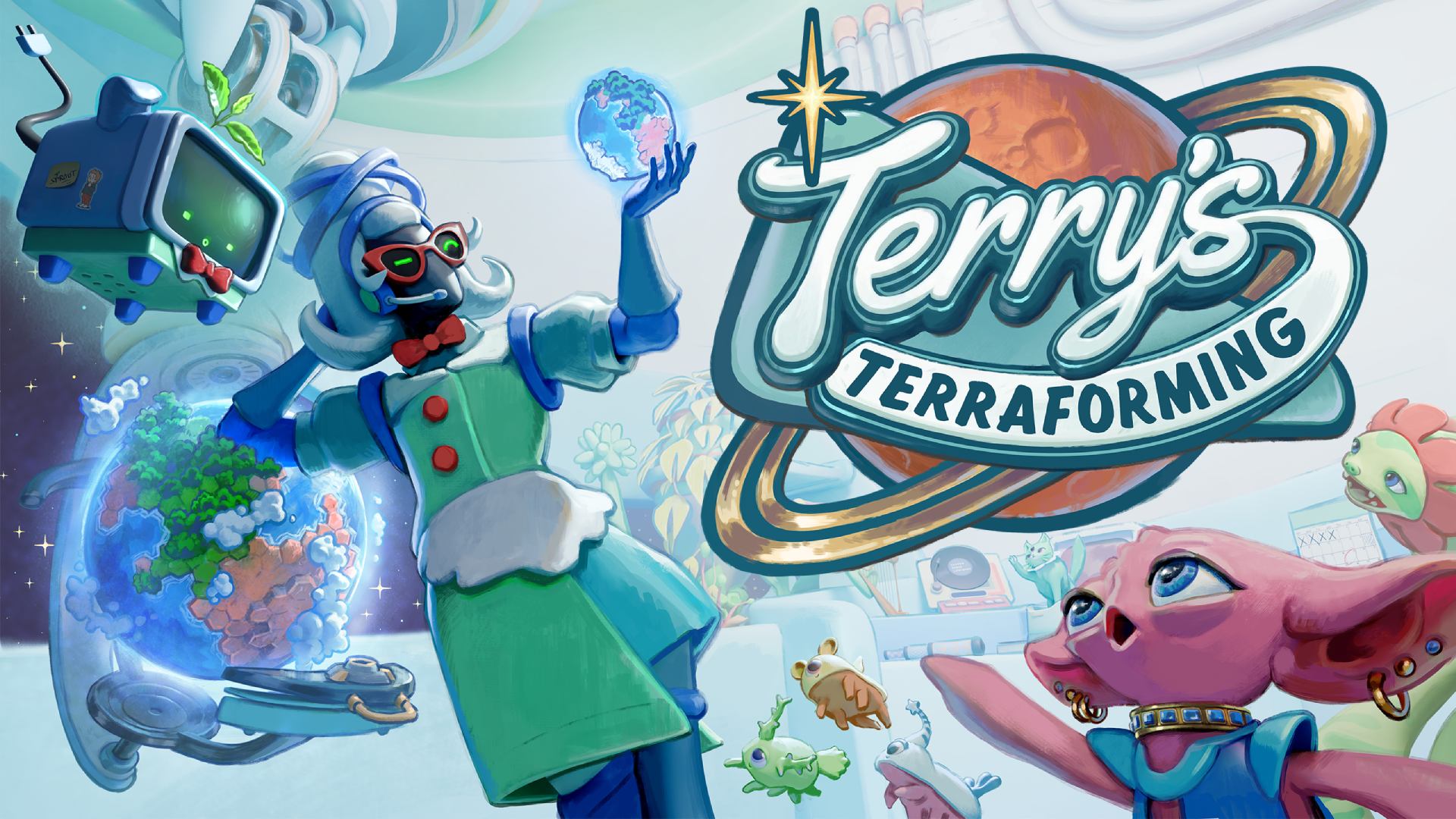
Terry’s Terraforming is a VR adventure that combines a deeply satisfying planet terraforming system with smart educational elements.
Science is such an astounding field. It has given us electricity, satellites, the Internet. Manipulating materials to our will with impressive results, it is no wonder some people dedicate their lives to this natural study. Yet, others go on about their lives, never even wondering how it is that with a simple flick of a switch we get light. As much a relaxing adventure as an educational tool to spark curiosity, Terry’s Terraforming is an insightful experience. Taking advantage of virtual reality to the fullest, it aims to reignite that passion for nature most of us have as kids. Who knows, maybe it even drives you to fight back against climate change.

Saving The Universe
Terry’s Terraforming starts strong. Longtime VR users are usually not as surprised when a game uses the immersion mixed reality provides. But as someone who picks up his Quest 3 every couple of weeks, those tricks still are quite effective on me. Not to mention that they make me fall in love with the medium all over again. But I digress.
Using the camera to show your literal surroundings, in my case the living room, a sentient old computer monitor appears floating to invite you to form part of the company Terry’s Terraforming. After signing a contract with it, a laser cuts your roof and literally sucks you up into the stratosphere. Reaching the space station where the game unfolds, it is as mindblowing as it sounds seeing it with your own eyes. A striking futuristic 60s iconography that details the colorful station and its inhabitants, you would not be remiss to think about The Jetsons for a moment.
Time To Get Your Hands Dirty
After a brief introduction to your new job, you are given a type of disket to now enter the nitty-gritty of the game: the terraforming. To be more precise, the simulation of how to terraform a planet successfully. It turns out that there are plenty of aliens who have consumed their planet and are now asking for Terry’s Terraforming to help them level their ecosystems to habitable levels once again. Now it’s time to get to work.
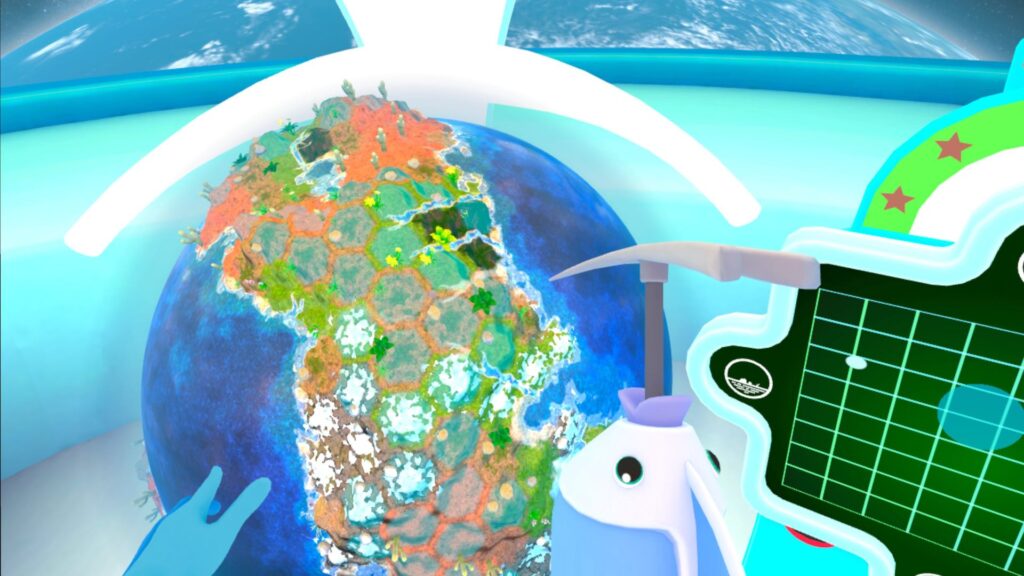
Your workspace is clean. Showing a sprawling view to outer space, your big monitor friend gives you a tiny marble of a planet’s landscape to simulate right in front of you. With the aid of a myriad tools, it slowly builds up to unlocking its more than 10 different tools.
From a heat laser to melt the planet’s poles to another to trigger volcanoes and create more land with the click of a button, they all have their purpose. In a graph to your right-hand side, there is an area that is called the Sweet Spot, which you must arrive at by terraforming to the aliens’ needs. Either by making it warmer, colder, more barren or forested, it is easy to get lost in each of the many requests as the story progresses.
But Wait, There’s More
Some may argue that this gameplay could be made into a mouse and keyboard setting, and sure, it could, but it could lose the illusion of physically being there. Sitting down in your workstation, overlooking Earth and the stars while your robot friend tries to crack a silly joke. Not only is every tool particularly made to engage in a physical manner—either by rotating it, clicking on it, or pointing at a specific spot—it feels like a true hands-on experience. Likewise, it is relaxing figuring out how to get to the place on the chart that the game requires.
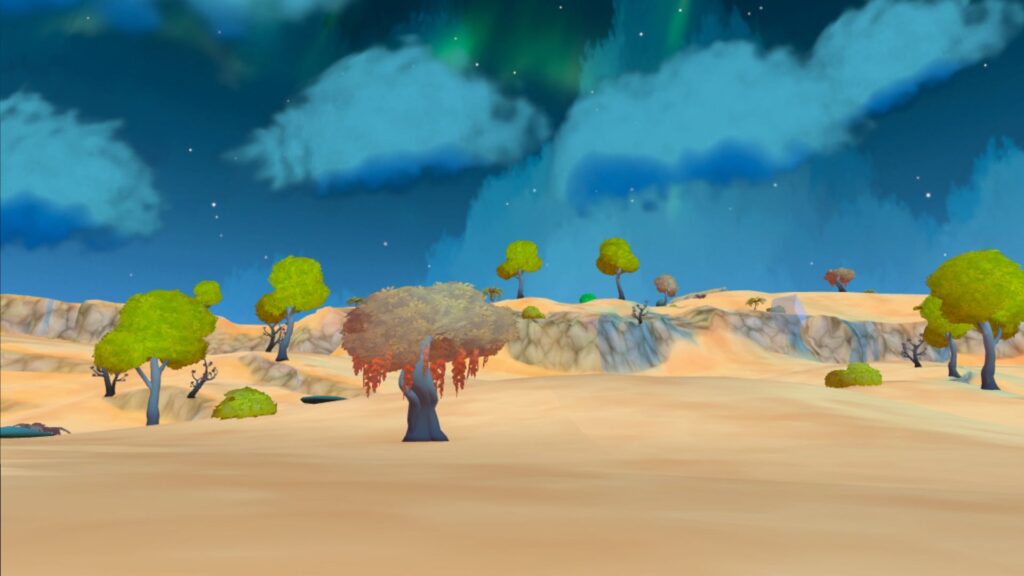
The cherry on top from all these chaotic tools is one more inclined to inspire awe. Dubbed the “Sweet View,” this probe launcher teleports you directly into the planet that you are so ineffably rearranging. With the sole purpose to take pictures and explore your surroundings, it is a brief but effective change in perspective. The always curious electronic music sounds in the background while you look up to an aurora borealis; it makes for an emotional moment that elevates one’s love for nature.
Watercooler Chatter
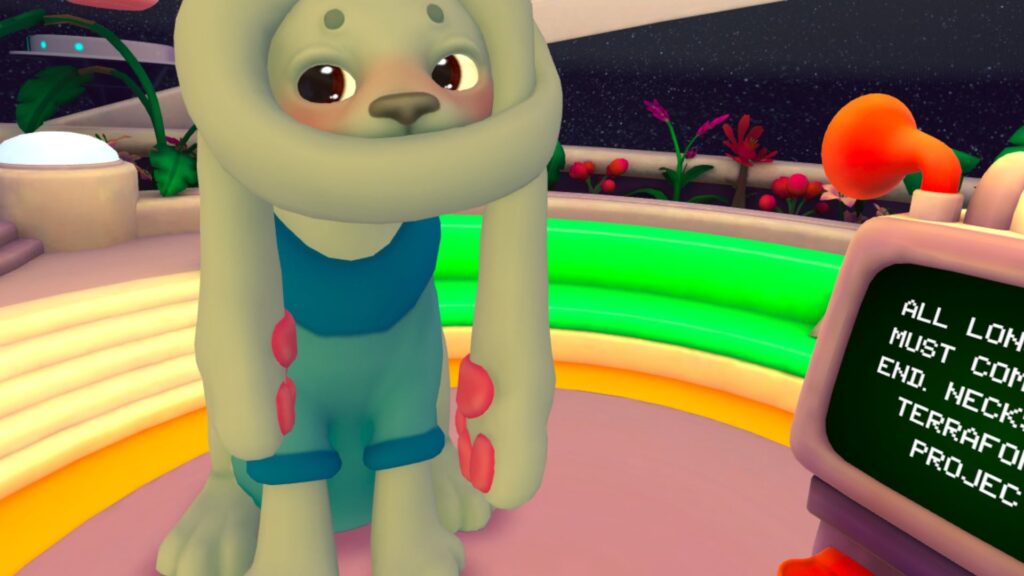
In between jobs, there are small workplace interactions that expand on the game’s lore. Occasionally you will have to talk to aliens yourself—because everyone else in customer service was fired—to assuage their concerns. With four areas in-game to explore, each is designed thoughtfully: the lobby, your workspace, an observation deck, and a C-suite (full of what I can only assume are the developers’ cats).
If the subtext was not clear enough, you’ll see in the -floor lounge a billboard with the ad “Earth! It is Worth Saving!” And you know what? It is. I, for one, am glad that this spirited message is declared so openly.
To wrap up Terry’s Terraforming in a neat package, there is a challenge mode once the 5+ hour narrative is done. To incentivize replayability, a tailored daily challenge with different types of terraforming requests has to be met. Offering every tool at your disposal, these increase the complexity to the point of making you want to sit down and take your time with them.
If you really click with this gameplay, dozens of other challenges are also available. And for the creative minds who would like to throw their hat in the ring, you can create your own challenge for others to play. This ensures its clever terraforming gameplay lives a long life.
Verdict: Terry’s Terraforming
For a moment, it occurred to me how Terry’s Terraforming could be used to spark curiosity towards the natural world while playing. See, the brief advice the robot gives could be self-explanatory, but it sometimes verges on cautionary. “If you melt the poles too much, the land will be flooded,” you are reminded as a laser razes the entire south pole of an alien’s barren wasteland.
It is difficult to not think about the real-life ramifications that this tool has on our world. It is told in such a gentle way that just as the tools you use are helpful to terraform, so does this game might help young audiences learn about climate change and ecosystems at large.
Through a relaxing gameplay experience firmly rooted in science, Terry’s Terraforming poses itself as the best of both worlds. An appealing narrative as more tools to terraform at your own pace are unlocked, hours may go by as you shape and destroy planets to your heart’s content. And if that isn’t enough, an abundance of challenge levels are ready to satisfy your desire to play god. In the end, it serves as a powerful reminder of the fragility of nature, our ability to mold it and the responsibility that comes with it. No other game that I have played this year synthesizes these ideas so deftly.
