
Warhammer 40,000 is a weird franchise when it comes to gaming. Logistically, the series has a multitude of games released every year, and despite varying in style, gameplay, and concept, they typically hit. This is even more shocking, at least for me, given the franchise’s oppressive authoritarian themes that usually lend to you playing a character you would probably hate in real life, rooting for them to kill other characters with equally bad morals because they aren’t you. Maybe that’s why it works so well, you start to see the appeal, and you don’t realise it. This is all contingent on you having fun; however, that is why you overlook how the universe is just sadness and evil all the time. It takes a game like Warhammer 40,000: Mechanius II to remind you of that.
Even by Warhammer 40,000 standards, the characters are wholly unlikable, starting with the fact that they are pretty generic. The game is divided into two campaigns that you unlock after you beat a brief prologue, where the two heads of the factions talk dirty to each other and attempt to kill each other. After this, the factions are the Adeptus Mechanicus, which is a group of tech priests, and the Necrons, which are an ancient race of hyper machines. If you have some familiarity with Warhammer 40,000, you should have at least a passing familiarity with both.
Regardless, all the characters quickly blend. Take, for instance, the Adeptus, which has 5 main leaders you can choose to lead your group through levels, who all look… Just… So similar. With different moves, you might want to make sure you pick the right one, and I absolutely did not do that multiple times. This is compounded by the fact that every single character, even the human-looking ones, sounded like they ran their voice through a filter. That gritty mechanical noise as they speak about nothing, since their situational goal might change, but their ultimate motivation is stagnant. It wears thin quicker than quick, almost instantaneous. I know that’s the filter most machines use in other titles, but it’s not every single person.
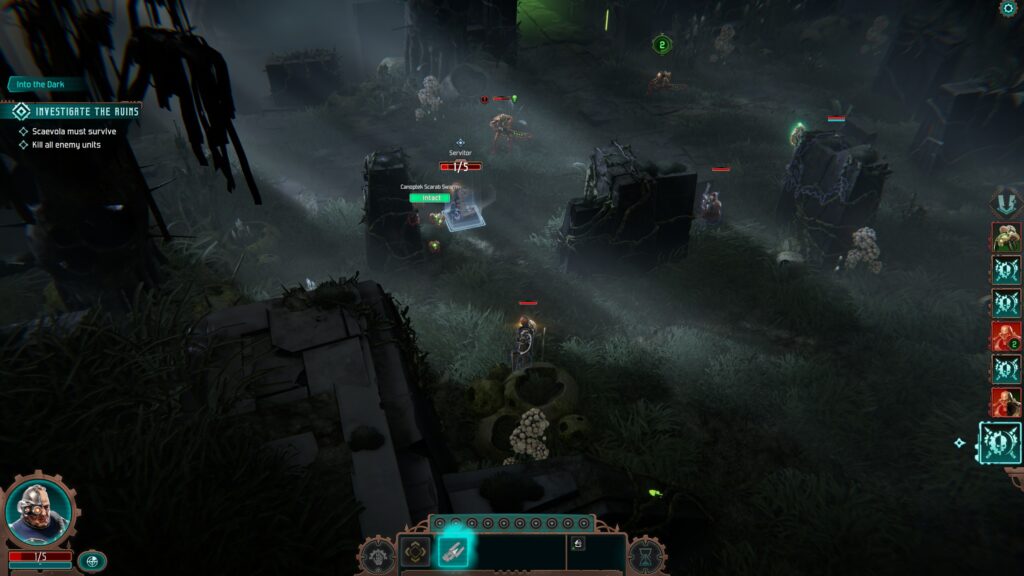
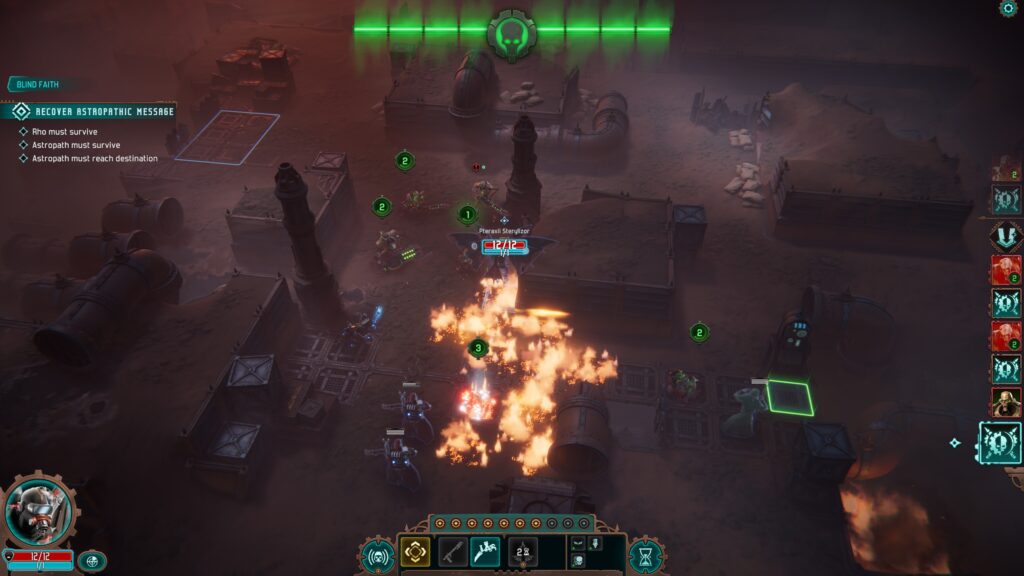
The game itself is a turn-based tactical experience. The player has a group of fodder units and a leader that they send into battle against enemies. In fairness, the arena design can be creative, as you often have to move your units around obstacles or to find cover as you fight enemies. Leader units have shields that recharge each round, making them much harder to defeat unless you can press them fully. Leaders on both sides are typically the main obstacle, as you lose if your leader dies or if you defeat the enemy leader.
Both units, for what it is worth, do play differently and have some switches to gameplay that make them less cumbersome to switch between campaigns. You can level up your units’ abilities, your leader, and unlock new troops through slightly varying mechanics that bring a different feeling to progress. One of the bigger switches between both units’ combat, besides the Necron being more aggressive in how they push enemies, is that they also have a revive mechanism that acts as a challenge in the Adeptus campaign, but a benefit in the Necron one.
Leaders can also be levelled up so that they gain more abilities, with most abilities being accessible in a single turn, using cooldowns on the higher-tier abilities to prevent overuse. The game itself is most comparable to X-Com in that it has a punishing sense of challenge to it. Your units can hurt each other, which can become annoying mostly when units swarm each other. Characters also get a free proximity hit if you try to leave their radius, which becomes fairly annoying if you have a ranged character, as, by virtue of this happening, they are locked in a situation where they can’t attack but can’t move.
You would actually be shocked at the number of situations you might end up in where a character is locked, and your party really can’t attack to rescue them. This is because, in some cases, your unit blocks the attack by existing, or the level layout just makes it impossible to move to a space with available range. Enemies can withstand and punish a lot, so even if you can, there is no guarantee your counter will make much difference. Each turn moves the cursor to a unit, but as long as your party member hasn’t gone, you can switch and move them. There are still a lot of cases where you are put in a situation of do you let them kill you or force them to turn to kill you.
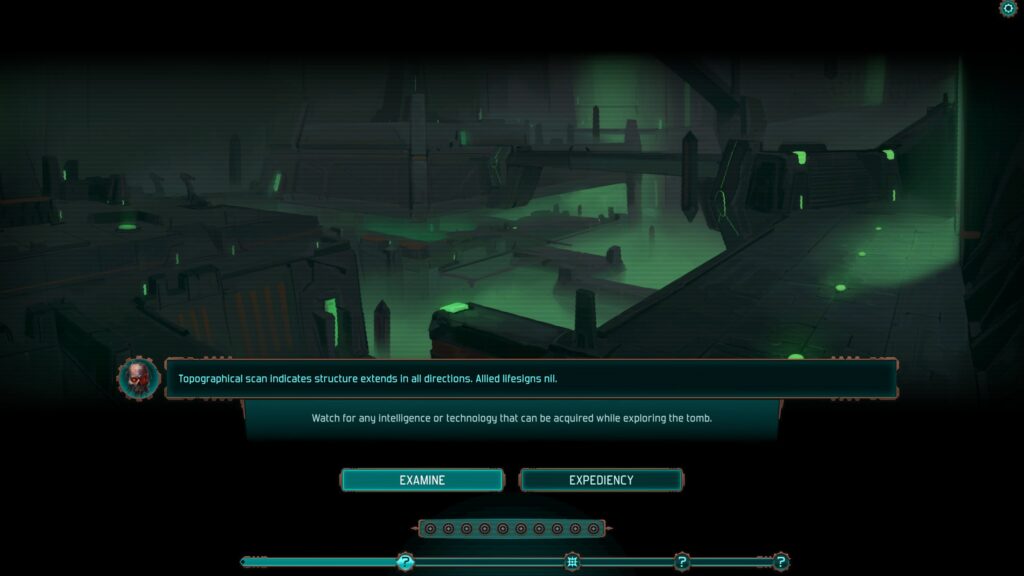
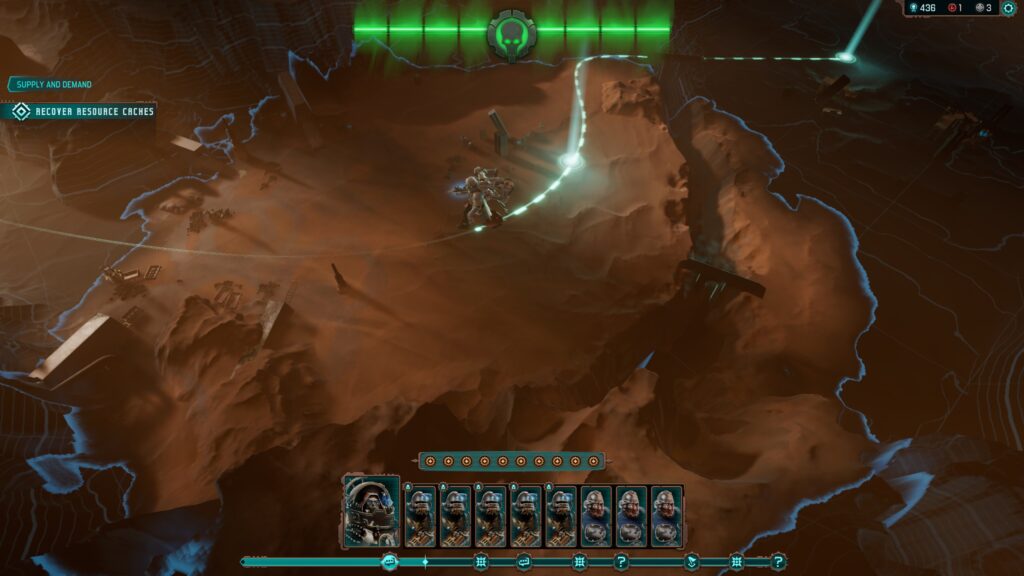
The way the combat is all structured is around a linear campaign that showcases your Leader running along a set path. There is a world map that allows you to select your location, and you often have a choice between a few missions to undergo. On this path, you are given choices on how to handle situations that can give you benefits or punishment, as well as the ability to recruit more units to your side. Every so often, they then throw a battle at you. Usually, you end up in two or three battles you need to get through, with each area ending specifically in a battle.
Your units all keep the damage they accrued, meaning that logistically, you have to survive multiple battles with a set number of allies to deploy. Even though battles only allow a set number to be deployed at the start, you will have more on hand, and you will get a reinforcement round. Enemies will always outpace this, and the difficulty spikes of dealing with this can be obnoxious. Depending on who you play, you might have access to healing, but never in a meaningful way to outpace the fact that enemies will almost always be in a position to hurt you. If a unit dies, they are lost forever, so you will suffer injury and lose as each fight stays at the same level of combat.
All of this might be manageable if it weren’t so boring. Turn-Based rounds can range, but typically mine were in the 30-45 minute time elapsed mark. Movement can be slow and cumbersome, and with the threat against you, not fully engaging is rewarded more than anything. Even as you unlock more units and abilities, nothing feels like it evolves much out of the formula established in the prologue, with basic unit abilities dictating even how your unlocked abilities are used.
This is made worse when a level adds a criterion for completion beyond just your Leader surviving. Stages when you need to move to a certain spot, at least for me, typically ended with the need to waste two or three turns moving across the battlefield to the marked location. What’s worse is that there are a few escort missions which are frustrating on a good day, but for the worse in a game spawning reinforcements from every angle every turn or two. These drag down an already annoying turn-based system into something unpalatable.
Verdicts
Warhammer 40,000: Mechanius II might have been more enjoyable; nothing in it is inherently bad, if it weren’t also a boring experience. There are so many franchises in the Warhammer universe to stack it against where it falls considerably short, but even more turn-based tactical games that it just fails to live up to. Personally, I typically love to get lost in a Warhammer game, which is why it’s a shame this one didn’t resonate with me at all. Furthermore, if I had to listen to those filters for another flipping second, I might genuinely lose it.
Remember to follow us on Twitter, Facebook, and Bluesky to keep up to date on everything we have going on!
Reviewed on PC, also available on PlayStation 5 and Xbox Series
*A code was provided by Kasedo Games for the purposes of this review
Developer: Bulwark Studios
Publisher Kasedo Games
Release Date: May 21, 2026
Pros:
+Some interesting stage designs
+Unlockable units off some diversity.
+Choices made during progression are interesting
Con:
-Extremely unlikable and one note characters with annoying vocal filters.
-Boring tactical turn based mechanics.
-leaders that blend together
-extremely punishing, and rarely fun in the process.
-Stages with added objects
-
Warhammer 40,000: Mechanicus II
