
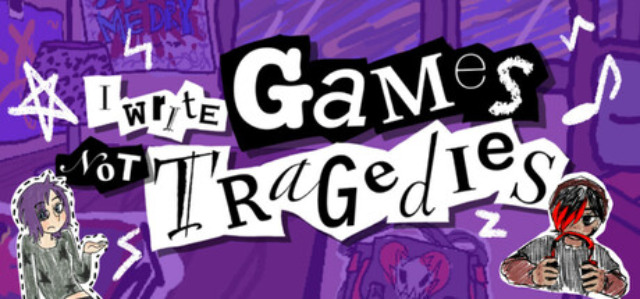
I Write Games Not Tragedies is a stylistic victory that struggles with the weight of its story.
We’re leading with the content warning on this one, as the review itself will also discuss some of these topics.
Content Warning
Per the game’s Steam page:
“I Write Games Not Tragedies,” explores alcohol abuse and mental health struggles as key narrative themes. If you have a sensitivity to these topics, we recommend that you play with care.
The game also contains references to tobacco, self-harm, and casual sex.
I’ve been struggling to write this review in a way that pays due regard to the really intelligent bits of writing and the total stylistic victory of I Write Games Not Tragedies, but also earnestly conveys what I feel to be its shortcomings. I think the rest will be easier if I just lay out here at the top. It’s a visual and aural masterpiece. It also invokes alcohol addiction in a way that feels intelligent but deeply insufficient.
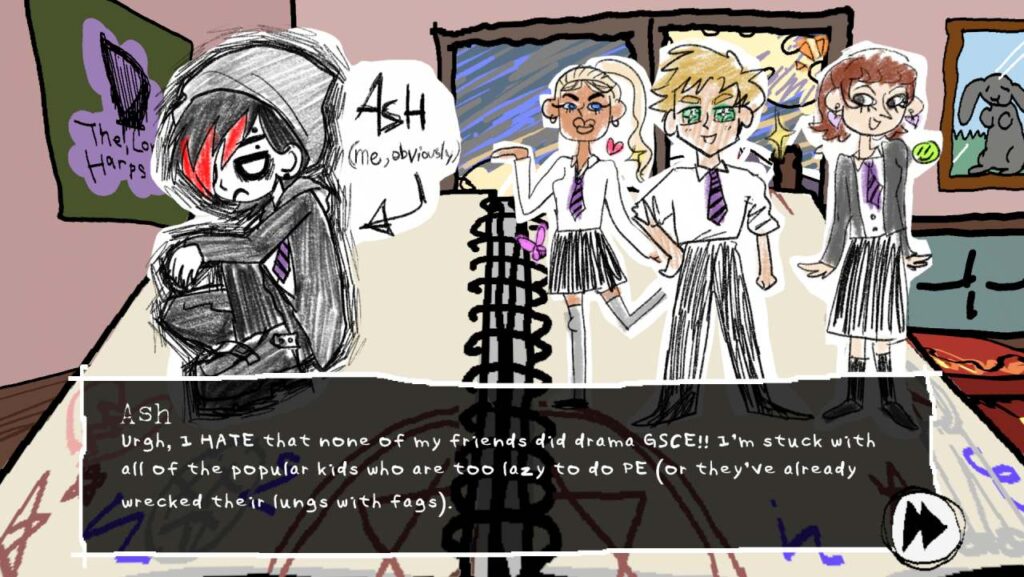
You play as Ash, a young emo trying to figure out his sexuality and how much his tastes and subculture define him while battling addiction. I will touch on some story elements while trying not to get too in-depth. The narrative is absolutely integral to the experience, so I don’t want to say overmuch. But please understand that there are so many really smart little touches in the writing that I just don’t want to spoil. Take my word for it – the dialogue and many of the choices absolutely rule.
With regard to the addiction angle, I do really love how the use of alcohol starts small and is initiated by a different character. I love how Ash compares himself to others to justify what he’s doing. I like how there are times where every dialogue option you can choose just sucks, is just an absolutely shitty thing to say, but you can’t help it (and Ash even acknowledges this). It reminds me a bit of the perennially relevant Depression Quest.
I remember very distinctly a time I was hanging out with two friends playing the Arkham Horror board game (2nd edition). We were already having beers, but one guy kept really obviously sneaking into the kitchen to take extra shots. It’s not 1 to 1, but there is a scene that reminded me of this episode from my own life. It’s poignant, and kind of bittersweet, to see some of my own experiences reflected in the game. But the realism also leads to my disappointment. I think it’s too easy.
Ash mournfully reflects on how he loses years of his life to addiction, then more finally fighting out of that addiction. I think after invoking alcoholism and weaving it so thoroughly into the life of the character and his friends: we need to see it. It is not enough to mention the hard, tedious, and lonely work of sobriety. I need to see some version of it fought for in the text of the game itself. We’re already jumping around time periods. I want one more chapter that details Ash fighting for himself in this way. We get one chapter where he is a young adult and you can see how lonely and depressed he is. I want to see a chapter where he is a couple years removed from that – STILL LONELY AND DEPRESSED – but slowly turning things around.
I lived a very small percentage of my life as an alcoholic. That’s well and completely behind me. But I’ve lived my entire life under the fallout of my father’s alcoholism. That will not and cannot ever go away. What’s there is well written. The game makes it clear Ash is not a villain for having an addiction, but he is measurably ruining things for other people and those feelings and that trauma in others doesn’t disappear when someone gets better (if they get better). So I just can’t be fully satisfied with how the final scenes of the game play out. I don’t mind a bittersweet ending. I don’t mind a happy ending. But I just can’t shake the feeling that it’s only half-earned. I need to see the work.
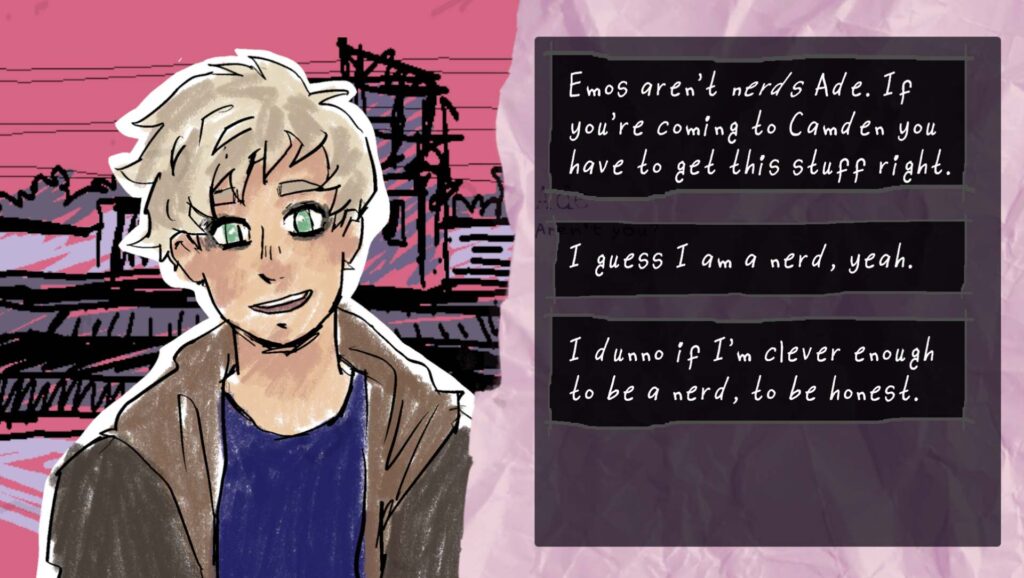
I love the style of I Write Games Not Tragedies. The visual presentation evolves through different time periods and moods. Some scenes are pulled straight out of your journal with bouncy, animated caricatures and text. Introducing Ash by literally reading his journal together and seeing his artistic expression was an amazing way to start the game. Later on when a scene is comparatively flat – you take notice. There’s also a scene where the background looks like the notebook paper was crumpled then flattened back out. Just a really sharp touch that literally illustrates the permanent damage of addiction.
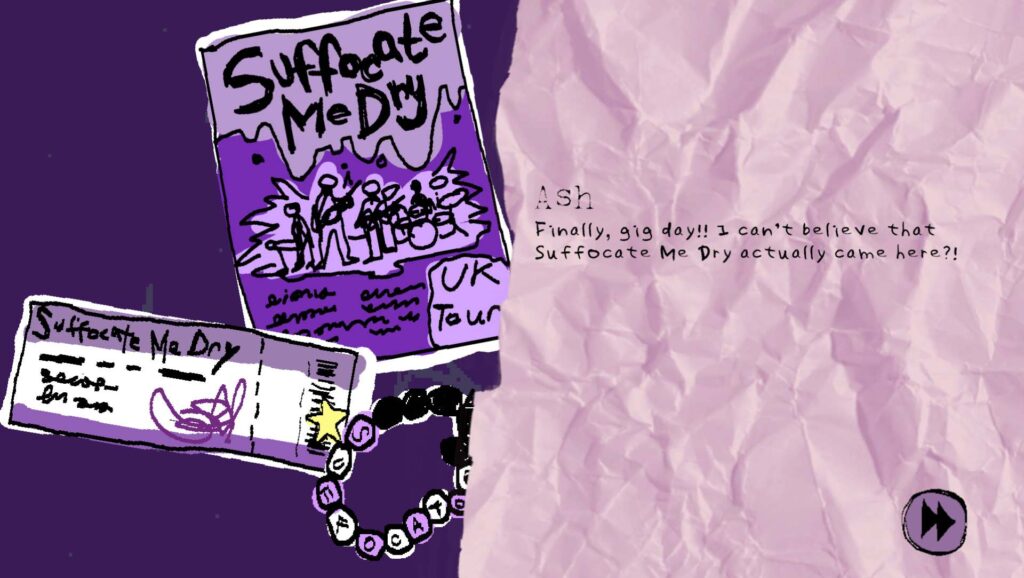
The music selections are excellent. There are a couple of times where a song will play during the regular scenes and I would just sit and listen to it. It recalled the idea of sense memory and all the weird little parts of my youth I remember because of a specific song or album. In a game made by emos about emos, there is one big normie surprise that also really works. This is more of a writing touch than a music one, but it’s so perfect that you see the band you love at a tiny club the first time and a huge music festival (way in the back) at the end of the story.
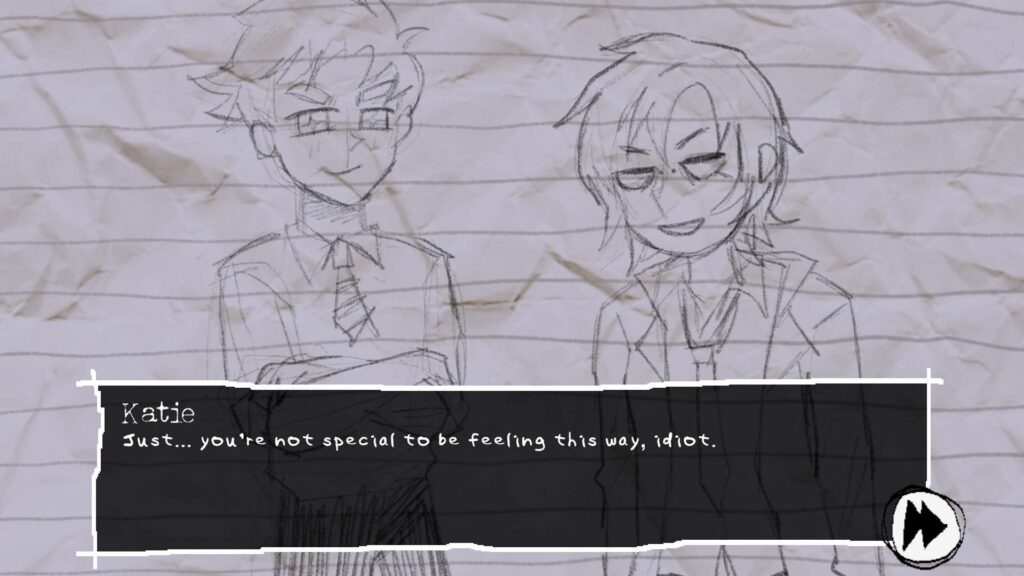
I also like the framing of the interactive music sections, but I don’t think they’re super well implemented. In a simplified sense – it’s Guitar Hero but the notes you need to hit are the lyrics themselves. The idea is really cool, but I found myself either having to focus on getting a good score or really listening to and absorbing the song. I was not really able to do both at once. It’s an interesting hook, but I think it’s better as a moment in the trailer than as something you actually do. I would have preferred to see them as non-interactive bits that trust the player to just pay attention. Outside of the Steam achievement list – it doesn’t matter at all what score you get on these sections.
I did find it interesting that the lowest score you can get in the music sections only generates a C ranking. Honestly it felt a little on the nose. There are consequences to Ash’s actions in his life, but not any consequences in the gameplay. The absolute nastiest things you can do or say on purpose amount to essentially nothing in terms of how the story resolves itself. I don’t “want” to see a bad ending exactly, but the lack of one kind of removed some weight from them.
Accessibility
The game offers the ability to “scream” during the song sections by mashing the spacebar instead of actually vocalizing into the microphone.
The game uses many “wiggly” fonts and hand-written style types, which could be difficult to read for certain players. There is no option to change these.
Verdict
I Write Games Not Tragedies is great as a stylish time capsule. It offers a reasonably nuanced look at the intersection of self-discovery, societal expectations (both real and imagined) and alcoholism – though, in my opinion, it doesn’t fully deliver on that one. But what is there will resonate with many players.
Look at the screenshots, watch a trailer, and maybe try the demo.
Reviewed on Steam.
Developer: Studio Wife
Publisher: Yotsuba Interactive
Release Date: Out now
Pros
- Absolutely amazing soundtrack
-Different visual styles contrast the phases of Ash’s life
Cons
- Do the music levels matter?
- Skips the hard work of sobriety
A Steam key was provided for this review as part of the Fall In Love Visual Novel Festival
-
Good
