
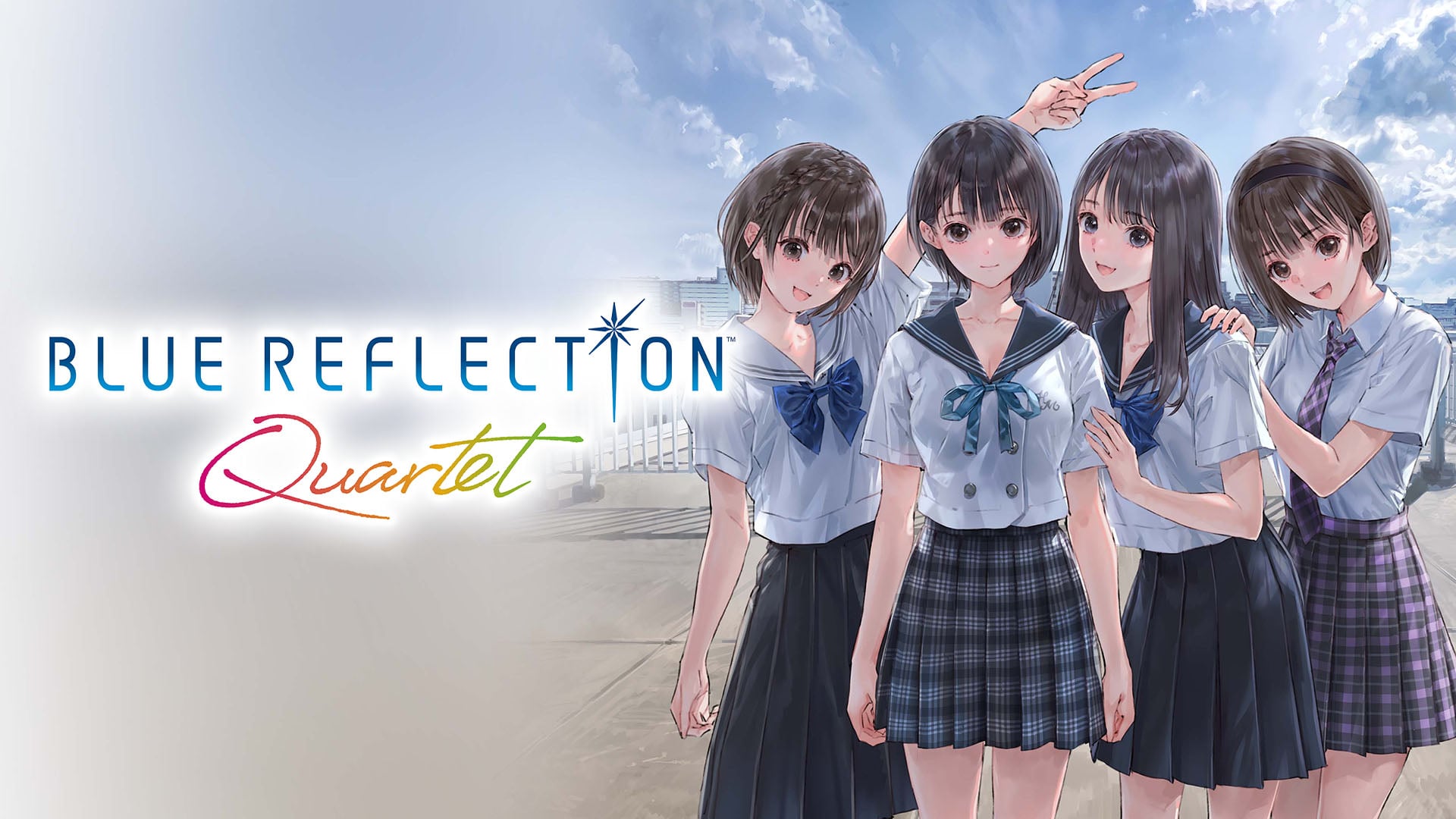
Blue Reflection Quartet is a weird collection of games, if we are being honest. Last year I also reviewed the Ryza DX trilogy, which is probably the developer Gust’s claim to fame, with the Atelier series being the series that they are known for in general. Blue Reflection is an enjoyable other franchise that never reached the same audience, which is a shame, but before Quartet, it wasn’t a quartet like Ryza was a trilogy. Up until this point, and much more accurately in the West, there were two games in the series: the 2017 original and a follow-up from 2021 subtitled Second Light. That was it.
Two of the games that make up this collection really didn’t exist. There is a for-better-or-worse element to this, as it’s impressive that both experiences clearly had genuine work put into them. In the case of Sun, this was a Japan-only mobile game rebuilt like one of the core games. Its gameplay is on par with that as a standalone experience. Square Enix keeps getting heaps of praise for doing this with games like the upcoming Final Fantasy Resonance, so it feels fair to do that here. That issue becomes that both of these experiences are sandwiched in between the main two games, which, if a player has familiarity with the series, are the two they would know.
For the uninitiated, Blue Reflection is a weird series both in its inspirations and its narratives. The simplest description would be to call it a Magical Girl RPG game since that’s literally what it is. The franchise follows a multitude of schoolgirls throughout the full game, with none featuring as the protagonist more than once. In Sun’s case, the choice was made to let you play as a male character for… some reason… The game also has the only outlier to the main premise of these characters getting rings that allow them to transform (yes, they get a transform animation) into heroes that fight against forces hoping to doom the world.
It’s not graphically violent, but I would still lead players to look less at Sailor Moon and more at Madoka Magica. This is partially because the monsters they are fighting against, mainly the big bads, can border on horrific, but also because the title makes a conscious choice to explore broken characters. The first game in the series, in particular, uses a slice-of-life formula to do this, with chapters often feeling standalone, which I very much liked. The game has drawn comparisons to Persona for its school life formula, but honestly, it is wholly different; it has a structure that reminded me a lot of Resonance of Fate, which never gets enough love. Same with Blue Reflection.
Of course it would make sense that the franchise would build past this later on. That was the first game after all. Blue Reflection: Second Light is set with the characters trapped in a school in an alternate reality of sorts, which is a series soft spot for me. Even with the slice-of-life elements, you feel the overarching plot much more vividly. The collection of games also cleanly outlines which game feeds into the next and what order you should play the whole thing in for the most cohesion. Since the plots don’t directly bleed into each other, you can kind of get away with starting where you want. There is no point, though, given you know you have the complete series in order.
Some characters will overlap between them, but Blue Reflection: Ray, even with some context, I found to be slightly confusing regardless. It’s odd in the placement, I assume, because its lead characters cross over with Sun with little context, which is why it is placed before that in the order; however, it serves as a build-up to the Second Light, so it feels early overall. This is also the shortest game in the collection, clocking in at around an hour.
It might not be accurate to even call it a game, as it serves as a recap of the Anime based on the series released in 2021. You play as the two leads from the anime, with some minor traversal elements but mostly with them heading to the next bullet point that unlocks cutscene stills from the Anime with narration. As such, the game actually starts right after this, then has traversal and minor gameplay to allow for this. If this game was its own thing, or some 10-dollar purchase, I probably would have been let down. All three other experiences are fairly long, though, and it’s part of a collection, so it’s hard to be too upset. Senran Kaguya (I shudder to invoke that long-forgotten name) used to have entire chapters that served no purpose other than to sell their Anime, but this at least gives some explanation. The anime is also available through Crunchyroll, and I definitely plan to watch it, so that feels like a win.
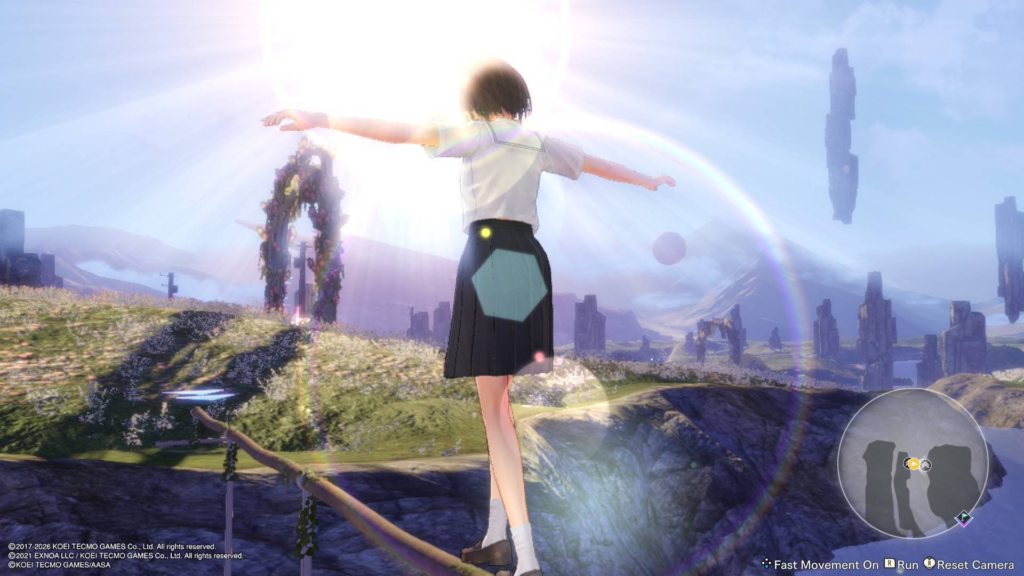
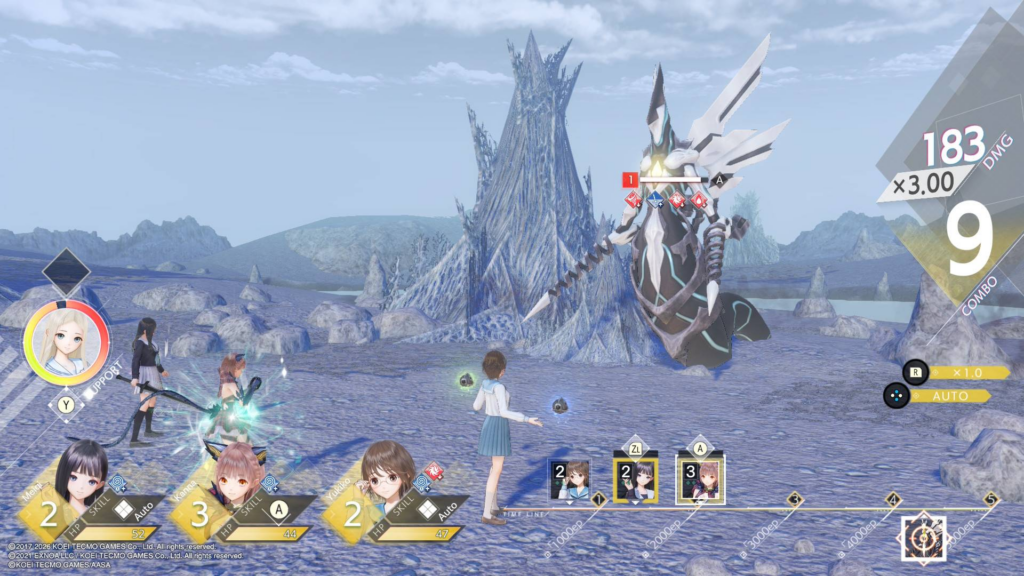
The rest of the games in the collection all feature traditional RPG mechanics. The characters line up and have a quick time gauge that the turns move along. The first game in the series acts as an outlier to the others, with a very weird system to master, or at least try to. While you do level up in this game, it’s not through combat, which can make this one the most frustrating. Levels are gained by completing tasks, but these tasks often involve entering the alternative world, fighting monsters, or grabbing items. These can be tight areas, so it is impossible really to avoid copious amounts of combat that offer a bare minimum reward. Typically, you can earn 1 or 2 levels in a cycle of the game, which unfortunately also forces bland, grindy sidequests on you, with the reward being a valuable power increase at the tale’s end.
What the game attempts to do is push a crafting system on the player to justify fighting multiple enemies that don’t ultimately offer a key reward. This system is useful, as a major element of the game is grabbing fragments you attach to skills so they now get additional benefits, with one of the things you can craft being upgrades for these. It’s a robust system, but abilities will unlock fast, and so will fragments, creating a system that feels pointless to go in with. Find the skill you like, then buff the hell out of it; ignore everything else. The combat does not remain from fight to fight; you recover everything, which is a system I have been growing to like more and more the older I get. The point being, you can spam your favorite abilities with little repercussion.
Where the first game genuinely succeeded is the story, which was before Life is Strange: True Colors did so. The lead character, Hinako, transfers to a new school, the Hoshinomiya Girls High School. At first, she suffers from a deep sadness stemming from the fact that she had to give up ballet due to a knee injury. To be clear, the game never fully makes clear, at least not to me, if this is a school for gifted students, though some classes are, and you definitely have to help plenty of prodigies. Once she becomes a magical girl, the story mostly deals with a classmate going crazy with emotion and the trio of heroes needing to go inside the common, a connected world built by people’s emotions, to save them.
The common is represented by characters glowing with a certain color based on their emotions, which will also dictate the landscape of the area. These areas will be small and looping, with a very basic task of exploring and finding something to help them. While there are only three playable party members, many of these people become assists that can be used against the bigger bad cosmic horrors set to arrive. It is weird because there is a Persona 3 style to this, as the characters establish that they know they will arrive, but since there is no real-time system, the player doesn’t really get the same insight. Multiple chapters can pass between them.
Everything is building up to these moments, which is why it’s super important to get levels where you can, leading to bloat-inducing grind. These things are freaky, though, like death incarnate that would look more at home in something like Saros. Even the standard enemies feel cleaner and more simplistic compared to, say, the demon tank you fight on the school soccer field. These big bads aren’t hard per se, but they require more focus on attack choice than everything else, putting what you have learned to the test. While I never fully struggled, there are points when you feel on the receiving end. It can be frustrating to feel limited in how you can meaningfully improve to counter said issues.
One constant throughout the series that is established with this entry is the clean simplicity and tranquility every entry invokes. There is a lot of brightness and darkness, but not an emphasis on color beyond this in the main world. It’s hard to describe, in all honesty, how jumping from the rooftop on a cloudy day to a meadow with bright greens on the ground and a clear blue sky feels. It is strangely nostalgic, to something even before I had played this game originally. Not only that, but it feels like an anime from my yesteryears that I can’t remember the name of.
Accompanying all this is a beautiful soundtrack from Hayato Asano that is part orchestral and part synthetic, with a heavy focus on both piano and violins. This leads to combat moments that have a sort of sadness to them and fields that have a somber tone. School life itself feels tranquil, which is one of the greatest strengths of Blue Reflection. All the games have this sort of inner peace brought from the soundtrack that juxtaposes with dark narrative tones, or even the more mundane parts of life, like taking your classmates on dates (it’s a 2017 game, and they are all girls; don’t read too much into their choice of terminology).
I feel it’s more prudent to move the discussion from this to Blue Reflection: Second Light next, as the two have the most in common. Again, these are the two games in the main series after all, so they have the most in common. The story this time sees the character of Ao get swept away to a school somewhere in a world that, and I mean this genuinely, might be the best attempt at replicating Digimon that there is. It’s a bizarro glitch world where the characters make do living in the school and fending for themselves.
This story is equally as enjoyable as the first game, though it might be better for some players, given that here we have a much tighter overarching plot. For me, it never reaches the depth of emotion from the first Blue Reflection, but pretty much everything else is a vast improvement. In this case, you will want to play the games in order because it might be harder to go back.
One big issue I had with the original was its fixed camera angles that made exploring long hallways in the school annoying. Bizarrely, it made finding people who are having breakdowns as you might need to fight the camera to see them. Despite being a 2017 title, it was also a Vita game, which made some JRPG PS4 games feel even more dated than they already were. The second game fixed this with a free camera for navigation.
This might also bleed into the biggest issue: that the first game still has a lot of framerate problems. I say still because I have played the original, and they were there as well. It’s one of the things Gust leaves to be desired because, similar to the Atelier DX games, this feels like a port with little done to fix the actual things that would have been a net benefit to hammer home. It becomes so much more noticeable when you factor in the work that needed to go into getting Sun and Ray ready for primetime. Thankfully, all the other experiences do not share this issue.
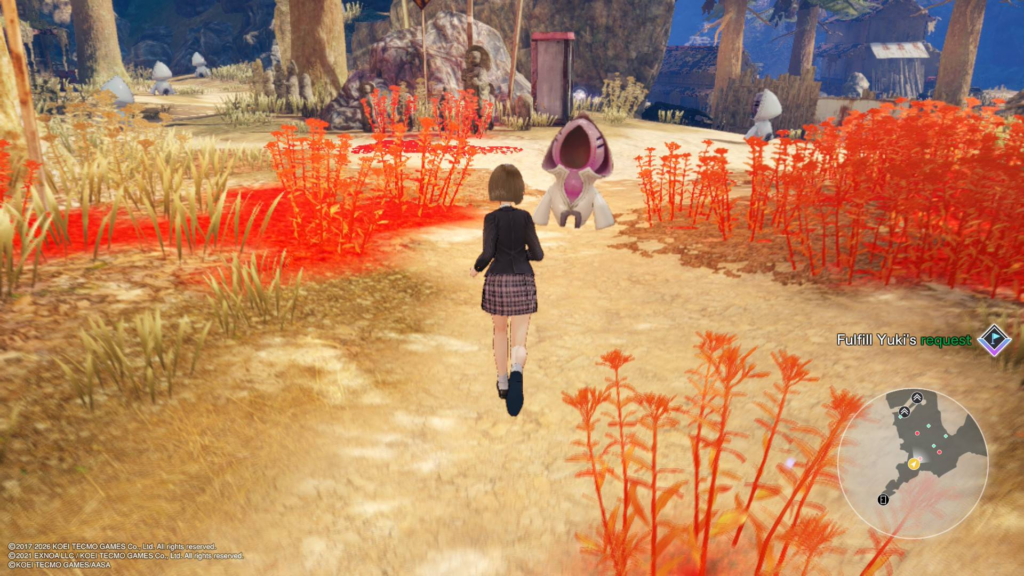
The second biggest switch is the combat system, which now, get ready for this, HAS TRADITIONAL LEVELS! Now you can still craft, getting items from killing enemies, but you also get experience for your trouble. See, you can do both! The entire combat system was overhauled as well to a more real-time system that doesn’t stop at any point. Each character has a button prompt in this, as the charge-up in the system, and while there is still a knockback system, it is less prominent than in its predecessor, in which you can milk that system.
This game is also way more open than the previous game, with areas feeding into each other with fewer loading screens. Not to mention the fields are more open with much more personality. Side quests, too, while still being fetch quests or slay certain enemy tasks, feel so much better with the drastic changes that were made over the system before. This is a serious case of taking every criticism to heart because my overall experience of Second Light left some things to be desired, but nowhere near as much as I expected.
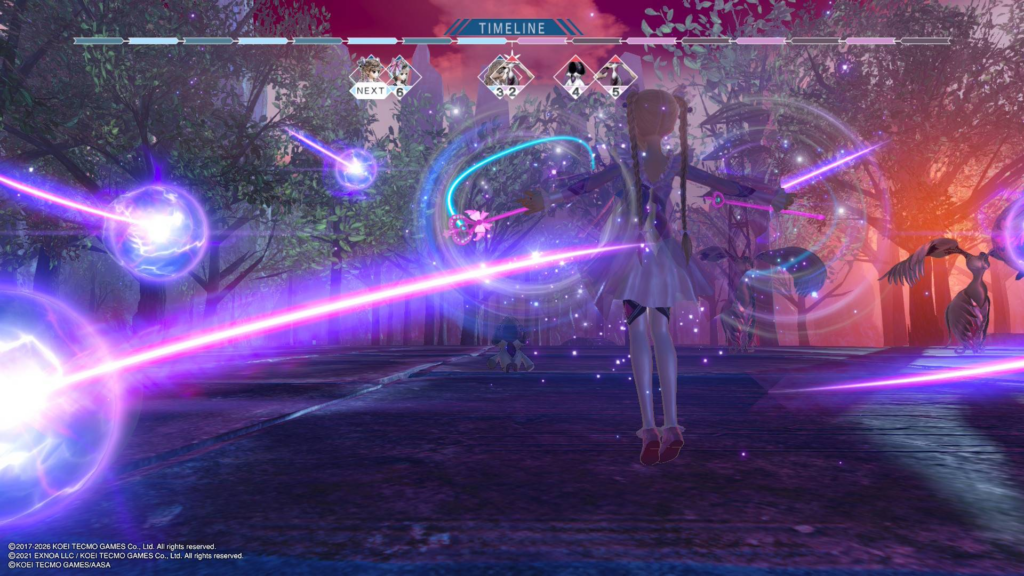
Here is the other reason we needed to discuss Blue Reflection: Second Light before Sun, at the very least. This is because both Ray and Sun are built from Second Light, literally. Through the exploration in Ray, for instance, you will encounter pretty cool dynamic traversal moments like balancing on a beam or the two leads helping each other up a ledge. Coming off the first Blue Reflection, these moments are a pretty impressive upgrade. They are a basic component of the second game, with the graphics being in line with that as well.
Blue Reflection: Sun is even more noticeable, though, starting with the fact that the game uses the school map identically. Again, while Sun was a real game, this version of Sun is not that version of Sun. That version of Sun was a mobile game that was much more limited, with a gacha mechanic for collecting. This version of Sun is a streamlined single-player take on it, with the collectible characters just unlocking as you progress. There are things to do in this map, though nowhere near as much as even the first game. This is also the only entry where you don’t play as the same type of magical girl.
Moreover, and this is important, WHY DO I HAVE TO PLAY AS THIS GENERIC GUY!? Seriously, the game has been an exploration of schoolgirls and their issues; it still is here, but I can’t play a Futaba-style support magical girl? Nope, we are assembling a group of women; bring in the generic male leader for will they, won’t they maybe be a harem. I have seen High School DxD; I know what this is. You can’t pull the wool over my eyes! I… Wasn’t a fan of not having a gender choice; here is the crux of my issue.
The other weird thing with this is that Sun also uses the combat system from Second Light. Why this is unusual is because combat is very limited in this mode to a collection of fights against a boss-like enemy type after wading through narrative. They offer a broad-stroke explanation of the system but give you full access to it immediately. This isn’t how they do it in Second Light, forcing you to unlock more of it as you upgrade. This can actually lead to you not maximizing the system in Sun because it is structurally suggested for play before that of Second Light.
Verdict
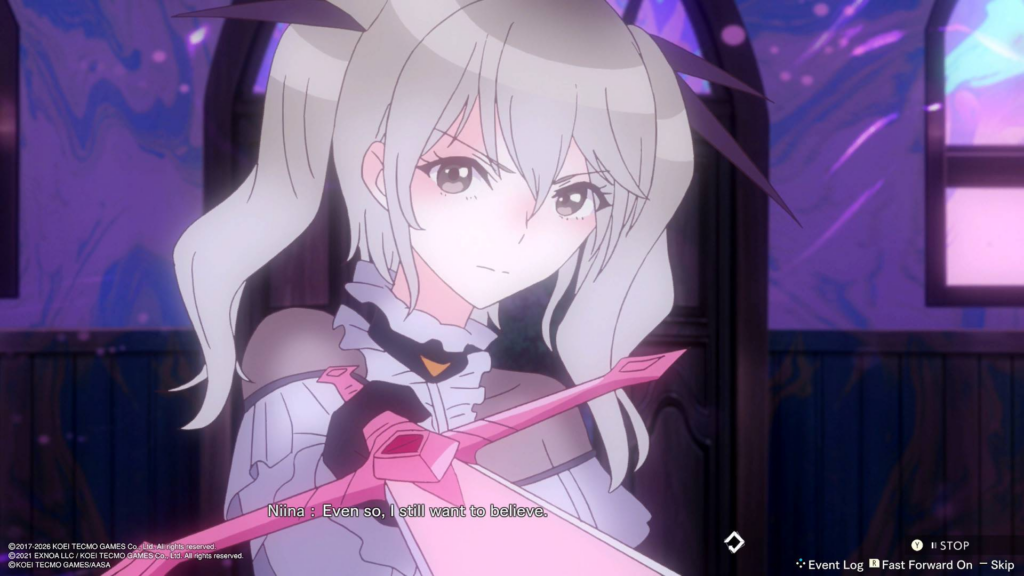
Blue Reflection Quartet is like 2.5 games and a short visual novel with some gameplay. This isn’t a bad thing when the two main events, the first and second Blue Reflection games, are big and engrossing. Sun, while not having the scope of either of them, is still a playable and enjoyable game and the only one with a chooseable party system. The only full letdown is Ray, which, when juxtaposed with the tag of Quartet, makes the experience feel like a trio with another guy on triangle that wants to make you sense that they are part of it. Maybe it was an advertisement for the anime; it could be it was included for the purpose of giving some narrative for part of the next game. Being part of a collection I very much enjoyed, it’s hard to feel too jilted.
Blue Reflection isn’t some fancy JRPG series that everybody is tripping over themselves to worship at the altar of. It’s not Persona. And maybe that is the issue. The Blue Reflection series invokes many franchises some might look at as better when compared to it. I never found this to be an issue, though. There is a deep catharsis to be found in the halls of each of these schools, and somewhere it can hold a mirror up to your own trauma and make you feel seen. Blue Reflection is imperfect, and that’s just part of the reason it is so special.
Remember to follow us on Twitter, Facebook, and Bluesky to keep up to date on everything we have going on!
Reviewed on Nintendo Switch 2, also Available on PlayStation 5 and PC
*A review code for this game was provided by Koei Tecmo for the purposes of this Review.
Developer: Gust
Publisher: Koei Tecmo
Release Date: July 30, 2026
Pros
+Main Two Games, Blue Reflection and Second Light, are both great.
+Four experiences to be enjoyed
+Good combat that clearly improved with later entries
+Outstanding soundtracks across all
+Clean Art Style The Evokes Emotion
Cons
-Original Game extremely dated, with framerate issues.
-Ray and Sun feel lackluster compared to the core games.
-Called Quartet, but feels like it has 2.5 experiences rather than four complete ones.
-
Blue Reflection Quartet
