

An opinion piece in which AndresPlays reminisces about his years writing about indie games, and what he has learned in the process.
I don’t consider myself Catholic anymore, but occasionally I wonder about being at the gates of heaven trying to make a case for myself. “I always gave my Uber drivers five stars!” “Yes, son, but you chewed their ear off enough that they earned it.” “What about my game reviews? I always tried to be as fair as possible.” “Is that so? What about that time you called a game one of the worst games to come out in recent years?” “But that’s how I felt at the time!” Then I would be banished to hell for eternity.
This is my fourth year writing professionally about video games. I decided to focus my efforts on indies because of how dull I find AAA titles nowadays. Yes, the graphics, the spectacle, and the massive open worlds are all enticing to me still. But they rarely hit those same creative highs for me anymore. On the other hand, indie games are where ingenious ideas often flourish. Just look at what I have written about recently. But there is something I did not account for when choosing this path.
The Crux of the Matter
Earlier this month I published one of my most scathing reviews to date. I took no joy in doing so. I reached out to cover it earnestly, same as any other game. There is nothing more disappointing than having high hopes and seeing them die in real time. My conclusion was that the game should be avoided for various reasons I detailed in the review itself. If there is anybody out there who looks up my work, I want to show my respect by being as truthful as I can.
The retaliation was swift. I saw how people claimed that I should be fired (even though I’m a freelancer), should never write again, or quite simply endure harassment for my opinion. As anger coursed through my veins, a new thought replaced it. Empathy. I get it. When a game you have chosen to align with is being attacked, you feel like you are being personally slighted. But then it occurred to me. This could deter how an aspiring game critic feels about a game.
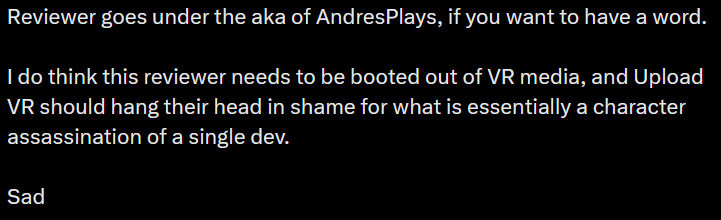
When a single negative write-up has people calling for my head, it’s difficult to engage constructively when the other side has seemingly made up its mind. I can see why other writers would think twice before doing so. The problem with covering independent games made by small development teams is the familiarity. It could not be long before you have long-winded conversations about the game’s development with its creator and share your thoughts on improving it. This is, clearly, a double-edged sword. More than once, a developer abruptly ended communication after I published less-than-stellar impressions.
Imagine you dedicate years of your life to your passion project. After all those long nights watching tutorials, frustratingly fixing bugs, and learning new skills, is this how the universe rewards you? With middling scores? It’s understandable to take it personally, though it’s not the right approach when the review feedback is constructive. These thoughts have run through my head when writing negative reviews, but I do not let them deter me. It has been mentioned time and time again how making video games is hard, so staying humble should be the golden rule.
I go back to my friend Westen’s review of Cattle Country. In it, he eviscerated the deliberately slow pace of its farm sim gameplay. Having played it myself, I concur. We both know that the essence of a farm sim is to take it easy while planting crops in the small town of your dreams. But it does not mean that every action has to be at a snail’s pace. For a few months after the review, he revealed that critical comments from people with more tolerance than him would sporadically show up. What’s funny about that situation now is that the developer actually implemented more quality of life features like the ones Westen pointed out were lacking. He who laughs last, laughs best.

Many people in the comments of a game’s launch usually attack when someone asks for a review code. “Can’t you pay for it?” they say. That has always struck me as infinitely short-sighted. There is an absolute difference between playing for fun and for a review. Writing notes, taking screenshots/recording video, and letting inspiration strike to write about a game are not the same things as doing it for entertainment.
In fact, it is encouraged that game reviewers play games for themselves before they turn their hobby completely into work. This is where the value of a trustworthy review comes from. You do not owe anything to whoever gave you a review code—apart from whatever you write is from the heart. It could be made by a solo dev or by 15 hardworking people. At the end of the day, the result is the same. A team’s size should never affect a review score. The work speaks for itself.
I still choose every day to give new games an opportunity. They may not always hit the mark, but even then I acknowledge the game might just not be to my taste. I am not here to make friends (although I love it when I do). I am here to deliver my most credible experience, whichever way it ends up being. The latent threat of being targeted or unjustly disparaged may always be there, but that comes with the territory. So whether I praise or criticize a game, I know it will not be because of outside influence. In my eyes, that is the ultimate show of respect.
