

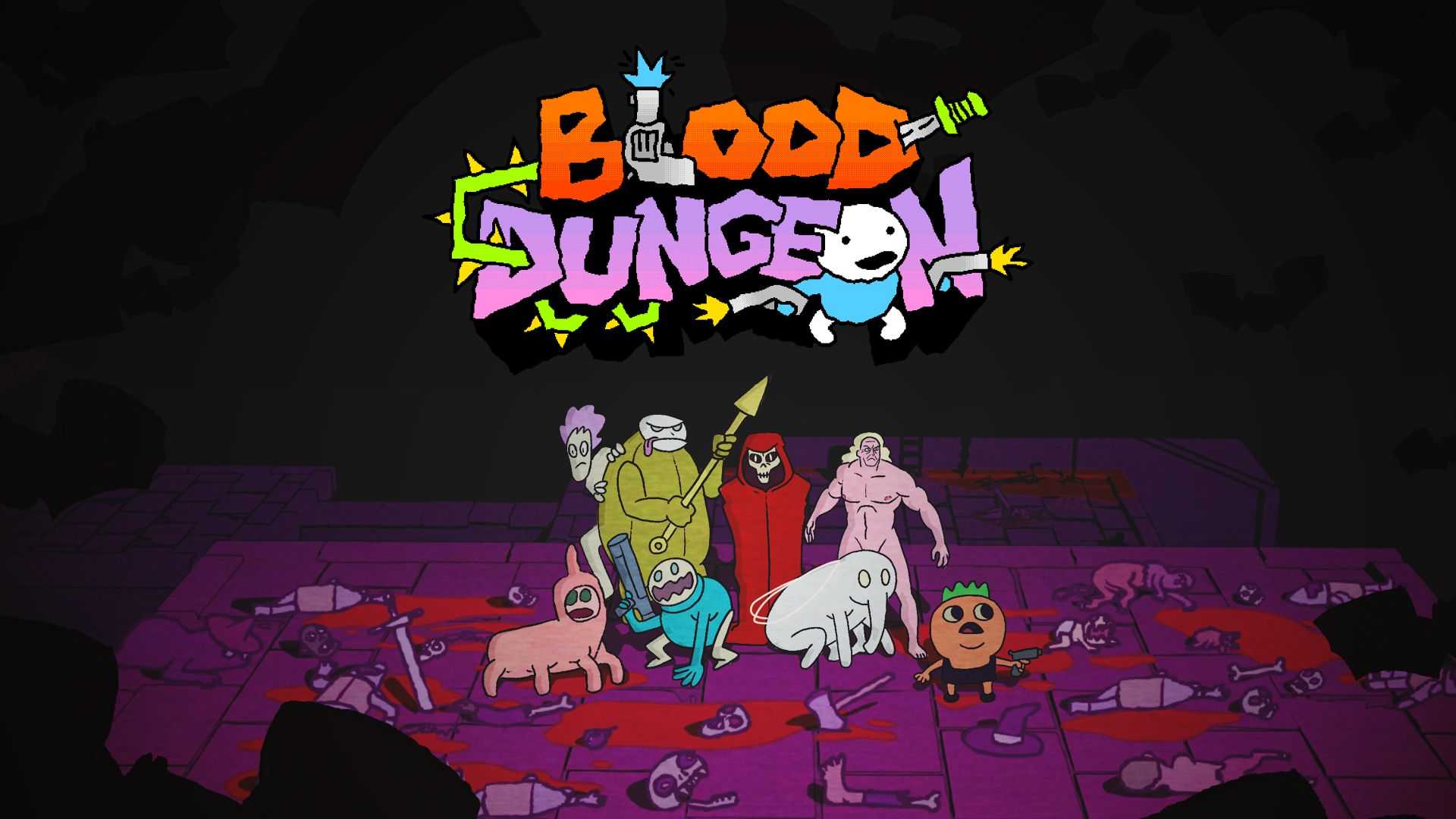
Blood Dungeon is the latest release by prolific developer Messhof, in which they continue to prove their forward-thinking design, now in the bullet heaven genre.
Tell me if you’ve heard this one before: a bullet heaven by way of Vampire Survivors, where the players utilize auto-shooting mechanics to combat waves of progressively tougher foes. Killing enemies generates experience, which is then used to buy weapon upgrades and statistical bonuses upon leveling up to assist in survival; whether you reach the time limit to face the final boss or you meet your end earlier, the result remains the same—head back to the beginning, upgrade your stats via metaprogression, and pick a character and stage to play again.
It’s familiar territory for the genre, and stated so plainly, it sounds dreadfully mundane by this point, despite the Adult Swim cartoon-style avatars of destruction that we pilot. But Blood Dungeon stands out in several key ways. First and foremost is the basic act of navigation. While many bullet heaven titles set the arena on an open 2D field, Blood Dungeon is a bona fide platformer with ledges to jump onto and pits to fall into.
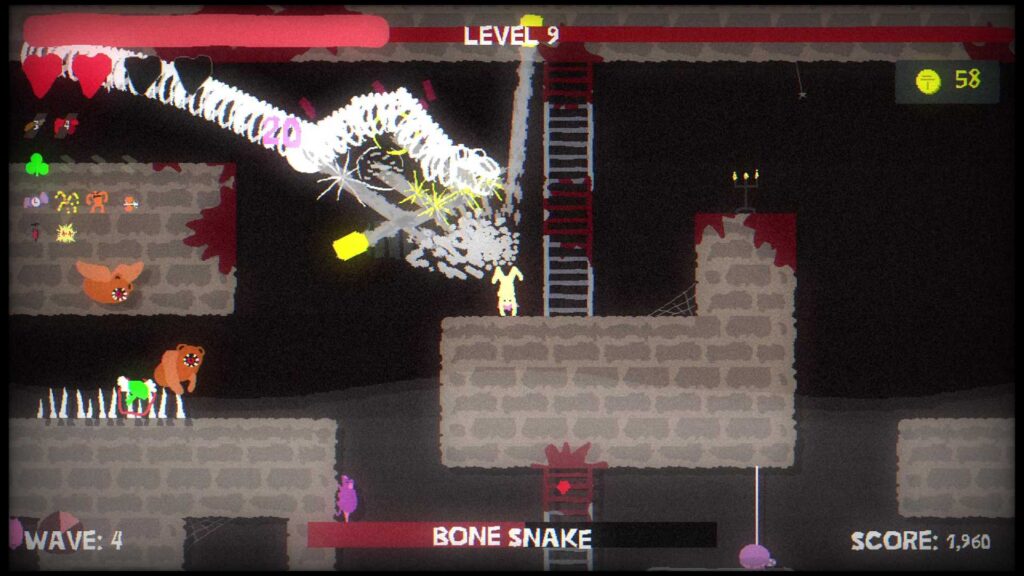
More surprisingly, every platform, wall, ladder, and chain can be clung to and scaled, allowing for an array of navigation trickery. The art of escape is often the most engaging element of play. Leaping from wall to wall, weaving between the small gaps in enemy sprites and hurled projectiles in an effort to avoid my demise gets the blood pumping in ways that the slow shuffles of the genre’s icons rarely achieve.
You’ll need to familiarize yourself with the navigation quickly if you’re going to survive. Each new zone has a distinct layout with its own set of obstacles to overcome in regard to movement; where one level may house an open layout with multiple paths of escape, others contain tighter corridors or looping rooms without walls to bracket them. The most remarkable level is perhaps the one where most of it stands covered in blocks of sand, which can only be destroyed by taking multiple hits from the player’s attacks.
I adore this level in particular because it presents challenges that you rarely find in bullet heaven titles. First, starting as a cramped crawl, you need to make your way through tight tunnels that are blocked by foes. While this cramped nature does make it harder to escape being cornered, it also provides easy access back to the top of the level where multiple chests (upgrades and equipment that are obtained without the need for a level up) can be unlocked for additional upgrades—if you have the coin.
The trick here is that destroying the sandy blocks with your attacks also reveals cash to be collected, but in doing so, the navigation becomes trickier. The open space actually makes it much more difficult to climb upward while avoiding foes. This exemplifies the game’s greatest strength. Rather than allowing players to sit stationary and melt their pursuers with easily obtainable flashy effects, deft navigation is necessary for survival. This movement dynamic extends to the roster as well; the playable characters each feature unique stats, body size, movement quirks, and starting weapons.
This helps the characters feel a bit more distinctive beyond what starting weapon they have—important for maintaining that fresh appeal as the hours begin to rack up through play. Because each character’s starting weapons are added to the general pool once they have been played, the pathing strategies and statistical differences inherent to each character act as their defining characteristics.
The second distinctive experiential aspect of Blood Dungeon is the more muted approach to upgrade and level progression. This is a genre often marked by abundance; hundreds of foes will flood the view, and innumerable bullets and swords dart across the screen so as to become noise. Levels are poured upon players one after another so they may become exponentially more powerful as a matter of course. Blood Dungeon does not do this—there are a low number of levels and upgrades provided to the player by design, and the quantity of enemies is comparatively small, helping with visibility.
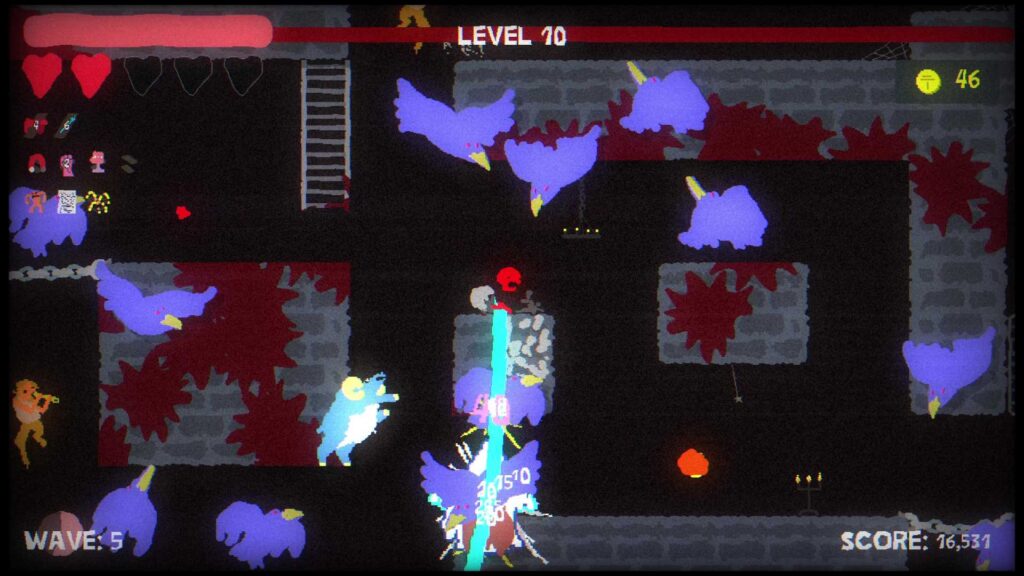
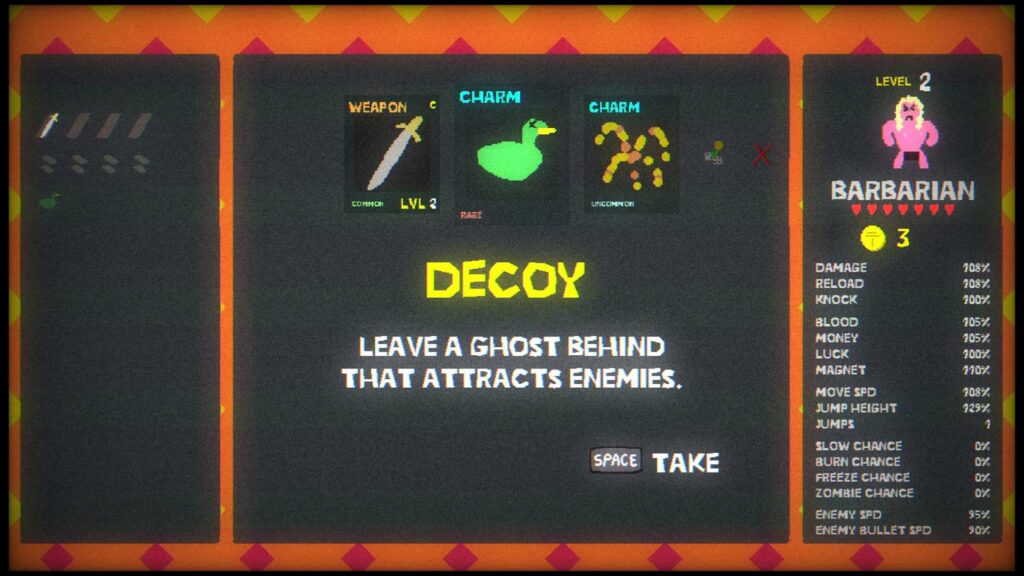
Where another game would see players end up with levels numbering in the hundreds, you’re lucky if you break level 15 here. This is not fully offset by the openable chests, either. This creates some interesting decision points for the player. Should you upgrade a weapon you have now, take a passive bonus, or even take on a new weapon entirely? This decision is made more difficult still by the way upgrading individual weapons or gear works.
Each weapon has multiple aspects that can be upgraded, randomly generated upon receipt of a chest or level up, and categorized by common, uncommon, and rare. Powerful boosts like additional projectiles are rarer than something like a short cooldown reduction, so you may not see them as frequently as you would want. The friction engenders trepidation; sometimes a weaker upgrade is necessary to make it past the current moment, while at other times, forgoing that boost in hopes of something greater later is the optimal choice.
These two elements—level progression and navigation—work hand-in-hand to elevate Blood Dungeon beyond rote mimicry. Because the player character is not nearly as dominating in their power as in other bullet heaven games, survival demands navigational familiarity. Deft navigation similarly leads to increased rewards and power. They exist in harmony, with no singular aspect being more necessary than the others.
As a result, time goes by in a blur when playing; the mesmerizing patterns of wave after wave of enemies are entrancing as the player works to avoid and erase them. That hypnotic dance runs the risk of turning into a slurry of experience, of course, but the game does enough to avoid this.
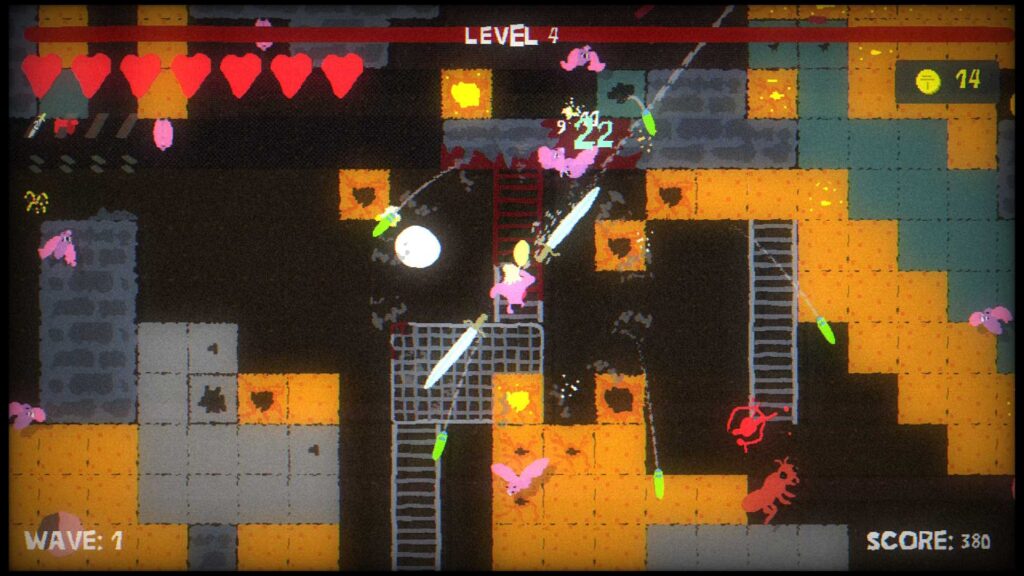
The stage-specific bosses and semi-randomized elites make each run more distinct, and these tougher threats do more than present a test of strength or skill—they also confer boons upon their destroyers in the form of chests. Outside of combat, a standard metaprogression shop lets you buy permanent stat upgrades—offering a clear sense of direction without diluting the essence of the experience.
Verdict
By taking a bountiful genre into new and interesting directions, Blood Dungeon is able to rise above the chaff. It eschews mindless stat boosts in favor of a more measured approach to the chaos inherent to the format and, in doing so, creates a distinctive experience that rewards quick thinking just as much as smart build choices. The balance between the low-level power of the player and the necessity of navigation elicits a tension and excitement so rarely seen in bullet-heaven titles.
Reviewed on Steam.
A key was provided for the purposes of this review.
Developer/Publisher: Messhof
Release Date: August 25, 2026
Pros
- Interesting boss fights
- Deft navigation is rewarded
- Bullet heaven chaos is legible
- Meaningful design choices that keep things interesting
Cons
- The friction and pace take some getting used to
-
Great
