
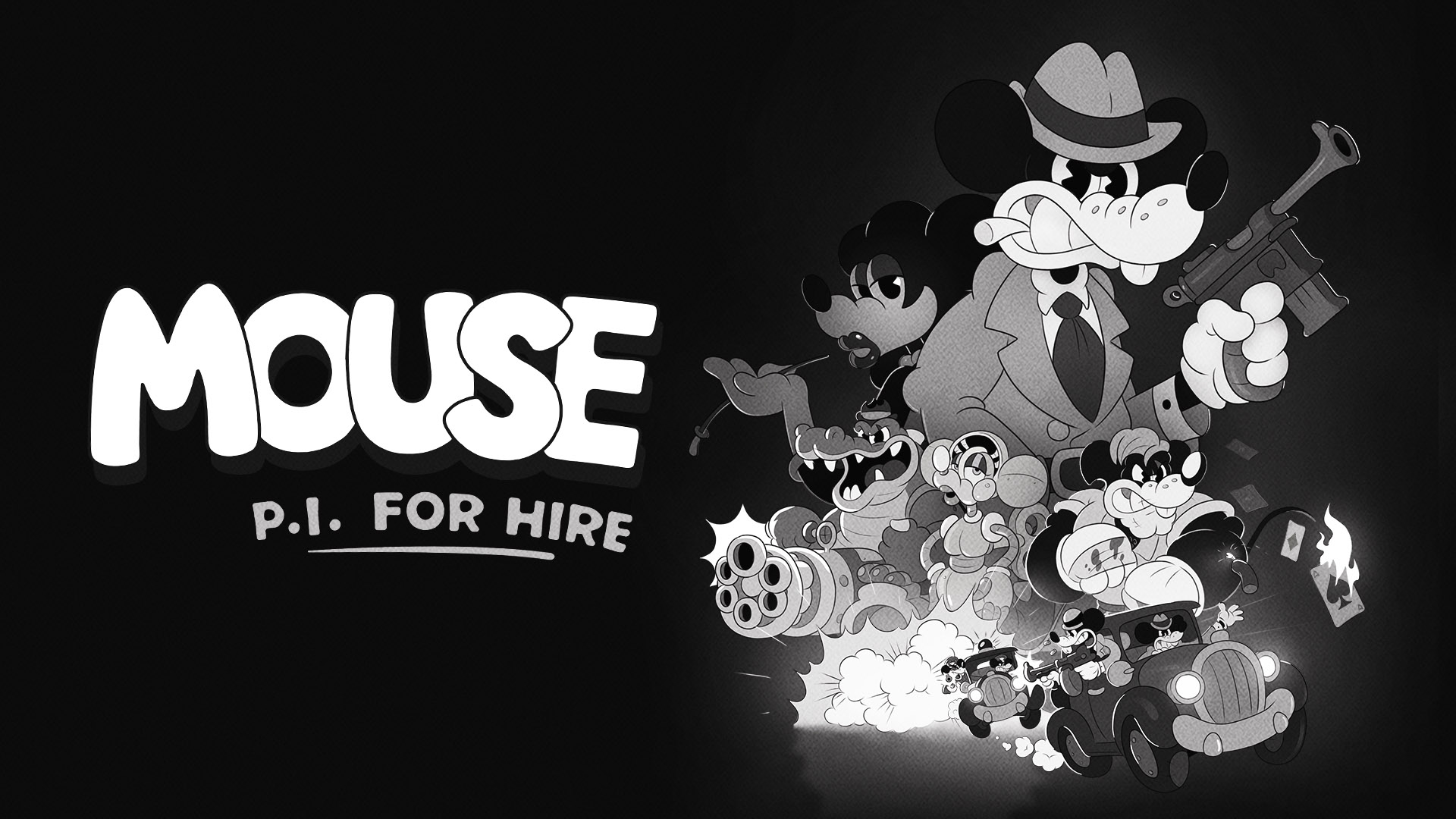
There is a core memory most of us have from our childhood. The coyote paints a tunnel on the side of a mountain, hoping the roadrunner is stopped once and for all. Instead, however, the roadrunner goes through, and the coyote, confused, tries to give chase, only to smash his face on the side of said mountain. The graphic violence made palatable by aesthetic charm. It helps that you know that with the next camera wipe, everything that just occurred will be forgotten for the cavalcade of brutality to continue, in front of our 10-year-old eyes. Mouse: P.I. For Hire invokes that, speaking to an audience raised on anvils, hammers, and the Disney vault, because staying up past bedtime was a rite of passage.
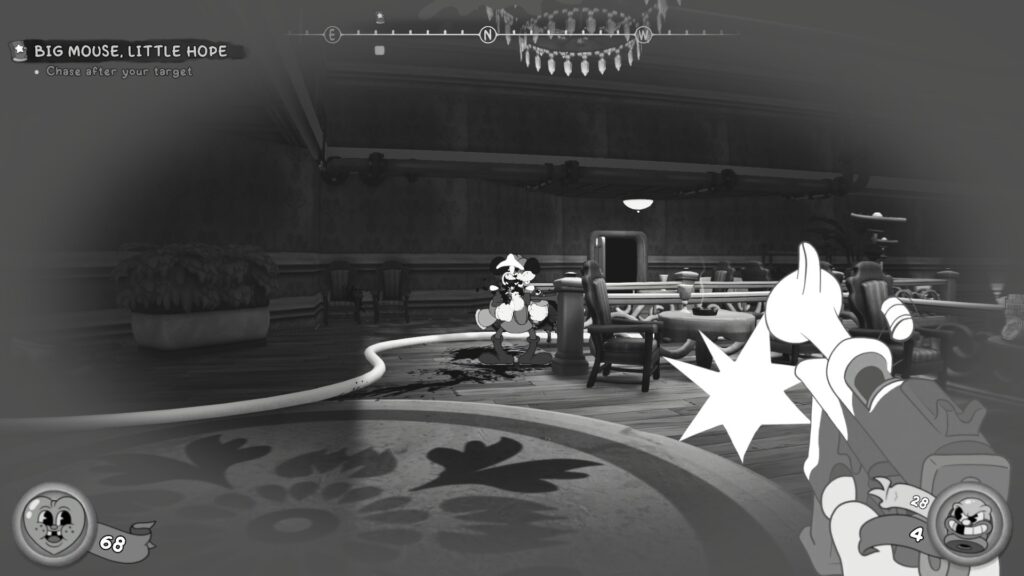
Aesthetically, Mouse harkens back to the Golden Age of Animation, between the 1930s and 1950s, and transports to a hardboiled world of rodents and mysteries. Players take the role of Troy Baker-voiced Jack Pepper (nowhere near the only cheese pun you can expect in the game), who, when we first meet him, is blasting his way across a blink, one bullet and dead enemy at a time. There is a chase, then the grates collapse, and suddenly the player is falling through the air with the city coming in hot below. Naturally, the all is lost moment is the perfect place to begin filling the player in on how exactly we got to this point.
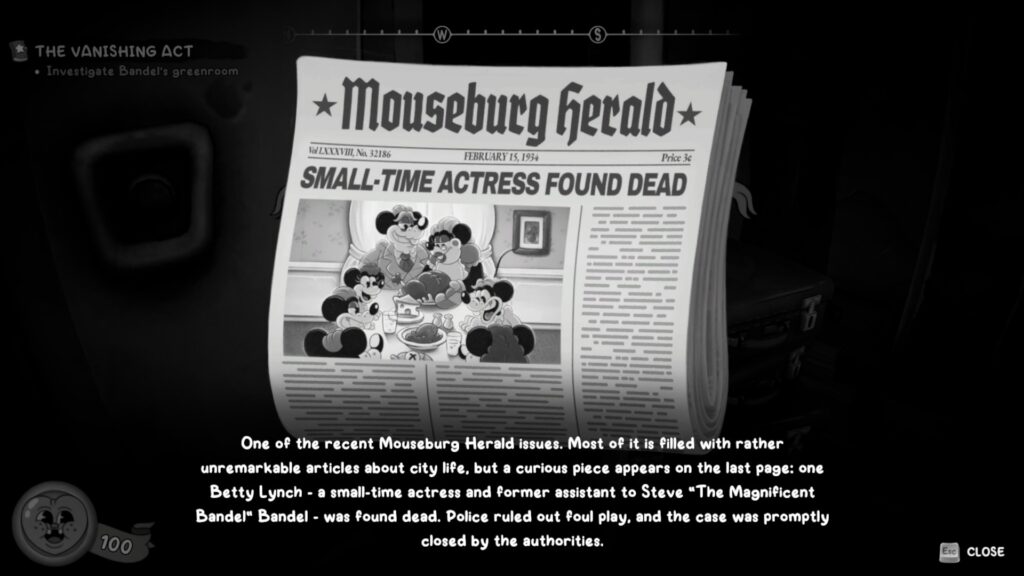
See, Jack is a detective in the seedy part of town, drowning himself in Fondue (this world’s version of liquor) when a series of cases land in his lap. Mouse: P.I. For Hire has one overarching narrative running throughout it, but this unfolds over several seemingly unrelated cases that quickly start to become interconnected as the clues start coming into focus. Think of Who Framed Roger Rabbit, as the game uses its vintage art style to invoke an emotion, a nostalgic feeling, rather than to feel nostalgic. Mixed within all this are the classic investigative bits, like creating a clue board and snapping pics, so you know you are a real detective.
All this said, it cannot be overstated how good the animation style actually is. Everything on screen has some kind of motion, some kind of personality, all in a rubber hose animation style. The heart, next to your health gauge, gets beaten bloody and raw as you take damage, and your bullet next to your ammo dances with little arms as you commit happy little acts of violence throughout each stage. These aren’t the only things, as you can expect trees to have, spiders, and shadows to take on their own quality of life in the world that makes it easy to just get lost in everything, even along linear and smaller paths.
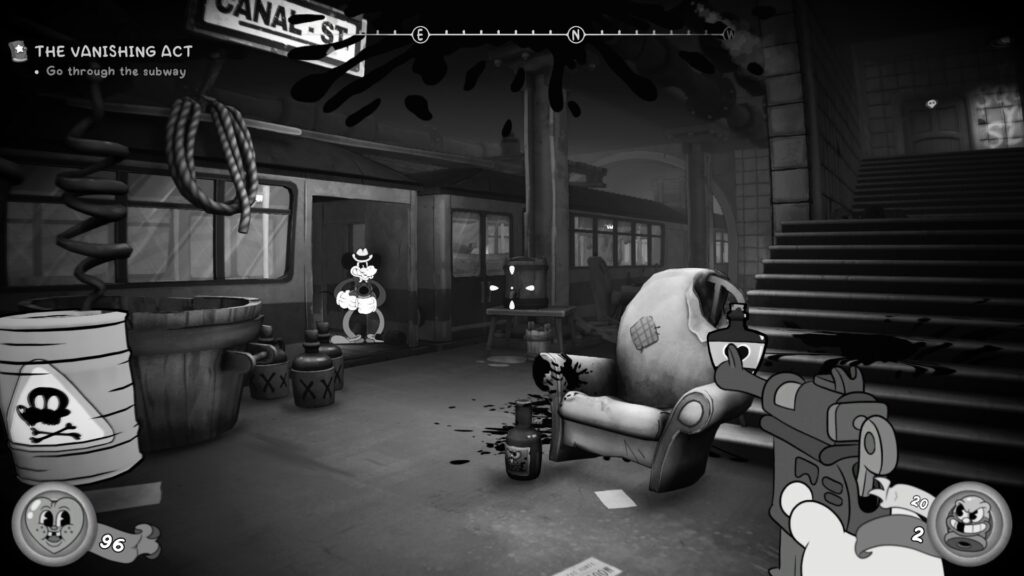
This is before getting to the vast array of guns you will still be collecting long into Mouse: P.I. For Hire. Each one again, has a rubber hose animating, giving every part of them, from the barrel to the body, movement. You start blasting with a pistol, and the barrel will bounce around as if spitting the rounds at enemies. Without giving too much detail, the first few weapons are cartoon versions of weapons that you might be familiar with. It’s a goofy but effective alternative to the Call of Duty mainstream. As you progress, though, you will start getting weapons right at home in a cartoon, almost like ACME itself designed your gear. One of my favorites was the Devarnisher, which melts your opponents down to bones.
Jokes and references throughout the game might feel dated, but not to the era on display, such as one point when Jack crawls through a vent and comments how he now knows what a TV dinner feels like, only to moments later tell the person he is chasing that, dead or alive, they will be coming with him. Both of which are 80s references, mixed within, not just playing an ode to the period of the art and themes themselves. There are a lot of off-handed remarks and sight gags, and at some points it feels like too many, though never enough to bog down the charm of the lead cast of characters and the original narrative.
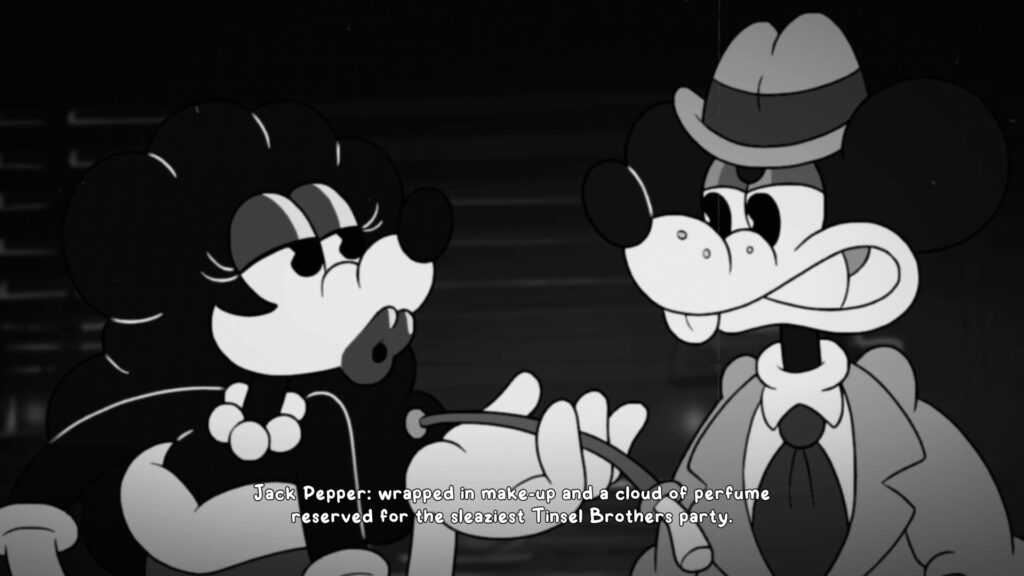
Characters are all voiced, evoking the era, but again being written in part with some objective perspective on the era. These characters play a significant role inbetween missions, where you can talk with them. Side missions come up through these characters that give a bit more narrative for them, though in almost every case boil down to searching for an item in the next mission. Missions cannot be replayed, locking you out of the corresponding area unless another mission sends you back, meaning side quests have a pretty severe time limit on them, but they aren’t hard if you keep your eyes peeled. It’s a shame, especially with the well-laid-out map, that you cannot revisit locations, or more so, missions, since they somehow pack a lot of hidden goodies in straightforward locations.
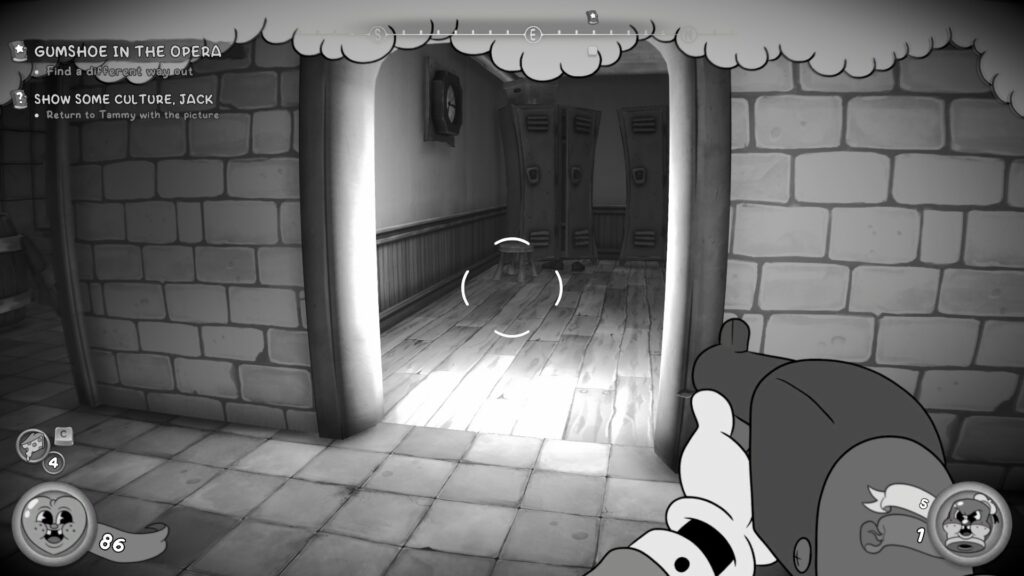
Stages in the game are rendered in 3D, in contrast to the character models, which are fully 2D in juxtoposition. There is a cartoony town that connects each of these areas, and the player has full control to drive between them as the story requires, with a few points in the game offering multiple missions to choose from. The full experience took me about 15 hours to hit the credits, which is far longer than most shooters take me these days. Even Resident Evil Requiem took me about 10 hours all in, making Mouse: P.I. For Hire a pretty lengthy game to complete.
What’s interesting is that, in between a lot of this, are classic platforming elements. Jack will get alongside his guns, a lot of abilities as to how you can move throughout each area. It would have been cool, again, to have some backtrackability between levels with added functionality, but the lack of this feature doesn’t hurt the experience. The bigger issue is some power-ups, which in any other game might just be part of your core kit, like a wall run, that feel bunched against other abilities that render your unlock less useful. Similarly, the wall run only works on walls marked for it, despite a lot of areas looking like they would be fun with the power, yet don’t allow it.
The problem is, these levels can often feel too lengthy, with specific areas dragging on far more than I would have liked. At the core, there are two segments in each stage to expect. The first is arena shooting, when you enter a big, wide area, you can move around with ease, or later put all your traversal abilities to the test, as enemies keep storming in through spawn doors. In between these rooms are hallways that typically require you to complete platforming segments to the next room or open a route forward. Thankfully, there is enough diversity in this, with there being a massive amount of arenas to shooting gallery your way through, and very little actually feeling like a rehash.
Between these moments, there is also a lot of diversity in the layouts of these areas, and the game isn’t afraid to throw a major shootout at you as you try to travel from point A to point B, which keeps everything fresh rather than letting it feel like the loop is king. Traversal is relatively linear in nature. Even without a compass that points you toward an objective, you will typically not get lost if you just move in a certain direction. Even if you can’t just do that, the idea of forward progression is usually easy to discern. There are deviations from this, such as the much wider swampland areas, for instance, but even then, they typically head towards other rodents on screen.
Sometimes these areas can feel repetitive. Make no mistake, once the shooting starts to gel, it is incredibly fun. So you would think any time you get to unload on waves of enemies is gonna be a good time. It is, by the way. Shooting arenas, though, can start to become draining as you progress with these areas, having sometimes four or five waves. This might be doable if these waves weren’t often followed by a second or third area in which you do the same. Elements like lockpicking and navigating vents, as well, are fun on their face, but become annoying as the game uses them far more than feels relevant.
Similarly, bosses can be frustrating in that way. Make no mistake, these fights are typically very fun as they all have a rhythm to them. One of the first bosses is a robot that involves you dodging lasers as you try to find an opening to start blasting. One of my favorites was a ghost that needs you to shoot its shield down, then hit it with your flashlight. Since the flashlight is typically used to traverse vents, that was an insanely cool switch off formula.
What the thing here is, is that many of these enemies will also mix in a lot of things that feel more designed to drag out the experience rather than elevate it. That ghost I mentioned also summons tons of skeletons in between each phase that basically need to be fought unless you can’t aggressively fight with the boss. Others will just have segments where you are ducking and dodging rather than fighting, and these moments can be commonplace, which becomes an otherwise drag on something I otherwise want to praise.
Enemies are also split between two types: ones that charge you and ones that shoot at you. There is a double-edged sword getting shot at, as most enemies have perfect aim, forcing quick movement, even if that doesn’t feel like enough sometimes. On the other hand, bullets take on visible space as they fly at you, giving shootouts a noticeable dynamic. Enemies that run at you are easy enough to gun down, but in some areas, they can become a lot. I died a few times pinned in a corner from bad movement, only to be beaten to death with baseball bats. Characters on screen are also rendered in 2 dimensions, with some interesting effects when you move around them, but the elements can become slightly disorienting, especially in a room with dead bodies that spasm around as you move past them.
There is happiness in walking into a fight and hearing those blaring trumpets come on as some incredible Jazz starts to play. This game has one hell of a soundtrack that perfectly fits each location, with passive sounds to help you explore, and blazing sounds as you confront those damn dirty rats that are up to no good. One of my favorite bands, Caravan Palace, even recorded a song for Mouse: P.I. For Hire that, honestly, might be one of their best. This is definitely a soundtrack that you want to hear on a .45. There is also a great amount of micky mousing to really transport you to the golden age.
The black and white element, which I respect the commitment to, was always something I knew I would have some issues with. Overall, it works, but as a fan of Ghost of Tsushima and Akira Kurosawa, I have been taught how much can be missed in a game with interaction. One ability you later gain allows Jack to catch a hook with his tail and swing. It almost always happens near the top of the screen, and the trigger can be spotty to appear. With it popping up black on white on black on white (I know, crazy), there were a few times I missed its pop-up completely. Since you typically need to jump to catch it, missing it can cause you to fall.
Verdict
There are a lot of ways I could take my thoughts when it comes to Mouse: P.I. For Hire. There were some issues I noticed, and I will note them. The thing is, though, it’s fun! It’s old school, unadulterated fun! It’s booting up your PlayStation 2 after rushing home from school, new game fever levels of fun! It’s the kind of game that makes you feel nostalgic, not for the obvious reasons, but because it’s the type long lost first person shoot that the world needs more of. Everything about Mouse: P.I. For Hire just makes me want more, and I cannot imagine you will feel any different.
Remember to follow us on Twitter, Facebook, and Bluesky to keep up to date on everything we have going on!
Reviewed on PC, also available on PlayStation 5, Xbox Series, and Nintendo Switch 2lable for
A review key for this title was provided by Fumi Games for the purposes of this review.
Developer: Fumi Games
Publisher: PlaySide studios
Release Date: April 16, 2026
Pros:
+Fantastic rubberhose animation with loads of Golden Age style
+Very Enjoyable Soundtrack
+Fun first-person shooter gunplay
+Well written narrative and characters
+Great stage design with tons of hidden features
+fun selection of guns and abilities to unlock
Cons:
-Some areas feel like they drag on
-Level replay would have been nice
-
Mouse: P.I. For Hire
