
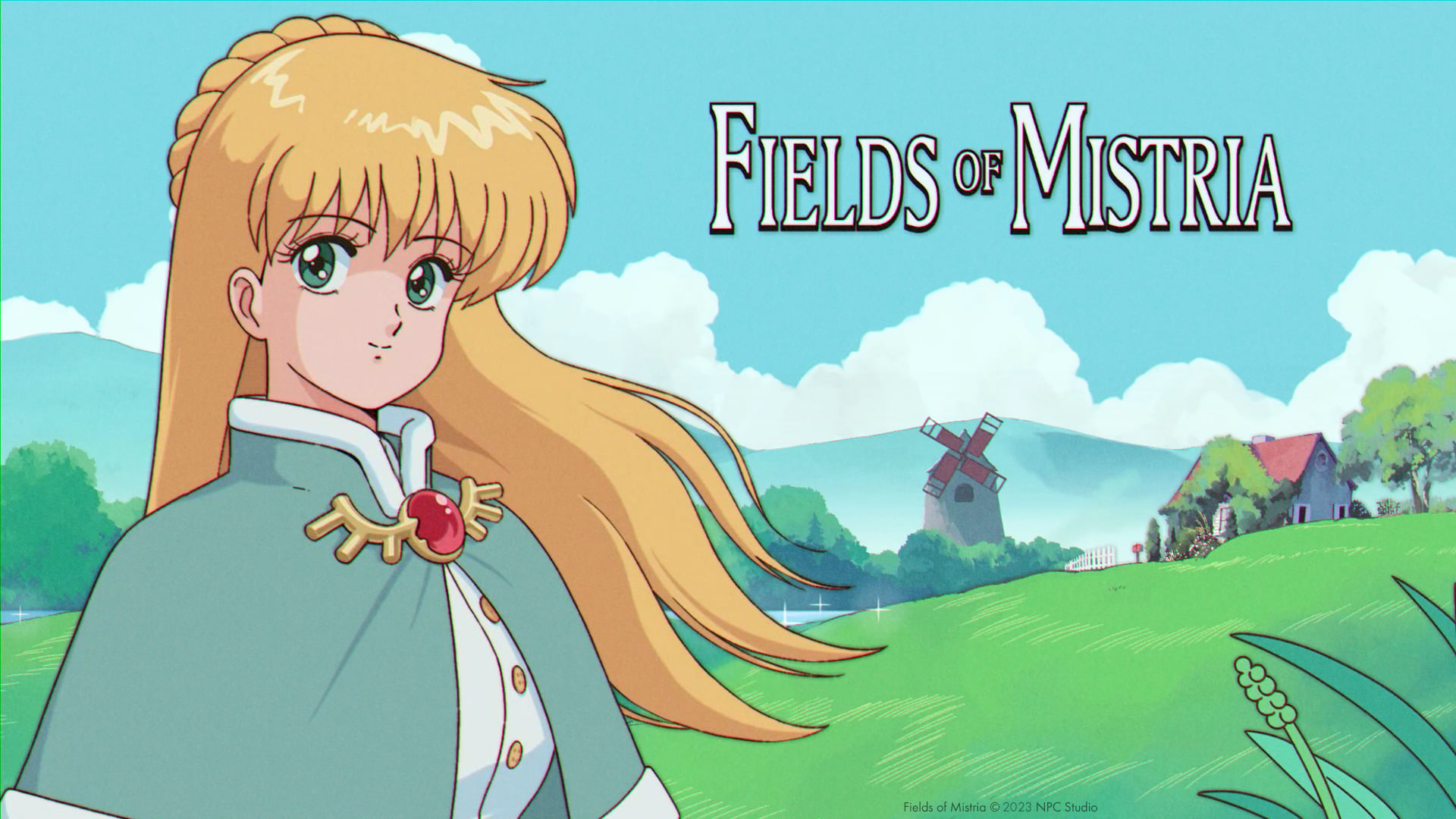
If there is anything I generally feel nostalgia for, at least in a meaningful and emotional way, it’s JRPGs. The Lunar series lives rent-free in my brain and, on any given weekend, in my PS5 disc drive. Maybe the fact that Fields of Mistria feels like a companion piece to all the games where the small village was just a stepping stone to adventure makes me enjoy it so much. It could be that it’s merely a good game too; I mean, it is, but I feel like I have this connection to this world I really can’t place.
At an absolute base level, Fields of Mistria follows in line with cozy sims that have followed the absolute juggernaut that is Stardew Valley. There was this adoption of the term “cozy sim,” but I have always wondered if we have a term similar to “soulslike,” perhaps “dewlike”? Obviously, Harvest Moon existed before Stardew, which feels like the massive revival and expansion fall under a neutral category, but when a game follows the template, they typically stay close to the chest.
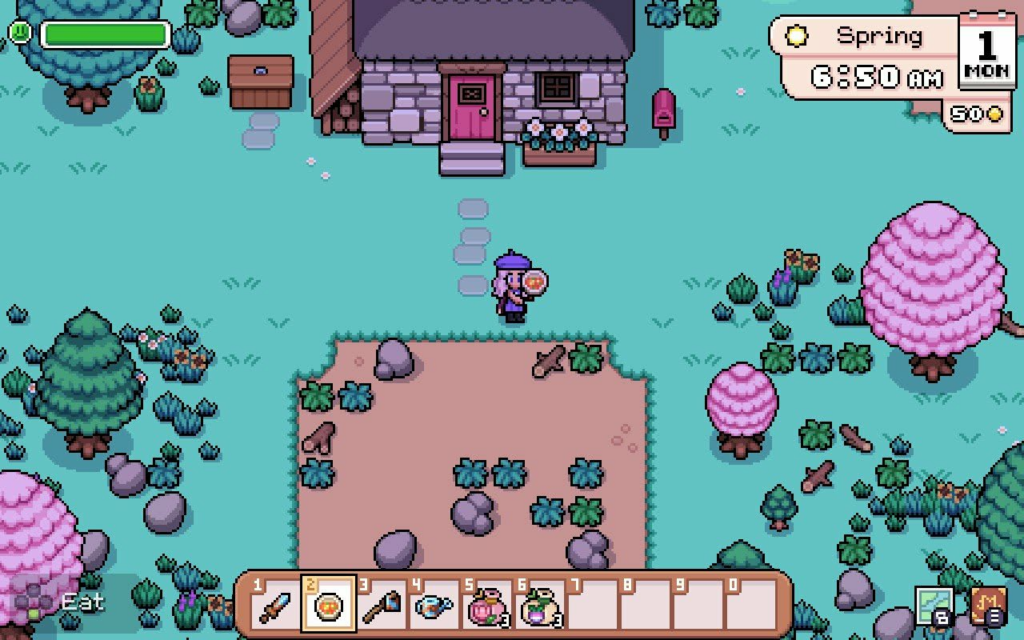
Mistria is a small town in the countryside recovering from an earthquake. They want an adventurer to help with the recovery effort, which is where you, the player, come in. You create your character and travel to the town, investing your time and effort to repair the damage and generally improve the quality of life in the village. As things go, you are gifted with farmland that had long since become a forest. You know, as is tradition. Within this, farming is typically king, but there is a heavy emphasis on adventure as well.
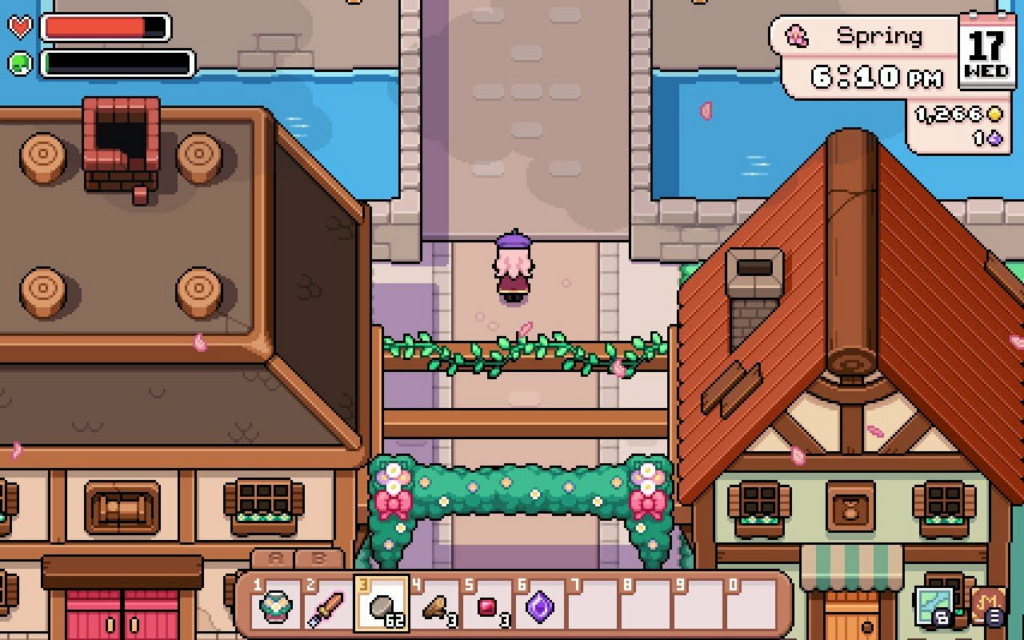
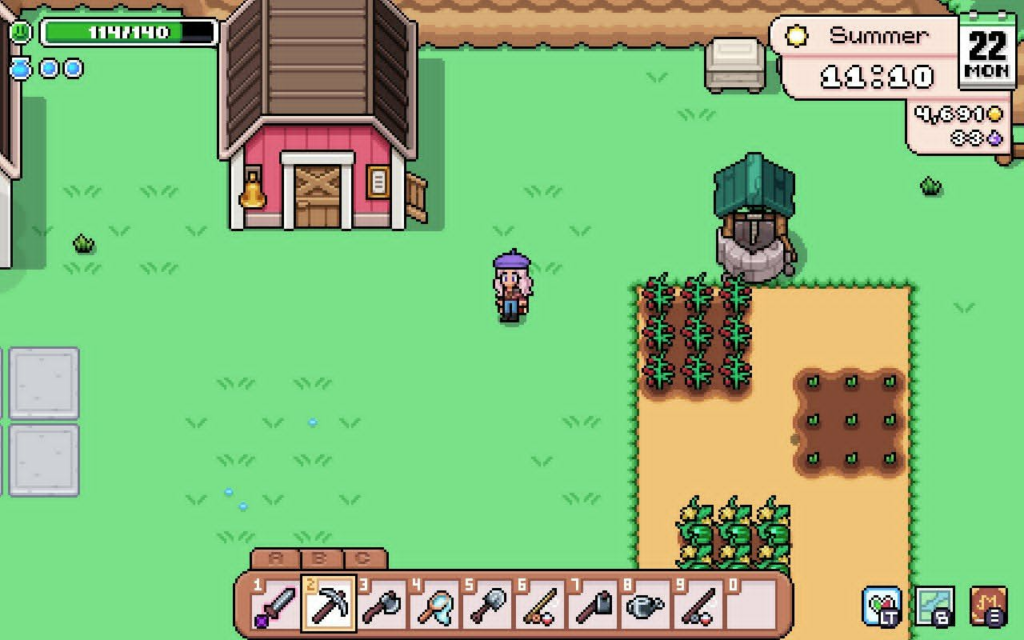
In early access and marketing, Fields of Mistria really made a point to make sure you understood that a selling point was its pixel art design. This isn’t new for these games, obviously, but they actually had something to differentiate. Even at a base level, the quality of the art in everything is apparent from the first moment you walk into the town. Buildings and layout are beautiful with a crisp palette of colors. Each season brings meaningful changes to each location and offers fun exploration, thanks in part to the attention to detail brought by each glorious pixel finding its place.
The characters also tout high-quality pixel art to represent them both in dialogue and on the map. Some of these characters also offer a retro design, feeling in part like a 90s anime, complete with occasionally goofy looks. Sailor Moon feels like a fair anime to point to, of course, especially with Juniper, who totally evokes a genius evil witch idiot vibe, which had its hooks into me from moment one (two guesses who I am romancing). However, Tenchi Muyo, Oh My Goddess, Rurouni Kenshi, or Cardcaptor Sakura are among the few where you might see some artistic overlap.
The characters are equally as good as their appearance as well and very fun to spark up a conversation with. One of the things that Fields of Mistria even adds on this front is that characters can often be found conversing with each other. These give the player more dynamic glances into the relationships of the town that make it feel more alive. There are also so many interesting events, like weekly meetings or the Saturday market, that allow the player more time to experience these people going off on tangents that don’t genuinely involve you.
There are also plenty of side missions the player can take on, which make an early way to gain profit, as well as get some extra love from the villages. These start well enough, one per day, with no real limit on how many you can accept. There are a lot, though; here you can get that help to deepen the village, unlock more functions, or learn a new function. There are many features waiting to be unlocked, so all of this is great. That said, though, most of these will devolve into collection tasks for the sake of collection, which can make tackling these less fun.
The issue with this becomes threefold. The first is that a lot of these tasks are seasonal, meaning you need to find this dropped in the area during the season you are in. You can delete a task if you fail to do so, but there is no benefit to doing that. Second, you can actually get beneficial items like recipes from this. The bigger thing is you are almost always guaranteed to gain renown, which levels up your town. This largely means you cannot ignore these tasks even if you are bored with doing so. The third is they will often throw tasks at you before you unlock what you need to complete them. This is honestly more common, especially as you progress further.
Much of this is locked behind the story missions that require the player to level the town. My issue with this stuff always is that I love decorating and making my farm look pretty. What I like more is having full access to the map and its facilities. And this is what you need to do to accomplish that. Unfortunately, the balancing act between focusing on that versus doing all the stupid stuff you want for yourself is an extremely fine line. The good news in all of this is, again, Fields of Mistria includes some of the best narrative to this progression when compared to their contemporaries. These characters aren’t eye candy; they have a lot going on where their quickness comes out.
The problem is it’s all fetch quests for materials. I know, I hear you say, Well, isn’t that this entire genre? And yes, that would be correct. At one point, I was repairing the inn and needed silver ingots. You go to the mine for that, which can literally become a time sink. While collecting those materials, I hit the bottom of the silver biome in the mine (every 20 levels is a biome with the next tier of material and specific flora and fauna). Reaching the bottom unlocks a mission to unlock the next biome, which involves collecting stuff in the previous biome. As it turned out, to unlock this biome, I also required a special scroll that had another mission attached to find it, which… Say it with me… Required me to find items in the mines.
All of these things have random spawns on a good day, but also not clear-cut overlap, so it’s not as easy as just completing two things at a time. Each item in a stack of 5 required items could force the player to forgo everything else, focusing exclusively on that if you want to try to get all of something. Even then, it might require several in-game days, and that is if you get lucky. There are countless areas that are obviously blocked on the map, and pretty much every one has something attached to this. Taking care of your farm is one thing since you also need money, Skeelo. Building and upgrading your farm, though, is a matter of materials, and you can often feel tied up on that front. The watering can doesn’t need to be filled, though, so that is time-saving and annoyance-avoiding.
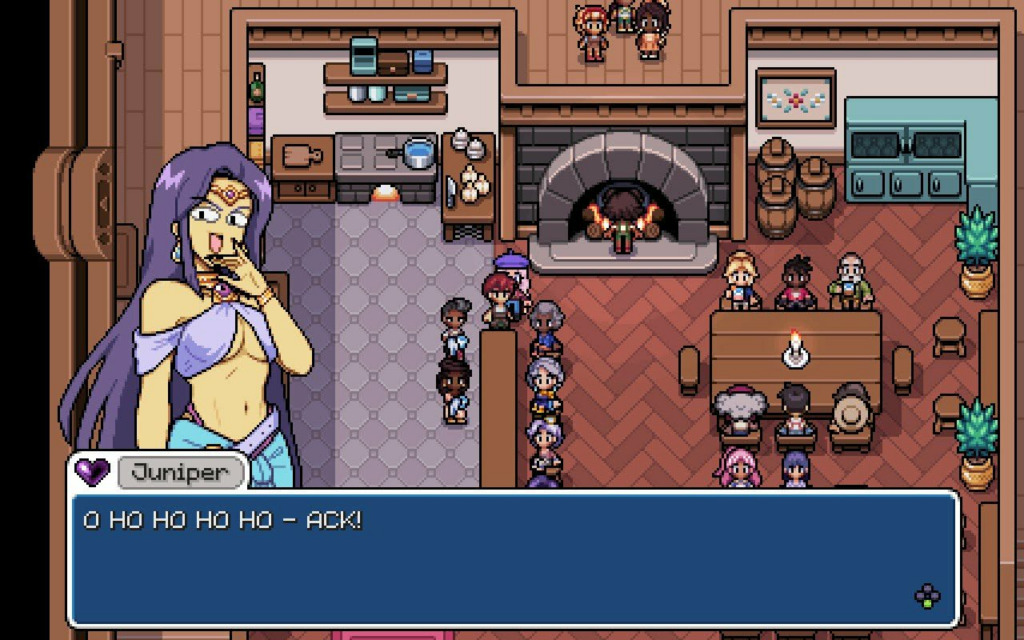
Life on the farm is what you can expect: exploring the world for things you require and working the land. I do really appreciate that you can create your own workable fields rather than half the farm being one big one you also build on. This gives you so much more liberty to customize your farm when you get there. One of the things that has annoyed me with Dewlikes, though, is how fast your massive land gets covered with weeds after cleaning it all, and that doesn’t appear to change here. What Fields of Mistria does to push forward the genre, though, is SWIMMING! Your character can swim; my god, I am happier about that than anybody can ever know, as that remains one of my biggest complaints with Story of Seasons: Grand Bazaar. You can also jump, another mechanic I absolutely love.
Of the core gameplay, though, the weakest element for me was the combat, which you do while exploring the mines. For starters, it frustrates me to no end when the sword isn’t set to its key as a combat item, and you need to constantly change between the sword and pickaxe. It is an annoying experience. Enemies are also easy to slip through, getting off two attacks, then going straight through and getting hit from behind because you are stuck in the tail end of the animation. No part of it is fluid enough, making nearly every animation, like jumping gaps, a risky endeavor.
The thing is, you will be in the mines a lot since this is where you get the ore, which gets you the ingots, which upgrade your gear (and make things you can sell for massive profit). The point here is that it’s not like this is a feature that is off to the side; it will be forced a lot. A few times, I even needed to collect monster parts for quests, so the game also forces this part on you from time to time. When collecting ore, I actively tried to avoid it as best I could.
The player does level up their abilities, though, which makes nearly every facet of the experience better. In the mines, for instance, you can increase the drop amount of ore to cut some time to collect what you need. The farm is even better, though, with abilities that literally return seeds to you occasionally as you water. Not a high drop rate, but that is a big get. You can also make plots retain some water to cut your work down. This helps minimize the annoyance from systems that might not gel with you, like my dislike of combat, but it also frees up some time. There is a setting to increase the time per day, but even then it can fly by surprisingly fast.
Monthly events like festivals exist in the game, though they are a bit lackluster. There is one per season, and while they look good… Moreover, multiple things are going on. You do get some interaction with stuff, but the bigger thing is the build-up to a few that is made into a collection contest that you win or lose just by doing what you were already doing. The shame is that the seasons swapping and the music that accompany them are so much better than what could be a cap off to the progression of time.
Verdict
By the time of writing this, I think I have around 60 hours in Fields of Mistria. There are so many things to love here, but what grabs me, genuinely grabs me, is where this game evolves the formula. The characters don’t just look good; they feel good to interact with. With constant conversations cropping up and a story that has a lot of personality, you are sure to fall in love with it. Exploration and farming are both then bolstered with a fantastic art direction and some minor tweaks that the game is all the better for. There are some places where Fields of Mistria feels more or less in line with what players would expect from a dewlike, but the other side of this is so much more impactful.
This is a cozy sim your friends have probably recommended at least once or twice while it was in early access. Now in 1.0, the developers have shown that they made the most of that time to create something great. There are no more excuses to be sleeping on Fields of Mistria, not anymore.
Remember to follow us on Twitter, Facebook, and Bluesky to keep up to date on everything we have going on!
Reviewed on PC
Developer/Publisher: NPC Studios
Release Date: August 5, 2026
Pros
+ Great Cast of Characters
+ Fun farming with a lot of customization
+ Strong narrative across main story and interactions
+ Beautiful pixel artwork across all seasons
+ SWIMMING!
Cons
- Narrative fetch quests can pile up
- Lackluster combat that is often forced on you
- Festivals are slightly boring
-
Field of Mistria
