

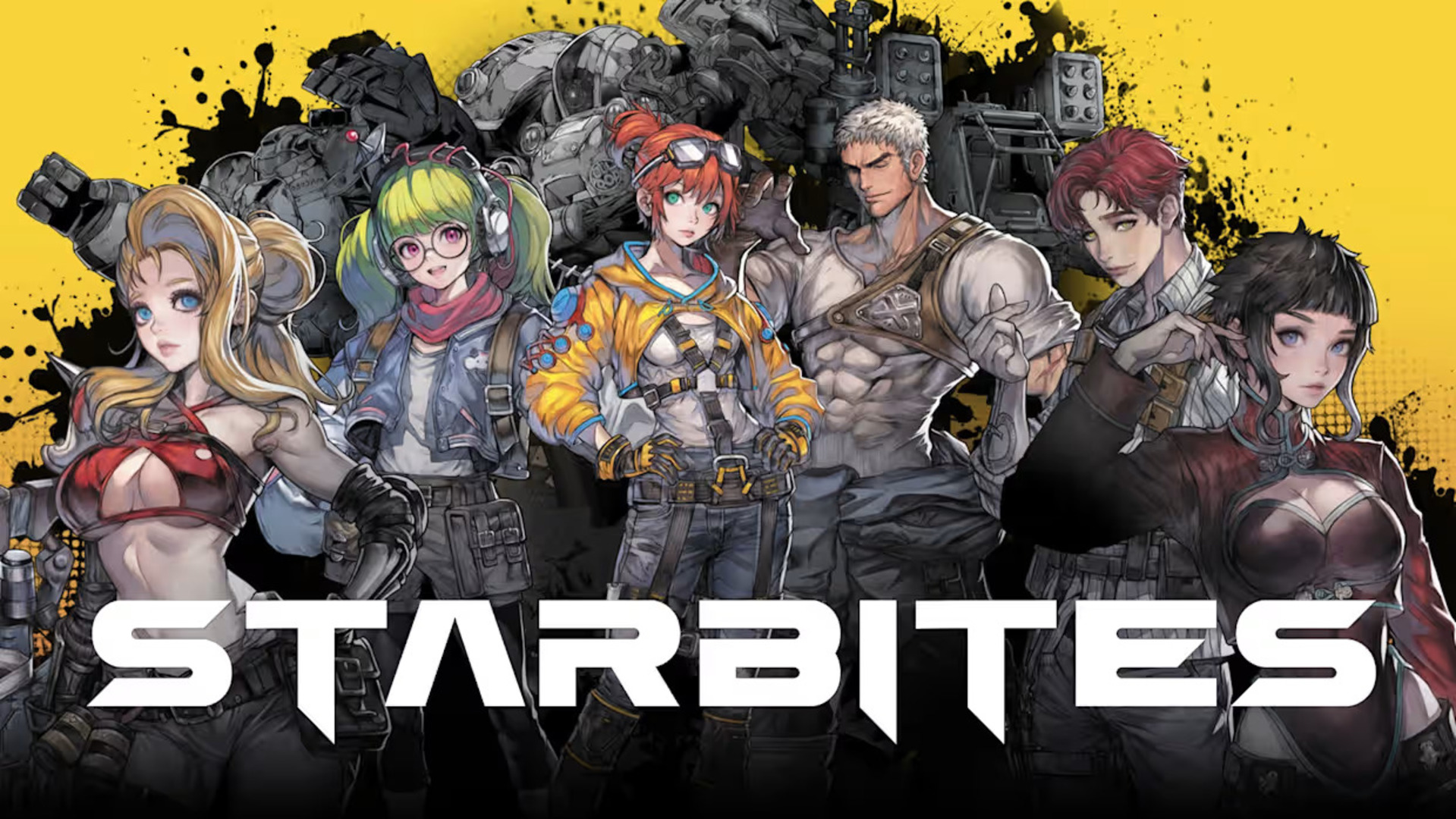
Starbites is a weird game because, and this is true, I can’t remember what exactly it reminds me of. There is a certain nostalgia to the title that makes it compelling, maybe of the 3DS era. Something I probably played while bored at work when your choice of portable games was limited. As a NISA-published game, this feeling is weird because the game has that old-school vibe of an American game simulating Anime but through a Western style. The studio behind the titles’ development, Ikina Games, is based in Seoul, so it still has that outsider vantage, but I guess I am used to the oddest titles from the publisher being akin to Labyrinth of Refrain: Coven of Dusk, a game that remains in my top tier of games I never expected to consume my life.
In the case here, it’s the feeling you get that putting this game and NIS in the same sentence that games its a lot of appeal. It really doesn’t feel like other games being published by them. It’s unique, for better or worse, and that gives it personality. Set on the planet of Bitter, we follow Lukida, a young scavenger trying to get off that planet. At least, trying her best she can for somebody who is dealing with massive amounts of debt. While this isn’t really a ‘post-apocalyptic’ setting, the planet is a barren wasteland with the characters making their homes in smaller cities and villages.
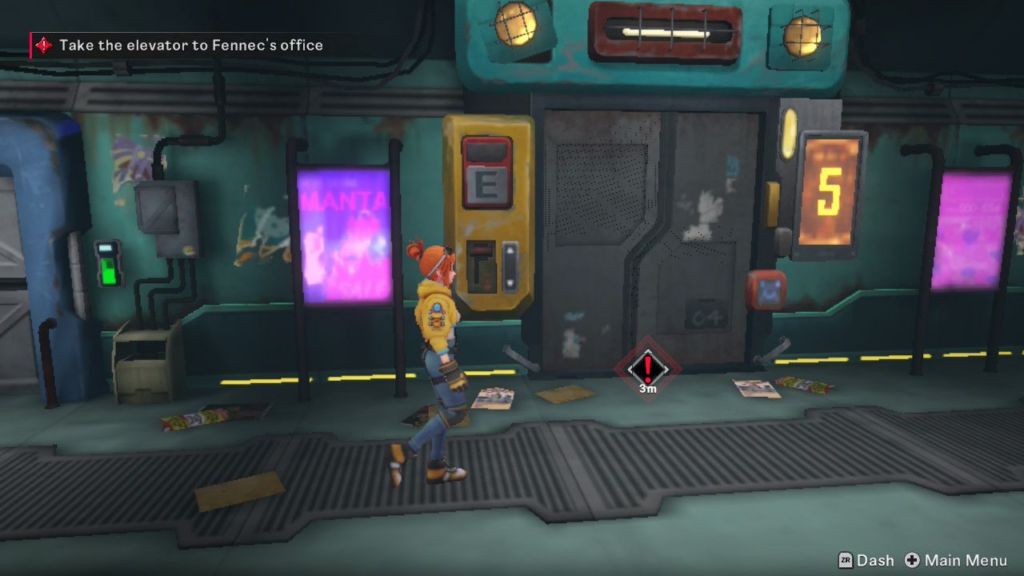
Lukida takes tasks for the overlord of some kind named Fennec, while trying to find her own scrape to squirrel away enough money to make her dream a reality. This segments the game between two area types, one in which you control Lukida on foot inside the confines of the villages, hitting up shops, purchasing upgrades, or taking on a side task or two. All of this is presented from a fixed camera that makes the scene feel like a side-on diorama that took a little getting used to, with stairs for lower floors actually being completely hidden from view until I moved slightly.
The other portion of Starbites features a top-down angle as Lukida pilots her mech around the world itself. Along these paths, you will eventually bump into robots roaming the land, which take you into a fight screen where players engage in turn-based combat against a roster of enemies. Navigating these areas can also be frustrating, though not due to the free-moving camera. You have a mini map that tries to be stylized, picking up enemy blips as you move, but it is structurally a radar. You also get a map, but this only shows the areas as boxes. These world rooms are functionally well designed too, but navigating can require going the wrong way from the objective, down a ramp, then back through a tunnel to the right way, none reflected in any of your navigation tools.
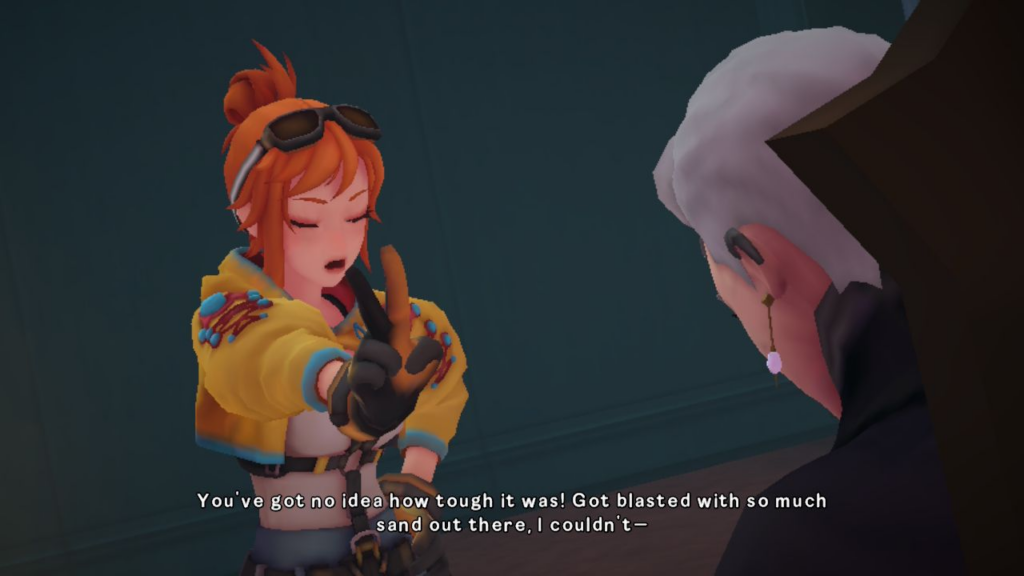
One of the first things I should make clear, beyond the obvious gripes above, the game has serious presentation issues. They are quickly and blatantly noticeable and very hard to overlook. While character models are actually really good, and in some part excusable given what I think the devs were going for, textures on everything can be a nightmare. Most everything as design choice, like a patch on the main character’s jacket that is blurry and hard to see in your face. It’s very off-putting. This gets worse when signs have unreadable words that are clearly words and not gibberish.
This gets compounded heavily with the rendering of the game, which is also noticeable in everything. Anything in the background has pixelation around its edges, and even characters in cutscenes might have the same. This review is being performed on the Nintendo Switch 2, which is probably not the most powerful of the available platforms to play on, but nothing about Starbites screams that this is a hardware issue. The console ran Cyberpunk 2077 with a minimal amount of these issues, so it feels like an optimization problem.
At one point, I needed to do some research to see if Starbites is a remaster, hoping for a reason. I feel like this was part of some style they were going for, maybe stemming from my own brain treating this title as a 3DS game I never heard of until now, but even if that was the case, it really doesn’t excuse the textures. Especially since they, at one point, made me slightly sick.
I wanted to get this out of the way because most of what’s left to say is actually praise for Starbites. The game has great animations that are both fun and dynamic. While cutscenes aren’t the norm, all three of your starting cast get moments that have full animation. Their personalities come through in these moments as well, though the Japanese-only audio is a TINY bit off-putting since, as stated, the art feels like a western approach to Anime in 2008. Code Lyoko-esque, if you will. I have this audio in my brain, and then I clash with what they say. But its quality is my point here.
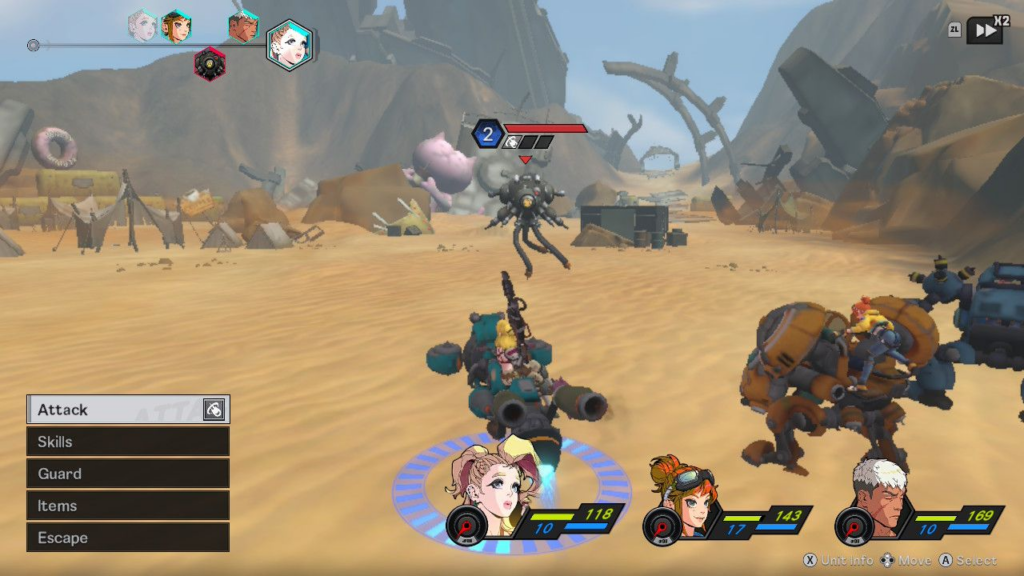
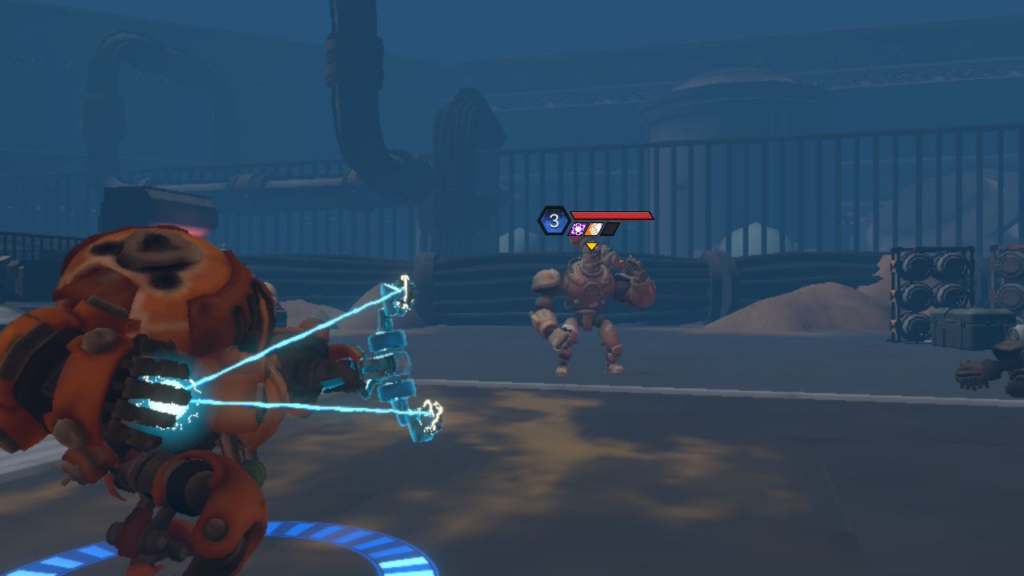
These animations in Starbites carry into the 3-party turn-based fights in which you tear down other mechs. Special moves, in particular, have detailed attack animations, like Lukida’s mech whipping out a slingshot and summoning her glyphs of death to fire the high-powered projectile. Gwendoll also has an awesome move where she does a flip off the bike she rides, slow motion, of course, before using the bike to steady her rifle and fire a single high-powered round into an enemy. Even a standard attack is a joy to watch.
Combat itself isn’t very hard, but I played on normal, and you have three difficulty options to choose from. The player party can withstand attacks or, moreover, get a lot of tools early on to deal with them, but the enemies can quickly start piling on damage. Gwendoll is where this becomes most obvious as a high-attack, low-health character. If the enemy party chooses to focus on her, she can be eliminated in two turns, depending on the situation, but the game is true turn-based, so when a character with healing has their turn, they will heal that turn. Enemies also get a lot of party attacks early on, which can punish you if you don’t make a point to learn the skill sets.
TP, which is like your magic, heals with every standard attack, so you are typically not far away from spamming power hits to drain enemies quickly. Your health does not heal unless you level up or find a charge station. These charge stations are almost everywhere and cost nothing, so there is that benefit; however, again, due to the map structure of Starbites in a lot of areas, you will know where they are, but might still have to wander around to find them. Leveling is pretty consistent, as the game does not pile on large XP cap increases, which also feels like you make a lot of progress.
Enemies, even as you leave, typically remain above whatever threshold you are, so there are a few other elements that help. Your mechs are your mechs, but each has multiple parts you can find and replace to increase each stat. Characters also have skill trees that help improve base states as well. This will make areas easier to contend with, more so than if you simply level and leave it at that, and there is no level scaling that I can tell, but it’s the type of game that never lets enemies become a complete chore with no threat.
Part of this is the constant backtracking, I’m sure, with fast travel only working for towns and not areas you have explored, so you run through enemies a lot. It’s a good mechanic to not completely hurt this, but I could also do without this constant back and forth. Worse yet, some missions require you to navigate between multiple areas multiple times, which can wear thin, even if the combat literally never does.
Verdict
Starbites is more than the sum of its part is an enjoyable RPG that should not be ignored. The turn-based fights are fun and dynamic, with great animations both in combat and in cutscenes. What genuinely lets down that entire experience is how painfully distracting the textures and graphical issues are. Without those, this would probably be a game I throw out in every I need an RPG to play conversation. I mean, I’m still going to recommend it, but now there is something you need to actively ignore to find the joy in it, which is a shame.
Remember to follow us on Twitter, Facebook, and Bluesky to keep up to date on everything we have going on!
Reviewed on the Nintendo Switch 2, also available on PlayStation 5, Xbox Series, Nintendo Switch, and PC
*A code was provided by NIS America for the purposes of this review.
Developer: IKINAGAMES Co., Ltd.
Publisher: NIS America
Release Date: May 21, 2026
Pros:
+Great character design choice
+Very good animations in cutscebes and combat
+Fun turn-based combat system
+well constructed world
Cons:
-Massive textural issues, with blurring, illegible text, and pixelation.
-Some hard to navigate areas, with map and radar less than helpful.
-
Starbites
