

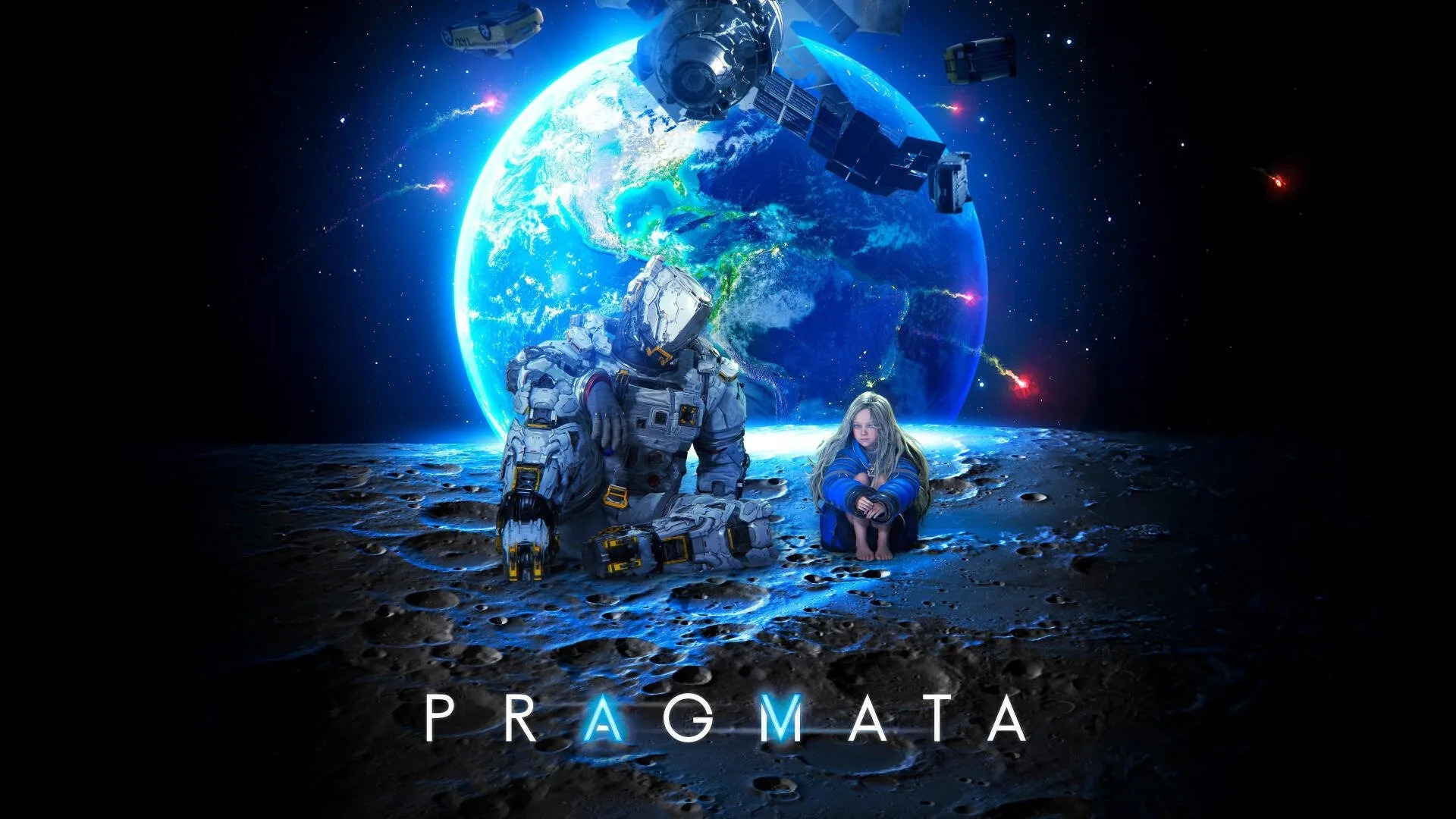
Pragmata starts in a way you are probably familiar with. In fact, the trope is so common that there is a name for the sub-genre, Sci-Fi Robinsonade. Main protagonist Hugh and company land on the Lunar colony to investigate an incident that occurred there, and don’t even get out of the entrance way before an earthquake, maybe, sorta, kills everybody and leaves you as the sole survivor on a space station that wants you dead. I say that because, through your exploration, that is one of the main things you’re trying to solve.
What comes next is that Hugh only survives this ordeal himself because of a Pragmata (hey, that’s the name of the game! How are they doing that!?), which is a cybernetic entity that looks like a child but is capable of interacting with all the mechanical components of the ship. While the player predominantly plays as Spaceman Hugh through exploration, these two form a cohesive team against a hostile world currently controlled by a rogue AI. Riding on his back, the Pragmata, which Hugh names Diana, fight in tandem as they serve as two halves of the same combat.
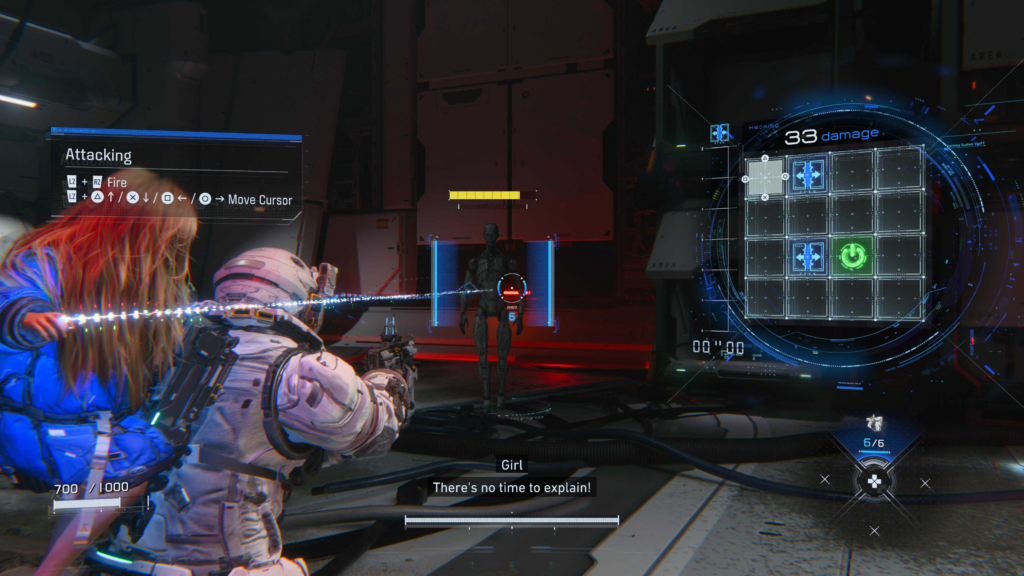
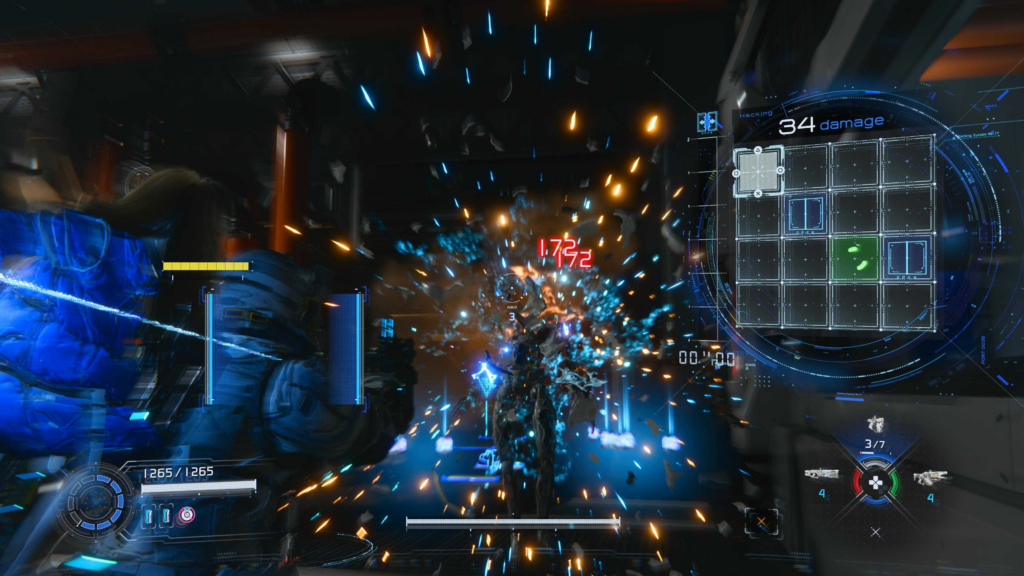
The player controls Hugh to move across the field, dodge, and blast your mechanical enemies while Diana hacks them so their weak points are exposed. Failing to hack enemies means they are, technically, still killable, but they are much harder to actually slay. With finite ammo, you will have a bad time doing that. So combat actually becomes a defensive endeavor while you navigate a puzzle to expose an enemy, then capitalize by shooting them in it until they drop dead.
This is an interesting concept. I was expecting it to become the bane of my existence, and, while it is not without its faults, it flows much better than anticipated. Movement through the puzzle is attached to the four buttons on your controller, each one controlling a direction. It doesn’t feel intuitive when you start this balancing act, rushing through a big maze on the side of your screen while dancing and weaving. Better yet, to maximize the effect, you need to hit certain nodes before hitting the end goal, so there is a part of it that straight up demands your attention.
As it becomes second nature, though, even as they add more components and more enemies to combat, it becomes way more manageable. There is a learning curve to overcome. If you land a dodge mid hack, the puzzle will remain, so you get that benefit, but getting hit can reset complex puzzles, which generates some frustration. This is more pronounced when you get to a point where an enemy can engage you from off-camera for literally no reason. As this continues, finding the opening to hack becomes more annoying than the hack itself, with hacking sometimes making quick movement more limited.
This is its apex for me: when I was fighting a group of enemies with these devices that pulsed jamming beams, cutting off my hacking ability completely. To contend, I needed to jump over those beams, dodge enemy attacks, and hack them all at the same time. The issue is the jump command, and one of those hacking movements overlaps, so I couldn’t consistently complete my hack because attempting it made it hard to jump out. Trying to hack the devices would auto-reset if I backed out, even if I jumped properly to avoid being hit. The thing is, I didn’t even die during that fight; I just felt frustrated by how the game piles on its mechanics in that way.
The gunplay mixed into this feels like it has an identity crisis as to whether Pragmata wants to be played fast-paced or slow. Take, for instance, the primary firearm that you always have access to. This is the only gun that you can reload, but regardless of the weapon you have in this slot, it reloads one bullet at a time. The process to get ammo back can bring combat to a grinding halt with enemies that aren’t even actively attacking, wandering around, then coming straight at you all while you are waiting.
This isn’t the only gun you have, as there are four categories in which one gun can typically be equipped at a time, until you progress some ways. The issue is these guns don’t reload, so you might want to play conservatively with them, not knowing the point pulling out your charging rifle will have the best effect. You can find replacements pretty commonly and access to the hideout to replenish them, but in a locked arena, enemy health can start to outpace damage output quickly, making burning through them all a real possibility and one that is not uncommon. If you make the mistake of firing ammo at unhacked enemies, a powerful bullet will still do next to nothing, and now you are in a worse place. You might think, ” Oh, this is no trouble if you do what the game has clearly outlined”, but then the number of times a shot directly at a weak point was preempted by the weak point closing has been too frequent to count.
The thing that makes gunplay fun, though, is the way these different weapons and abilities can ultimately be insanely fun combined. Diana’s hack gains special abilities you can pick up, like the multihack, which allows a hacked enemy to infect every enemy around them. During one arena fight, I threw out a decoy which attracted all the enemies, then multihacked them, and while they were grouped up, used a riot blaster (a grenade launcher type gun) to basically wipe the entire room. The mix-and-match concept clicks as soon as you have a full kit and manages to make even the most frustrating moments more palatable in the process.
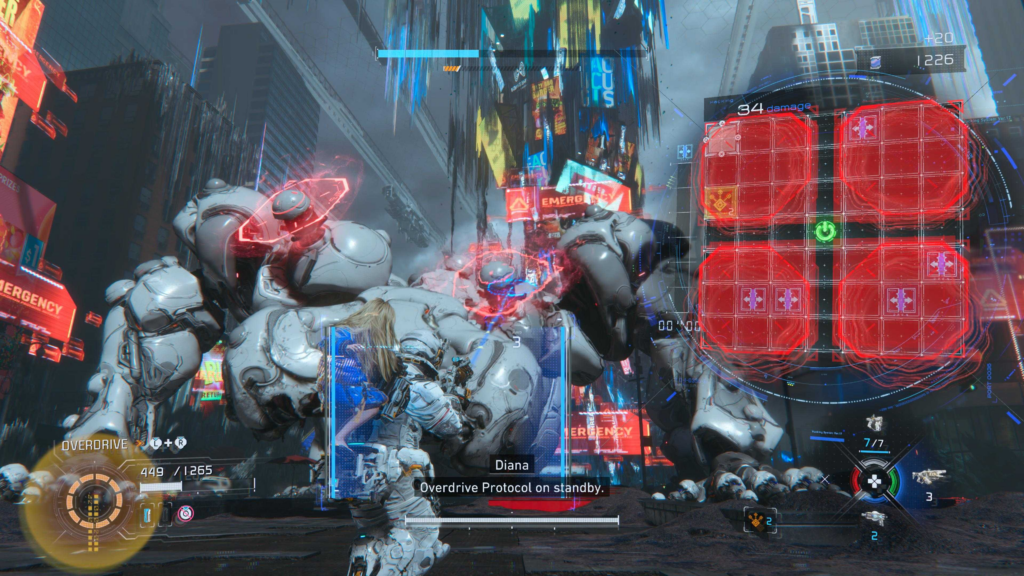
Each area is capped off with a big bad, as one might expect, but I just wasn’t expecting them to be one of the easier components of the game. I played the game on normal, just for reference. Every enemy projects nearly all attacks, with the bigger attacks that can’t be dodged easily giving ample time to do what is needed to escape them. Otherwise, they work the same as normal enemies, hack, then shoot the weak points. Do this until they stagger, then go in to deal massive damage.
To put this into perspective, I accidentally entered a boss fight in the second area with only about 300 of 1300 health and one heal, with the healing device acting similar to the Souls games. This was my first try at this boss. I think during the fight, I took one hit, but I managed to win. One boss managed to beat me, but I had miscalculated the range on its attack, which hit me even as I dodged because it outranged me. On my return, I fought the enemy slightly further back and was able to dodge out just fine. Bosses genuinely come down to range, which can be annoying against the smaller standard enemies, but with bigger ones its hard to miss.
Exploring the station is one of the more fun things to do, with a little Metroidvania mixed in there for good measure. Areas of the station have linear routes as you progress, but almost everywhere have offshoots and hidden nooks to explore, with a lot of collectables for leveling or unlocking bonus features in the hub area. As you progress, you never lose access to these places either, making backtracking worth it as you gain new abilities to open up routes.
Capcom does its typical, hey, you can’t go through here unless you complete these multiple objectives, but this is one of the few times where I really didn’t feel like it was a burden. Paths have an enjoyable mix of platforming and combat, with a lot of combat sections playing out in multi-tiered areas so you can take advantage of every ability at Hugh’s disposal. There is also a mix of environmental puzzles you can stumble upon that don’t feel like an imposition.
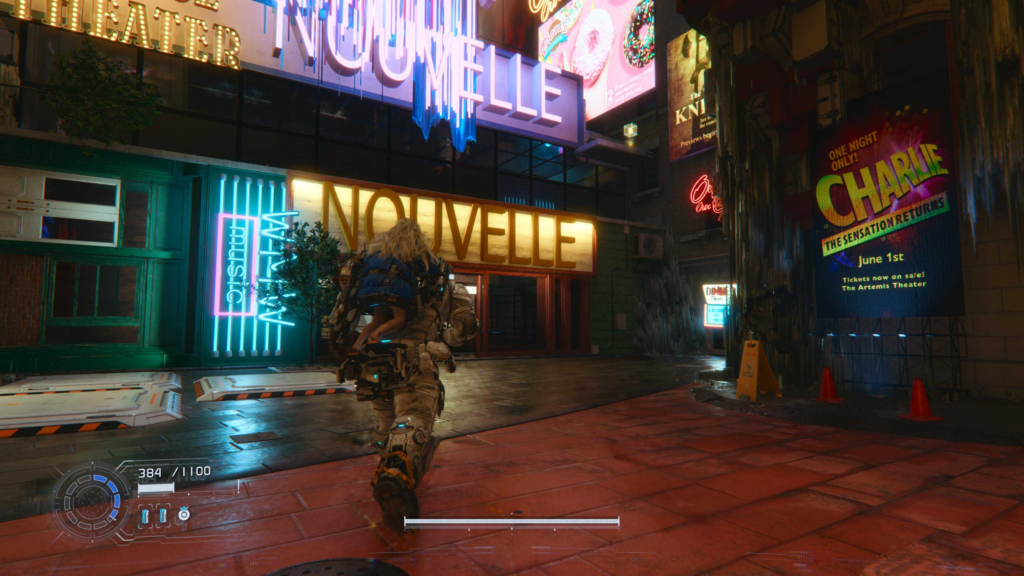
It was also great to see that the Lunar Colony has diverse biomes in it, keeping your journey engaging as you take in the sights. These areas also bring unique elements, such as a forest area that you need to explore to find microchips. Removing them from the plants they are attached to causes them to wilt, but you can then use them on bigger trees to create a pathway to traverse forward over. In the city area, you wander a street that looks like Times Square, or cut through a shopping district with lasers, which I guess are a good shoplifting measure.
At the core of the experience is the relationship between Hugh and Diana, which is at its cutest when you complete puzzles in the map, discovering gifts to give to her that fill up part of the hub. In this area, you can watch her wander around, look at objects with wonder, or even dance. For Hugh, things like the training missions can allow him to unlock more tools, so everybody wins.
This being said, some of the dialogue can be lackluster as the two explore, and Diana’s inquisitive nature comes out. Hugh can often seemingly explain human concepts to her in the worst possible way, and these moments are extremely frequent. This is before throwing in that, when you meet another Pragmata later, they have a childlike body as well, but much more understanding of the events going on. I could live with Diana being clueless in a sense, but it often comes across like they heavily pushed the childlike nature of her, despite her not actually being a child.
Verdict
Pragmata has its issues, but there is one thing it does very right. It tries something different and, for the most part, succeeds in its crafting. The combat can get frustrating, but never because it splits itself between a third-person shooter and a maze-running puzzle. Exploration of the lunar colony is diverse and enjoyable, with the title using a mix of sci-fi ideas on familiar locales. While some of the writing is a little lackluster, the relationship between our two protagonists still carries enough weight to propel players, similar to the thrusters on Hugh’s suit, into the next fight.
Remember to follow us on Twitter, Facebook, and Bluesky to keep up to date on everything we have going on!
Reviewed for PlayStation 5, Also Avbailable on Xbox Series, Nintendo Switch 2, and PC
Develope/Publisher: capcom
Release Date: April 17, 2026
Pros:
+Puzzle solving mixed with combat works well
+Great environmental design with fun exploration
+Gunplay combinations create good diversifications
Cons:
-The frequent slowdown of combat.
-Lackluster bosses
-some writing is off-putting
-
Pragmata
